


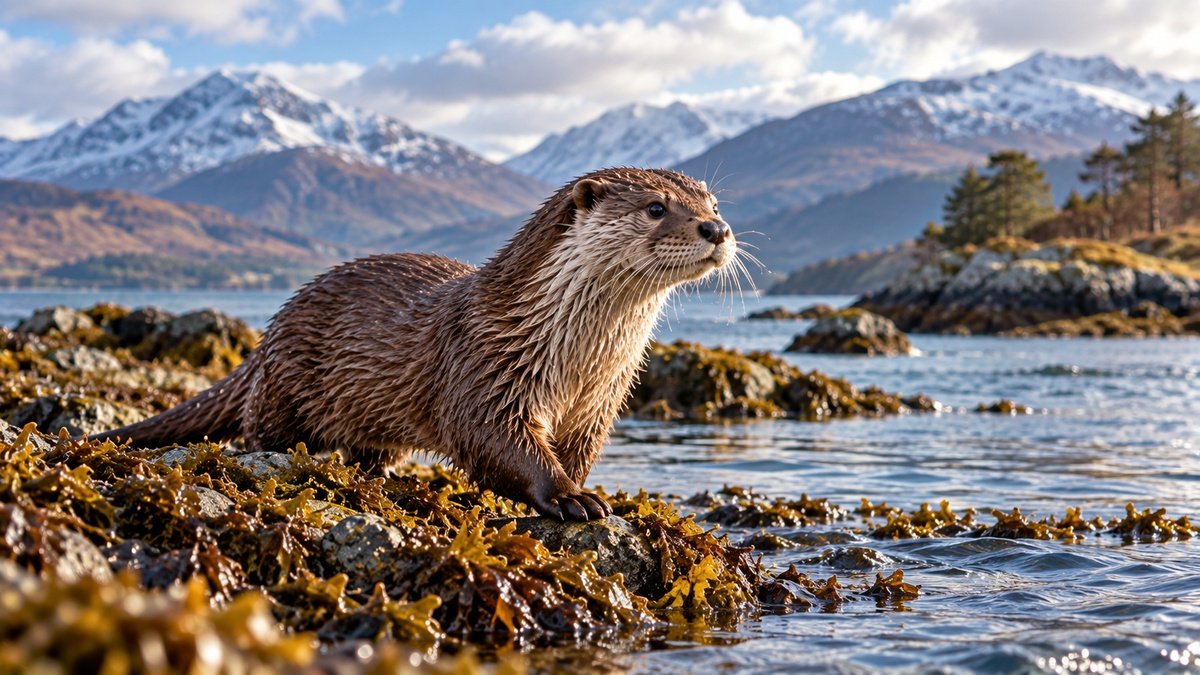
Otters in Scotland live between worlds that people often describe separately. They move through rivers and lochs, forage along coastlines and return to land for shelter, rest, breeding and movement.
That ability to cross boundaries is central to understanding them.
An otter disappearing beneath the surface may appear entirely aquatic. Yet the same animal may later emerge onto a bank, travel through vegetation, rest beneath tree roots or move over land before entering another stretch of water.
In Scotland, this relationship becomes particularly interesting because many otters live along the coast as well as beside freshwater.
Consequently, the story of the otter is not simply about rivers. It is about the connections between freshwater, sea, shoreline and land — and about the conditions that allow an animal to move between them.
Otters in Scotland
The otter found in Scotland is the Eurasian otter, Lutra lutra.
Scotland is an important European stronghold for the species. NatureScot currently estimates the Scottish population at around 8,000 animals.
Otters occur around Scotland’s coast and throughout inland rivers and lochs. They can also occur within landscapes that people may not immediately associate with wildlife, including some urban areas.
However, their distribution does not mean that an otter will be easy to see.
They are largely solitary animals, and their behaviour varies with habitat, food availability and individual circumstances. Freshwater otters can also occupy extensive home ranges.
Therefore, a landscape may support otters even when a visitor never encounters one directly.
An Otter Is a Semi-Aquatic Mammal
Calling an otter an aquatic animal tells only part of its story.
Otters obtain much of their food from water, and their bodies are well adapted for swimming. Nevertheless, they also depend upon terrestrial habitat.
Land provides places to rest, shelter and breed. Vegetation can offer cover, while riverbanks, rocky shorelines and natural cavities may provide suitable resting sites.
Otters can also travel over land, sometimes moving between separate areas of water.
This means that protecting the water alone does not necessarily protect everything an otter requires.
An otter’s habitat does not end at the water’s edge.
Holts, Couches and Places to Rest
Otters use different places for shelter and rest.
A sheltered site commonly described as a holt may be a burrow, natural cavity, cave or another suitable structure. Tree roots can create spaces that otters use, while some human-made structures may also provide shelter.
Otters may additionally use above-ground resting places known as couches.
These structures remind us that habitat is not simply an area marked on a map. Small physical features within that area can determine whether an animal has somewhere secure to rest or breed.
Importantly, otter shelters receive legal protection in Scotland. That protection can apply even when an otter is not visibly present.
For wildlife watchers, this creates a straightforward principle: finding or approaching a holt should never become the objective of an otter encounter.
What Do Otters Eat?
Fish form an important part of an otter’s diet, but otters do not eat only one kind of prey.
In freshwater habitats, NatureScot identifies fish such as trout, salmon and eels among their principal foods. Frogs and toads can also become important when amphibians gather to spawn in spring. Otters may occasionally take birds and mammals as well.
Coastal animals use marine food resources, including fish and crustaceans.
An otter needs a substantial amount of food. NatureScot estimates that an individual consumes roughly 1 to 1.5 kilograms of prey each day.
Consequently, the quality of the surrounding habitat matters partly because it supports the food web on which the otter depends.
A river, loch or coastline is not simply water surrounding an animal. It is an ecological system containing prey, shelter, vegetation and connections with the land around it.
Coastal Otters Are Not Sea Otters
One of the most useful distinctions when learning about otters in Scotland concerns the animals seen around the coast.
People sometimes call them sea otters because they forage in marine water.
However, Scotland’s coastal otters are not true sea otters. They are Eurasian otters — the same species as those living around inland rivers and lochs.
True sea otters belong to a different species and occur in the North Pacific.
Scotland is unusual because a large proportion of its otter population lives around the coast. NatureScot suggests that perhaps half or more of Scotland’s otters are coastal-dwelling.
These animals may obtain almost all of their food from the sea, particularly from productive shallow inshore waters.
Yet even a coastal otter remains connected to freshwater.
Why Coastal Otters Still Need Freshwater
An otter’s fur plays an important role in insulation.
For coastal animals, repeated exposure to seawater creates an additional requirement. NatureScot explains that otters need freshwater to remove salt from their fur so that it continues to insulate effectively.
This creates an elegant ecological connection.
An animal may spend much of its feeding time in the sea while still depending upon freshwater within the surrounding landscape.
Therefore, the ecological requirements of a coastal otter cannot be understood by looking only at the marine environment.
The sea, shoreline, freshwater and land function together.
Otters, Lochs and the Highland Landscape
Our article on Highland lochs explored how water shapes the Scottish landscape through lochs, rivers and connected waterways.
Otters add another dimension to that story.
For an otter, a loch is not simply a scenic body of water. It can form part of a larger territory connected with burns, rivers, wetlands, banks, vegetation and areas of terrestrial cover.
Likewise, a river is more than the channel through which water flows.
Its banks, tree roots, adjacent vegetation, prey populations and connections with other waterways can all influence the habitat available to wildlife.
As a result, looking for the ecological importance of water often requires looking beyond the water itself.
Are Otters Nocturnal?
The answer depends partly upon where an otter lives.
Freshwater otters in Scotland are largely nocturnal. Consequently, an animal may live along a river without being regularly visible to people using that landscape during the day.
Coastal otters can behave differently.
NatureScot notes that coastal animals are mainly active during the day. They also tend to occupy much smaller home ranges than their river-dwelling counterparts because productive inshore waters can provide abundant fish and crustacean prey.
This difference provides a useful reminder that animal behaviour is not always captured accurately by a single label.
When an animal is active can depend partly upon where and how it lives.
When Cleaner Water Changes More Than the Water
The history of the Eurasian otter in Britain shows how changes within an ecosystem can reach far beyond one species.
Between the 1950s and 1970s, otters disappeared from much of England and Wales. NatureScot identifies pesticide pollution of waterways as a major cause of that decline.
Scotland’s cleaner waters, particularly in the north and west, provided an important refuge.
Subsequently, otters recovered across much of Britain as water quality improved and harmful pollutants were reduced.
That recovery illustrates an important ecological principle.
Improving a river does not affect only the organisms that remain permanently beneath its surface. Changes in water quality can influence aquatic plants, invertebrates, fish and amphibians. Those changes can then affect predators that depend upon them.
In this sense, an otter can reveal something about relationships extending throughout an aquatic ecosystem.
Recovery Does Not Mean the Absence of Risk
The recovery of otters in Scotland is an important conservation story, but it should not be interpreted as meaning that the species faces no continuing pressures.
Road traffic presents a particularly significant risk.
NatureScot identifies road accidents as the largest source of otter mortality in Scotland apart from natural causes.
Fishing equipment can create additional hazards. Habitat alteration and disturbance may also affect the places otters use for feeding, resting and breeding.
Consequently, a species can be widespread and recovering while still requiring protection and thoughtful management.
Recovery is not the same as invulnerability.
A River Can Continue Beneath a Road — an Otter Still Needs to Cross
Roads reveal what happens when human infrastructure intersects with animal movement.
A bridge may allow a river to continue beneath a road. From a human perspective, the watercourse therefore appears connected.
An otter may experience that crossing differently.
Depending on water levels, bridge design and surrounding habitat, an animal may leave the water and attempt to cross the road rather than passing safely beneath it.
Wildlife passages, suitable culverts and other mitigation measures can help reduce that risk in appropriate locations.
The issue illustrates why ecological connectivity is more complicated than drawing an uninterrupted blue line on a map.
A route must function from the perspective of the animal using it.
Otters and Highland Weather
Water and weather are inseparable parts of the Highland landscape.
Rain changes river levels and flow. Storms transform coastlines and inshore conditions. Meanwhile, periods of calmer weather alter visibility for anyone trying to observe wildlife.
Our exploration of Highland weather considered weather as part of the place rather than an interruption to it.
The same perspective is useful when considering otters.
Changing conditions influence waterways, shorelines and prey. However, they do not allow us to predict exactly where an individual animal will appear.
Wildlife observation always retains an element of uncertainty.
Seeing Otters in Scotland Responsibly
Seeing an otter can be memorable precisely because the encounter cannot be guaranteed.
If an otter appears, quiet observation from a suitable distance is generally more appropriate than trying to move closer.
Binoculars can extend the encounter without reducing the space available to the animal. Similarly, remaining still may allow natural behaviour to continue.
Avoid positioning yourself between an otter and the water or blocking an obvious route along the shoreline. Following an animal repeatedly as it moves can also create unnecessary disturbance.
Most importantly, do not search closely for holts or attempt to photograph an otter at its shelter.
Otters and their breeding and resting places receive strict legal protection in Scotland. Deliberate or reckless harassment and certain forms of disturbance are offences.
Responsible observation therefore allows the animal to determine the distance between itself and the observer.
You Do Not Need to Travel Deep Into the Highlands
Wildlife experiences are sometimes presented as though greater physical effort creates a more authentic encounter.
Otters challenge that assumption.
They occur around coasts, rivers and lochs, and they can also live surprisingly close to places where people live and travel.
Depending on location, observation may be possible from accessible shorelines, established paths, bridges, harbours, viewpoints or visitor facilities. Of course, no particular place can guarantee a sighting.
Mobility, health, balance, sensory preferences, transport, weather, work, caring responsibilities and available time can all shape how someone encounters a landscape.
One person may spend several hours walking beside a remote loch. Another may notice an otter from an accessible coastal path or while quietly watching a river.
Neither experience becomes more meaningful simply because it required greater physical effort.
Wildness is not measured by how difficult it was for us to reach it.
Not Seeing an Otter Is Also a Normal Wildlife Experience
Wildlife tourism can sometimes create an expectation that visiting the right place should produce a sighting.
Wild animals do not work to a visitor timetable.
An otter may be resting, hunting elsewhere, travelling through another part of its range or simply hidden from view.
For that reason, absence from our field of vision does not mean absence from the landscape.
Tracks, habitat, waterways and the wider ecology can still tell a story, although protected resting sites should not be investigated or disturbed in pursuit of evidence.
Sometimes responsible wildlife observation means accepting uncertainty rather than trying to overcome it.
A Common Misunderstanding: An Otter in the Sea Is a Sea Otter
The distinction is worth returning to because it reveals something important about habitat.
A Scottish otter feeding along the coast has not become a different species because it entered seawater.
It remains a Eurasian otter.
The same species can occupy freshwater and coastal environments, while individuals may develop patterns of behaviour suited to the resources available where they live.
Coastal otters can forage extensively in marine water, remain active during daylight and occupy comparatively compact ranges. At the same time, they still use land and require access to freshwater.
Therefore, the animal resists the neat categories we may try to place around it.
River. Land. Coast. Sea.
For the otter, these can become connected parts of one lived landscape.
The Orenna Perspective — The Edge Is Not Always a Boundary
People often divide landscapes into recognisable parts.
Land ends where water begins. A river becomes a loch. Freshwater reaches an estuary and eventually becomes sea.
Those distinctions can be useful. However, an otter reveals how permeable some of them are.
The animal can feed beneath the surface and rest on land. A coastal otter may hunt in salt water and later seek freshwater. Another may move along a riverbank, cross terrestrial habitat and enter water again somewhere else.
Its life happens not only within habitats, but also between them.
This perspective connects with our wider exploration of nature and wellbeing. A landscape becomes richer when we move beyond seeing it simply as scenery and begin noticing relationships, transitions and the different ways living things inhabit the same place.
Understanding otters in Scotland therefore changes the water’s edge.
Instead of seeing a boundary between two environments, we can begin to see a meeting place.
Sometimes the most interesting part of a landscape is not one habitat, but the place where different habitats meet.
References & Further Reading
NatureScot. Otter. Information on otter ecology, distribution, diet, coastal and freshwater behaviour, shelters, population and threats in Scotland.
NatureScot. Protected Species: Otters. Current guidance on the legal protection of otters, breeding sites and resting places in Scotland.
NatureScot. Otters and Licensing. Guidance concerning activities that may affect otters, holts, couches and other places used for shelter.
The Orenna Journal explores yoga, well-being, philosophy and place from historical, evidence-informed and contemporary perspectives. Wildlife populations, habitat conditions and conservation guidance can change over time and differ between locations. This article provides a general introduction to otters in Scotland rather than site-specific wildlife, ecological or legal advice.



