


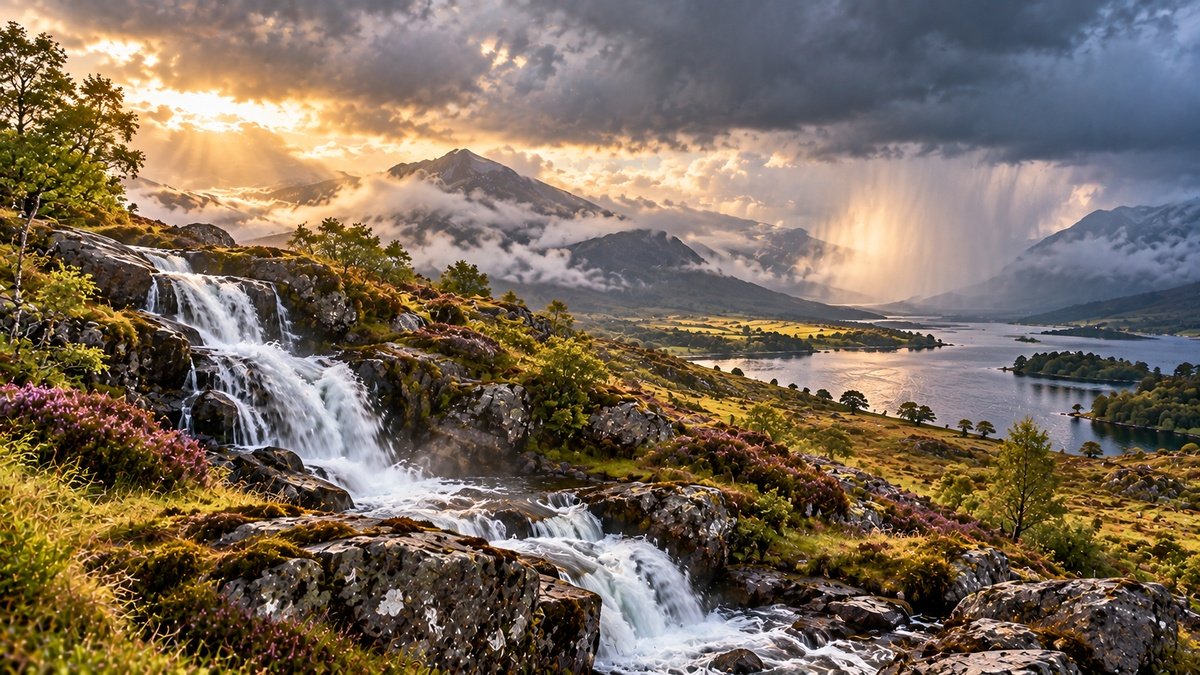
Highland weather is part of the landscape itself. Rain moves across a loch. Cloud lowers over a mountain. Wind changes the surface of the water. Mist removes a distant ridge from view, while an opening in the clouds can return it minutes later.
The land has not moved, yet our experience of it can change completely.
This is one of the distinctive qualities of spending time in the Scottish Highlands. Landscape and weather are difficult to separate because light, visibility, temperature, wind and precipitation continually influence what can be seen, heard and felt.
It can be tempting to divide those conditions into simple categories: sunshine is good, rain is bad; clear skies reveal the landscape, while cloud hides it.
The relationship is more interesting than that.
Weather can reveal, conceal, soften, sharpen and transform a place. At the same time, changing conditions have practical consequences. Appreciation does not require ignoring discomfort, accessibility or safety.
Perhaps understanding Highland weather begins by allowing both ideas to exist together.
Why Is Highland Weather So Changeable?
Scotland sits within a part of the world where several geographical influences interact.
The wider UK lies within the mid-latitude westerly wind belt and beside the Atlantic Ocean. Weather systems frequently approach from the west, carrying moist air towards Scotland.
Then there is the land itself.
When moist air encounters mountainous terrain, it can be forced upwards. As rising air cools, water vapour may condense into cloud and precipitation. This process helps explain why mountainous parts of western Scotland can receive considerably more rainfall than locations farther east.
Mountains can also influence wind, cloud and visibility locally. Conditions at higher elevations may therefore differ substantially from those experienced in nearby lower ground.
As weather systems, topography and altitude interact, conditions can vary from one location to another and change over relatively short periods.
Changeability is not an exception to Highland weather.
It is one of its characteristics.
Highland Weather Changes What We See
Imagine looking across a familiar Highland glen on a clear morning.
The farthest ridges may appear sharply defined. Individual slopes can be distinguished from one another, and the eye can follow the landscape towards the horizon.
Now introduce low cloud.
The upper mountain disappears. Distance becomes harder to judge. The landscape may appear smaller because its most distant features are no longer visible.
Mist can reduce that visual field further. Rain can soften distant detail, while a sudden opening in the cloud may illuminate one hillside and leave another in shadow.
These changes do more than alter a photograph.
They change what is available to our attention.
A mountain that dominated the horizon may disappear. Water may become the most visible feature instead. A patch of woodland that seemed secondary under clear skies can suddenly become prominent when everything behind it vanishes into cloud.
The landscape remains present, but weather continually reorganises what we notice within it.
Rain Is Part of the Highland Landscape
Rain is often described as something that spoils an outdoor experience.
Yet rainfall is inseparable from many of the landscapes people travel to the Highlands to see.
It feeds rivers and burns, contributes water to lochs and wetlands, changes waterfalls and moves through entire catchments. In mountainous parts of Scotland, topography can enhance rainfall as moist air rises over higher ground.
Rain also changes the visual character of a place.
Stone darkens. Vegetation can appear more saturated. Loch surfaces become patterned. Distant features soften behind precipitation, and low cloud may gather around hills.
These relationships between rainfall and water are explored further in Where Land Meets Water: Lochs, Rivers and the Highland Landscape.
Recognising rain as part of the landscape does not mean everyone has to enjoy being outside in it.
Wet weather can mean slippery surfaces, muddy paths, reduced visibility, higher river levels and greater heat loss when clothing becomes wet. Heavy or prolonged rainfall can also alter watercourses and make crossings more difficult.
Rain can be both landscape and practical condition.
One does not cancel the other.
Wind Makes the Landscape Move
Wind is less visible than rain, but its effects can be seen throughout a landscape.
Grasses bend. Tree canopies move. Cloud travels across ridges. Loch surfaces change from reflective to textured, and waves can form along exposed shorelines.
Sound changes too.
A sheltered woodland and an exposed hillside can offer completely different auditory experiences on the same day.
Wind can also change how temperature feels against exposed skin and how comfortable it is to remain in one place.
At higher elevations, strong wind becomes much more than an atmospheric detail. It can affect balance, walking speed and route choice. Mountaineering Scotland advises paying close attention to both wind speed and direction when planning journeys into the hills.
That distinction matters.
A breeze beside a sheltered loch and strong winds across exposed mountain terrain should not be treated as equivalent experiences simply because both are called wind.
Mist, Cloud and the Landscape We Cannot See
Highland landscapes are often celebrated for their views.
Mist asks a different question: what happens when the view disappears?
Low cloud can remove the upper parts of mountains from sight. Mist can soften edges, reduce colour contrast and shorten the apparent distance between the observer and surrounding features.
A familiar landscape can become visually unfamiliar.
That may feel atmospheric to someone viewing the landscape from a safe location. For someone navigating exposed mountain terrain, poor visibility can create a very different situation.
Mountaineering Scotland notes that Scottish mountain weather can change quickly and that poor visibility places greater demands on navigation.
Context therefore matters.
Mist does not need to be labelled beautiful or unpleasant in every situation. Its significance changes with where we are, what we are doing and what the conditions require from us.
Highland Weather Changes the Light
Weather and light cannot be separated easily.
Cloud changes the amount and direction of light reaching the landscape. Rain alters visibility and reflection. Mist scatters light. Snow can dramatically increase the brightness of a scene by reflecting incoming light.
Sometimes thick cloud produces an almost uniform grey light. At other times, openings between clouds create concentrated areas of brightness.
A hillside may suddenly become illuminated while the surrounding mountains remain dark.
The effect may last minutes.
This continual relationship between atmosphere and illumination is explored more fully in The Changing Light of the Highlands: Season, Landscape and Attention.
Highland light is therefore not only seasonal.
Weather can transform it throughout a single day.
The Same Place Can Feel Completely Different
Return to the same loch, woodland or viewpoint under different conditions and it may barely seem like the same place.
Sunshine can increase contrast and reveal distant detail. Overcast skies may soften shadows. Rain can intensify nearby colour while reducing distant visibility. Frost changes surfaces. Snow can simplify the visual landscape by covering differences in colour and texture.
Wind adds movement where there was stillness.
These changes help explain why a relationship with place can develop through repeated encounters rather than through one ideal view.
Knowing a place can mean seeing it bright and dark, wet and dry, exposed and sheltered, visible and partially hidden.
This broader relationship between environment, attention and individual experience sits at the centre of Why Place Matters: Nature, Attention and the Experience of Being Outdoors.
Place is not one frozen image.
Weather makes that particularly difficult to forget.
Highland Weather Through the Seasons
Season changes the range of conditions that may be encountered, but it does not create simple boundaries.
Summer does not guarantee warmth and sunshine. Winter does not mean continuous snow.
Rain can occur throughout the year. Wind is not confined to one season. Higher ground can remain considerably colder than lower elevations, and mountain conditions may differ from those in nearby glens.
Winter brings shorter daylight hours and a greater possibility of snow, ice and freezing conditions. Summer brings much longer daylight, yet cool temperatures, rain, cloud and strong wind remain possible.
Spring and autumn create their own transitions rather than functioning merely as intervals between the other two seasons.
Season therefore provides context, not certainty.
The forecast still matters.
The Highlands Are Not Always Dramatic
Images of the Highlands often emphasise spectacle.
There are fiery sunsets, shafts of light breaking through storm clouds, snow-covered summits, dramatic mist and perfectly reflective lochs.
Those conditions exist.
They are not the whole landscape.
There are also grey afternoons when the light remains flat for hours. There is drizzle without dramatic cloud. Mountains disappear behind low cloud without a theatrical opening appearing before sunset.
Paths become muddy. Windows collect raindrops. A view that looked expansive yesterday may be almost completely hidden today.
Ordinary conditions belong to the Highlands too.
If we only value a landscape when it performs spectacularly, we risk reducing place to scenery.
Attention can also exist on an unremarkable grey afternoon.
Is There Really Such a Thing as Bad Weather?
A familiar saying suggests that there is no bad weather, only unsuitable clothing.
It can be a useful reminder that rain does not automatically prevent someone from going outdoors.
But taken literally, it oversimplifies the relationship between people, weather and place.
Some weather genuinely changes what is safe or practical.
Strong winds can affect balance. Heavy rainfall can raise river levels. Ice changes traction. Snow can cover paths and alter navigation. Low cloud and mist can substantially reduce visibility.
Comfort also matters even when conditions are not dangerous.
Someone does not have to enjoy being cold, wet or windswept in order to appreciate the Highlands.
Another person may genuinely enjoy walking in gentle rain or hearing strong weather from somewhere sheltered.
Neither response is more authentic.
There is no requirement to endure uncomfortable conditions as proof of a meaningful relationship with nature.
You Do Not Have to Experience Highland Weather in the Same Way
Weather is a sensory experience as well as a meteorological one.
Brightness, wind, temperature, humidity, precipitation and atmospheric pressure contribute to the conditions around us.
People can respond differently to those conditions.
One person may enjoy the sensation of wind. Another may find it distracting or physically uncomfortable. Someone may appreciate low light and cloud, while another prefers brighter conditions and greater visibility.
Cold, heat, wet ground and strong sunlight can also affect what feels practical or comfortable.
Access matters here too.
A change in weather can alter surfaces, visibility and transport conditions. What was an accessible route in dry weather may become more difficult after heavy rain, frost or snow.
Recognising these differences does not diminish the experience of nature.
It makes space for more than one way of experiencing it.
Experiencing Weather Does Not Require a Mountain
Highland weather does not need to be experienced from an exposed summit.
It can be noticed from a woodland path, a lochside road, a garden, an accessible viewpoint or through a window.
Cloud movement can be observed from indoors. Rain can be heard against glass or a roof. Changing light can move across a room. Wind can be seen in trees without standing directly within it.
This matters because contact with place should not be defined by the most physically demanding way of entering it.
Walking farther, climbing higher or remaining outdoors in more difficult conditions does not automatically create a deeper experience.
Sometimes attention begins much closer to home.
Forecasts Are Part of Experiencing the Landscape Responsibly
Appreciating changeability should not mean ignoring forecasts.
For journeys into hills and mountains, weather information is part of planning.
Mountaineering Scotland recommends using the forecast to shape the plan itself rather than choosing a fixed route first and checking the weather afterwards.
That approach recognises that wind, temperature, precipitation and visibility can alter the demands of a route.
Conditions can also vary with altitude. A sheltered glen does not necessarily indicate what is happening on an exposed ridge or summit.
For mountain journeys, specialist forecasts from services such as the Met Office and Mountain Weather Information Service can provide information designed for higher terrain.
Changing a plan because conditions have changed is not a failed experience.
It is part of responding to the place as it actually is.
A Common Misunderstanding: Wild Weather Is More Authentic
There can be a tendency to romanticise difficult weather.
Wind, rain, mist and snow photograph beautifully. They can make landscapes appear dramatic, remote and unmistakably Highland.
That does not make exposure to difficult conditions inherently meaningful.
Nor does choosing shelter make someone’s experience of the landscape less valid.
A storm can be appreciated from indoors. Rain can be noticed without walking through it. A mountain can matter without being climbed.
Weather does not have to become a test of endurance.
Respecting a landscape includes recognising when conditions call for a different plan.
The Orenna Perspective — We Do Not Need the Landscape to Perform
At Orenna, a place does not need perfect conditions to be worth noticing.
That principle matters in a landscape so often presented through carefully selected moments of spectacle.
A Highland sunset can be extraordinary.
So can the return of a mountain after hours behind cloud.
But a grey sky does not represent a failed landscape. Rain does not make the day meaningless. Mist does not remove everything worth noticing simply because it removes the distant view.
The landscape does not need to provide tranquillity, drama or inspiration on demand.
That idea has something in common with restorative practice.
At Orenna, rest is not judged by whether someone reaches a predetermined state of calm. In the same way, a place does not have to produce a particular emotional response before the encounter has value.
Weather changes what is available.
Sometimes it expands the view. Sometimes it reduces it to the nearest trees, the movement of rain across water or the sound of wind outside.
Attention can begin with whatever remains.
Perhaps that is one of the most interesting things about Highland weather.
It reminds us that place is not static.
We encounter it as it changes.
References & Further Reading
Met Office. UK Regional Climates. An overview of the geographical factors contributing to the variability of UK weather, including Atlantic influence, prevailing westerlies, topography and regional differences.
Met Office. How Much Does It Rain in the UK? Information on rainfall patterns across the UK and the role of mountainous terrain and orographic enhancement in wetter western and Highland areas.
Met Office. Northwest Highlands Mountain Weather. Specialist forecast information for the Northwest Highlands, including conditions and hazards at higher elevations.
Mountaineering Scotland. Using the Weather Forecast. Practical guidance on using wind, rain, temperature and other forecast information when planning journeys in the Scottish mountains.
Mountaineering Scotland. Weather Conditions. Guidance on changing mountain weather, wind, precipitation, temperature and other conditions relevant to journeys in Scotland’s hills and mountains.
Mountaineering Scotland. Mountain Navigation. An introduction to navigation in Scottish mountain environments, including the implications of rapidly changing visibility.
The Orenna Journal explores yoga, well-being, philosophy and place from historical, evidence-informed and contemporary perspectives. This article is intended as general educational information. It is not a substitute for current weather forecasts, mountain-specific safety information, route planning or professional outdoor guidance. Conditions in the Scottish Highlands can change, and anyone planning outdoor activity should use information appropriate to the location, activity and conditions.



