


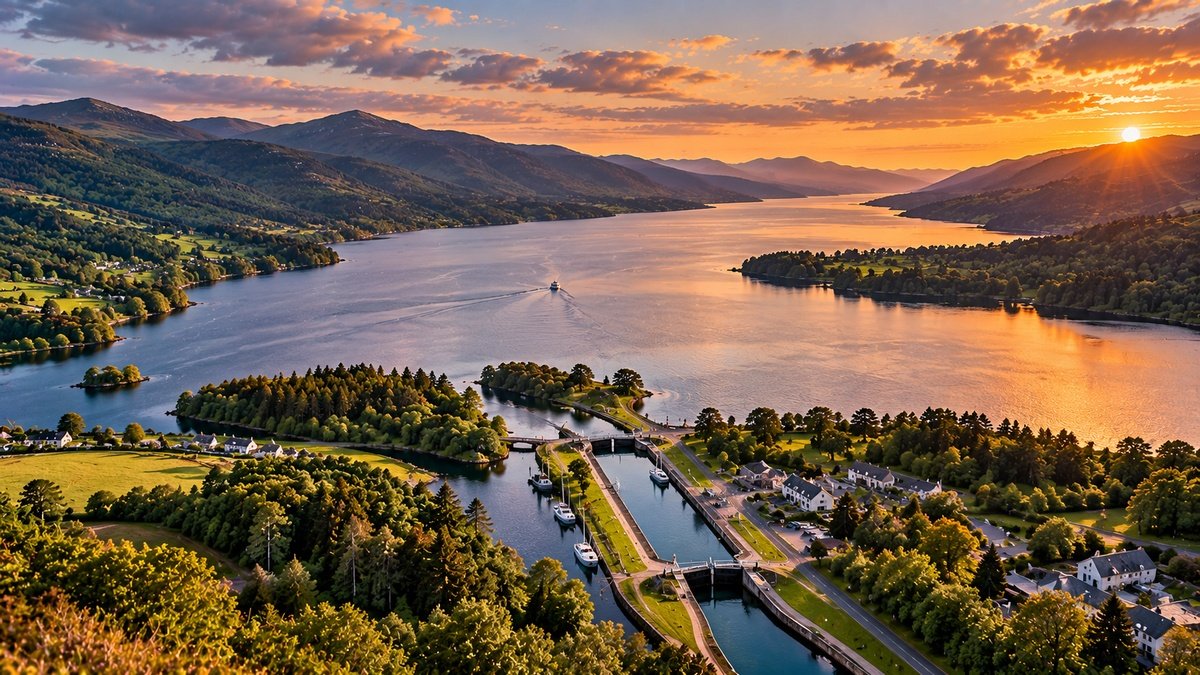
Highland lochs are among the most recognisable features of the Scottish landscape. Water appears between mountains, alongside roads, through woodland and across wide open spaces. Yet the Highland relationship with water extends far beyond the familiar image of a perfectly still loch reflecting the hills.
There are rivers and burns, waterfalls and wetlands, freshwater lochs and sea lochs, rain moving across the landscape and an extensive coastline where land meets the Atlantic and North Sea.
Water is not simply placed within this landscape as decoration. It has helped shape the land itself, supports complex ecosystems and continually changes how a place looks, sounds and moves.
Sometimes it reflects the sky. Sometimes wind breaks its surface into movement. Sometimes rain makes water almost impossible to separate from the wider landscape.
To understand Highland lochs, therefore, is to look beyond the postcard image and consider water as part of a much larger and continually changing place.
The Highlands Are Shaped by Water
Water appears throughout the Highlands in many forms.
Some of it gathers within large freshwater lochs. Some travels through rivers and smaller burns. On the western coast in particular, long sea lochs extend inland, creating an intricate boundary between land and sea.
Rainfall feeds rivers, wetlands, waterfalls and lochs. Peatlands hold water within the landscape. Mountain slopes direct it towards lower ground, while rivers continue carrying it through catchments towards larger bodies of water and eventually the sea.
Water is therefore not one separate feature.
It moves through connected systems of land, weather and habitat.
This is one reason the Highland landscape can change so visibly after prolonged rain, during dry periods or as weather moves across a catchment. Water levels, river flow, waterfalls and ground conditions can all respond to what has happened elsewhere in the landscape.
What Is a Highland Loch?
Loch is the Scots and Scottish Gaelic word commonly used for a lake or an inlet of the sea.
That distinction matters because not all Highland lochs contain freshwater.
Freshwater lochs occupy inland basins, while sea lochs are marine inlets connected with the sea. From the shore, both may appear enclosed by mountains or hills, but their hydrology and ecosystems can be very different.
Scotland contains more than 30,000 freshwater lochs, according to NatureScot, ranging from small lochans to enormous bodies of water such as Loch Ness, Loch Lomond and Loch Morar.
Many of Scotland’s smaller lochs and lochans occur in the western and northern Highlands. Larger lochs are often found within U-shaped valleys shaped by glaciation.
Glaciers profoundly altered the Scottish landscape during successive periods of glaciation, eroding valleys and contributing to the formation of many of the basins that later filled with water.
That does not mean every loch has precisely the same geological history. Scotland contains a wide variety of loch types, sizes, depths, water chemistry and surrounding geology.
Highland Lochs Change How We See the Landscape
Water changes the visual structure of a place.
A loch creates an opening within the land. Hills may rise around it, woodland may reach its shoreline and distant mountains can appear beyond the water rather than directly in front of us.
Reflection adds another dimension.
Under relatively still conditions, the surface may reflect sky, cloud, vegetation or mountains. When wind increases, that reflection fragments. Colours shift as cloud moves or the angle of the light changes.
The water itself can appear blue, grey, silver, green or almost black depending on illumination, depth, weather, surroundings and viewing angle.
This relationship between water and illumination connects directly with The Changing Light of the Highlands: Season, Landscape and Attention.
Light changes the appearance of water, while water reflects and redistributes some of the light within the scene.
Neither element is visually independent of the other.
Water Is Never Really Still
Well-being imagery often presents water as perfectly calm.
A motionless lake becomes shorthand for tranquillity. A smooth reflection represents a quiet mind. Still water becomes a visual metaphor for stillness itself.
Actual water is more complicated.
Wind creates ripples and waves. Rain disturbs the surface. Rivers flow. Burns descend through rock and vegetation. Waterfalls turn gravity into visible movement. Tides influence coastal environments and sea lochs.
Even a loch that appears completely still from a distance is part of a living hydrological system.
Movement does not make water less meaningful or less beautiful.
Sometimes movement is precisely what attracts attention: sunlight catching ripples, rain arriving across a surface, a river changing direction around stones or waves reaching a shoreline.
Water does not have to become motionless before it becomes worth noticing.
What Are Blue Spaces?
Environmental and public-health research increasingly uses the term blue space when discussing environments that contain or are associated with visible water.
Depending on the research context, this can include coastlines, rivers, lakes, canals and other aquatic environments.
Researchers have investigated whether access or exposure to these environments is associated with different aspects of health and well-being.
Possible pathways are varied. Waterside places may provide opportunities for walking, recreation, physical activity, social interaction or time in a natural environment. They may also contain distinctive visual and sensory characteristics.
However, the term blue space does not describe one uniform type of environment.
A city canal, remote freshwater loch, riverbank and Atlantic coastline differ considerably in accessibility, ecology, scale, weather, activity and risk.
Those differences matter when interpreting research.
Highland Lochs, Blue Spaces and Well-being
Research into blue spaces has reported associations with aspects of health and well-being, but the evidence requires careful interpretation.
The World Health Organization has reviewed evidence concerning green and blue spaces and mental health. Its report describes an overall positive relationship in the literature while also noting important limitations in the evidence concerning blue spaces.
In particular, relatively few high-quality studies were available for comparing different types of blue-space exposure. That made firm conclusions and recommendations difficult.
More recent systematic-review research into freshwater blue spaces also shows substantial variation between studies. Results can depend on how exposure is measured, which health outcome is considered, characteristics of the environment, differences between study populations and how researchers address potential confounding factors.
In other words, research can investigate relationships between water environments and well-being without establishing that looking at water automatically makes someone calmer, healthier or happier.
A Highland loch is not a treatment simply because it contains water.
Why Might Water Capture Our Attention?
Water provides continual visual change.
Reflections move. Light shifts across the surface. Ripples appear and disappear. Rain creates patterns. Rivers flow around obstacles rather than remaining visually fixed.
These features can attract attention without requiring someone to study them deliberately.
Yet we should be cautious about turning that observation into a universal psychological mechanism.
Someone may find moving water fascinating. Another person may barely notice it. A dramatic coastline may hold attention differently from a small river passing through a familiar neighbourhood.
The broader relationship between environment and attention is explored in Why Place Matters: Nature, Attention and the Experience of Being Outdoors.
As with other natural features, water becomes part of experience without dictating what that experience must be.
Water Creates a Sensory Landscape
Water is experienced through more than sight.
A burn produces a different sound from a broad river. Rain on water differs from rain on woodland. Waves reaching a shoreline create rhythm and movement. Wind across an exposed loch changes both sound and temperature.
Humidity, spray, cold air and wet ground may also become part of the experience.
These sensory qualities are not inherently relaxing.
Some people may enjoy the sound of moving water. Others may prefer quieter surroundings. Strong wind beside an exposed loch can feel invigorating, uncomfortable or simply cold. The sound of waves can be welcome in one context and distracting in another.
There is no universal sensory response to water.
This is consistent with Orenna’s wider approach to sensory experience: environment matters, but individual preference matters too.
Not Everyone Experiences Water in the Same Way
The language of well-being can sometimes make waterside environments sound universally inviting.
Experience is more individual than that.
Open water, deep water, strong currents, exposed coastlines or unfamiliar shorelines can carry different associations for different people. Weather and visibility can change those responses further.
Practical access also varies.
Some lochside paths contain uneven ground, steep gradients, mud, rocks or limited facilities. Remote locations may require transport. Shorelines can become slippery, and water conditions may change quickly.
A meaningful encounter with a waterside landscape does not require swimming, kayaking, climbing over rocks or reaching a remote shoreline.
Someone might experience water from an accessible path, a bench, a bridge, a roadside viewpoint, a garden, a window or another comfortable location.
There is no hierarchy in which closer physical contact with water makes the experience more authentic.
Rain Belongs to the Highland Water Story
Rain is often treated as the weather that interrupts a visit to the Highlands.
Yet it is also part of the landscape’s water system.
Rain feeds burns and rivers. It changes waterfalls, saturates peatlands, alters ground conditions and contributes water to lochs and catchments.
It also changes what we see.
Rock becomes darker. Vegetation appears more saturated. Water surfaces become patterned. Mist may develop around hills, while cloud reduces the apparent distance between land and sky.
None of this means rain must be enjoyed.
Wet conditions can make paths difficult, reduce visibility and create additional practical considerations. Appropriate clothing, route choice and attention to local conditions remain important.
But rain is not separate from the Highland landscape simply because it complicates the postcard view.
It helps create the water-rich environment being photographed.
Sea Lochs: Where the Highlands Meet the Sea
The word loch can sometimes cause confusion for visitors who associate it only with freshwater lakes.
Scotland also has sea lochs: coastal inlets where marine water extends inland between surrounding landforms.
They are particularly characteristic of parts of Scotland’s west coast.
Sea lochs can appear visually similar to inland lochs when viewed from the surrounding hills, yet they belong to marine systems and are influenced by tides, salinity and connections with coastal waters.
The distinction is a useful reminder that appearances do not tell us everything about a landscape.
Two bodies of water may look similar from a distance while functioning very differently as environments.
Water, Memory and Sense of Place
Places can acquire meaning through repetition.
A loch passed regularly on the way home is experienced differently from one encountered once on holiday. A river may become associated with a daily walk, a particular season, family time or years spent living nearby.
These associations do not come from the physical properties of water alone.
They develop through relationship.
This is part of what the idea of sense of place attempts to describe: environments are not only geographical locations. People can develop attachments, memories, meanings and routines around them.
The same Highland loch may therefore function as a destination for one person, part of home for another and simply a body of water on a map for someone else.
None of those perspectives exists entirely within the water itself.
A Common Misunderstanding: Being Near Water Automatically Calms the Nervous System
Statements about blue spaces sometimes move beyond the evidence.
You may encounter claims that being beside water automatically lowers cortisol, activates the parasympathetic nervous system or regulates the nervous system.
Those statements are too broad to apply to every person and every waterside environment.
Research can examine physiological measures, psychological outcomes, environmental exposure and population-level associations. However, the presence of water alone does not allow us to predict an individual’s response.
Nor are all blue spaces equivalent.
Accessibility, safety, environmental quality, activities, social context and personal experience can all influence what happens when someone spends time near water.
Blue-space research is interesting precisely because the relationship is worth investigating. It does not need to be exaggerated into a universal therapeutic claim.
The Orenna Perspective — Water Does Not Need to Be Still
At Orenna, water does not need to be still to change our experience of a place.
A perfectly reflective loch can be beautiful, but so can water moving beneath wind, a river crossing stones or rain arriving across a distant hillside.
The distinction matters because stillness can easily become an ideal that we expect both landscapes and people to reproduce.
Within restorative practice, stillness may sometimes be useful. At other times, reducing demand without becoming completely still may be more appropriate. This idea is explored further in Rest Without Stillness: Does Rest Always Mean Doing Nothing?.
The landscape offers a similar reminder.
Water can move without becoming chaotic. It can change without losing continuity. It can reflect its surroundings one moment and obscure them the next.
Across the Highlands, lochs, rivers, rain and coastline continually reshape how land, light and weather meet.
Perhaps that is more interesting than asking water to represent calm.
We can allow it simply to be water.
References & Further Reading
NatureScot. Freshwater Lochs. An overview of Scotland’s freshwater lochs, their distribution, physical characteristics, water chemistry and the influence of glaciation on many Scottish loch basins.
NatureScot. Sea Lochs. Information on Scotland’s sea-loch environments and the marine habitats found within them.
World Health Organization Regional Office for Europe. Green and Blue Spaces and Mental Health: New Evidence and Perspectives for Action. WHO, 2021. A review of evidence concerning green and blue spaces and mental health, including important limitations in the available evidence for specific blue-space environments.
World Health Organization Regional Office for Europe. Assessing the Value of Urban Green and Blue Spaces for Health and Well-being. WHO, 2023. A technical report examining the potential environmental, social and health value of green and blue spaces.
Wang, Ke; Zhang, Xia & Zhou, Qi. The Influence of Freshwater Blue Spaces on Human Health and Well-being: A Systematic Review Based on Assessment Method. Environmental Research, 2024. A systematic review highlighting variation in freshwater blue-space research, exposure assessment methods and reported health associations.
The Orenna Journal explores yoga, well-being, philosophy and place from historical, evidence-informed and contemporary perspectives. This article provides educational and general information rather than medical or psychological advice. Research into blue spaces can identify associations across populations, but those findings cannot predict how every individual will experience a particular loch, river, coastline or other waterside environment.



