


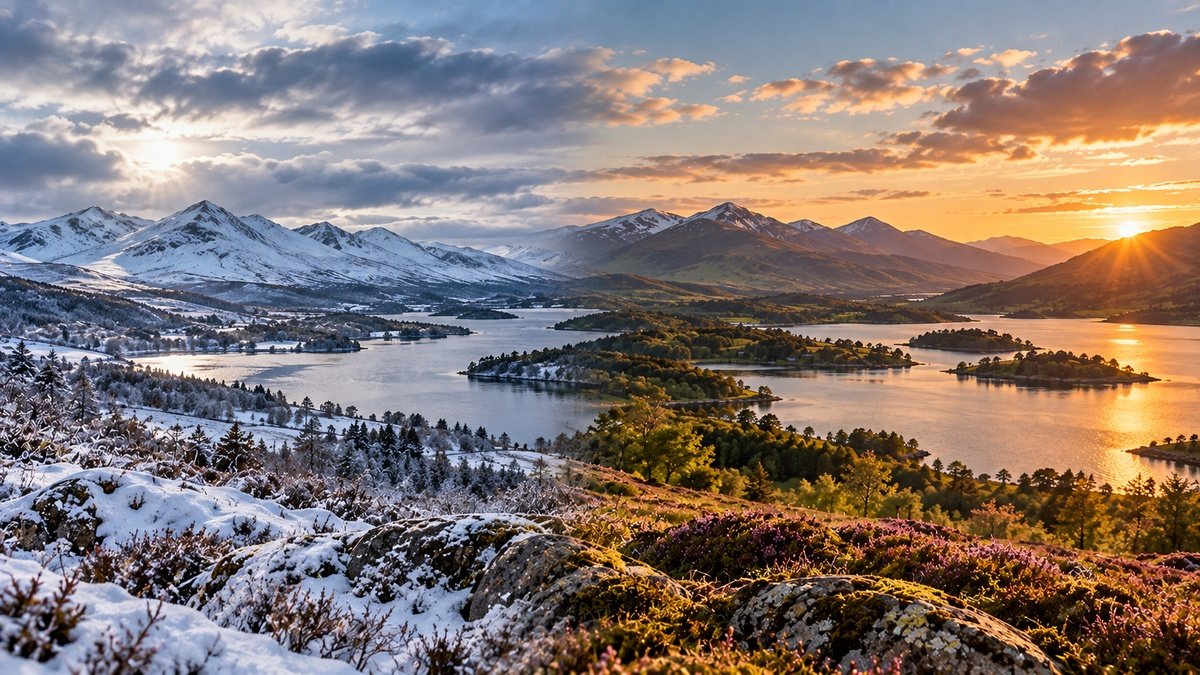
Highland light rarely seems to leave a landscape unchanged. A loch that appears silver beneath cloud can become intensely reflective when the sun emerges. Hills that looked close in clear morning light can recede into layers of blue and grey by evening. Mist can remove an entire horizon, while a break in the clouds can suddenly illuminate one small part of a much larger landscape.
Here in the Scottish Highlands, light changes not only through the hours of a day but markedly across the seasons. Long summer evenings give way to much shorter winter days. The angle of the sun changes. Weather filters, reflects and obscures light. Water, frost, cloud and snow alter what reaches the eye.
The landscape may remain geographically familiar, yet its appearance does not remain fixed.
Perhaps that is part of what makes light so interesting: it does not simply allow us to see a place. It changes what becomes visible within it.
What Makes Highland Light So Changeable?
The Highlands sit far enough north for the length of daylight to change substantially across the year.
As Earth moves around the Sun on its tilted axis, the apparent path of the Sun across the sky changes with the seasons. During summer, daylight extends far into the evening. During winter, the period between sunrise and sunset becomes considerably shorter.
Day length is only part of the story.
The Sun also reaches different heights in the sky through the year. Lower-angle light can produce long shadows and illuminate surfaces differently from the higher-angle light of summer.
Then there is the weather.
Cloud, rain, mist, frost and snow continually alter the way light reaches and reflects from the landscape. The result is not one distinctive type of Highland light, but an environment in which illumination can change remarkably quickly.
Highland Light and a Landscape That Never Looks Quite the Same
Familiarity can make us think we already know a place.
Yet return to the same shoreline, woodland or viewpoint under different light and different details become noticeable.
A slope that seemed relatively uniform may reveal ridges and folds when shadows cross it. Water can appear almost opaque beneath heavy cloud, then reflect the sky when conditions change. Wet stone can deepen in colour. Frost can make the smallest surfaces catch the morning light.
Light changes contrast, colour, shadow and reflection. In doing so, it influences which features stand out and which recede.
This does not require a dramatic viewpoint.
The same process happens on an ordinary street, in a garden, through a window or along a familiar path. A change in illumination can make something previously overlooked become visible.
Place may be familiar without ever being visually identical.
Highland Light Through the Seasons
Seasonal change is sometimes described through temperature: warmer summers, colder winters and the transitions between them.
Light provides another way to experience the year.
Spring brings increasing daylight and a changing solar angle. As vegetation develops, light interacts with fresh leaves, water and growing colour across the landscape.
Summer extends daylight into the evening. The distinction between daytime and evening can feel gradual, particularly around the longest days, when twilight stretches across a large part of the night.
Autumn brings shortening days and another change in angle, colour and contrast. Vegetation changes alongside the light itself.
Winter compresses daylight into a much smaller part of the day. The Sun remains lower in the sky, shadows lengthen and darkness occupies more of the twenty-four-hour cycle.
None of these seasons needs to be treated as the ideal version of the Highlands.
They reveal different versions of the same places.
The Long Light of a Highland Summer
Highland summers can create an unusual relationship with evening.
Rather than darkness arriving soon after the day’s activities have ended, usable daylight can remain for many hours. Twilight extends the transition between day and night, and landscapes can remain visible late into the evening.
This extended light changes what is possible to notice.
A place encountered at midday may look very different later, when the Sun is lower and shadows become longer. Water may begin to reflect warmer tones. Hills can become layered silhouettes rather than clearly defined surfaces.
Long summer days can also be experienced differently from person to person.
Some people welcome the extended evenings. Others may prefer darker nights or find very late daylight less comfortable. Neither response is a more authentic way of experiencing summer.
The season changes the light environment; it does not prescribe our response to it.
The Low Light of a Highland Winter
Winter is often described primarily through absence: less daylight, less warmth and fewer hours before darkness.
Yet shorter days also reveal particular qualities of light.
A lower Sun can cast long shadows even around the middle of the day. Frost catches light across grass and vegetation. Bare branches create patterns that summer foliage conceals. When snow is present, reflected light can transform the apparent brightness and colour of a scene.
Clear winter light can make distant features appear sharply defined. Under cloud, the same landscape may become almost monochromatic.
These observations do not require us to romanticise winter.
Short daylight hours can create practical constraints. Weather may limit travel or outdoor activity. Individual responses to darkness and seasonal change also vary.
Winter does not need to be presented as either bleak or magical. It is another expression of a changing environment.
Weather Changes Highland Light Too
The calendar does not determine the appearance of a Highland day by itself.
Weather can transform the light within minutes.
Cloud can diffuse sunlight and soften contrast. A break in the cloud can illuminate one hillside while the surrounding landscape remains in shadow. Mist reduces visibility and changes our sense of distance. Rain darkens surfaces and creates reflections.
Water adds another layer of variation.
A loch may reflect bright sky, broken cloud or surrounding hills. Wind can fragment that reflection into movement. A still surface may produce something entirely different.
These interactions between light, weather and landscape connect directly with the broader questions explored in Why Place Matters: Nature, Attention and the Experience of Being Outdoors.
Place is not simply the ground beneath us. It includes the changing conditions through which we encounter that ground.
Why Does Changing Light Affect What We Notice?
Vision depends on light, but seeing a landscape involves more than registering that objects are present.
Contrast helps edges and forms become noticeable. Shadows reveal depth and surface. Reflections alter apparent colour and brightness. Changes in illumination can direct attention towards one part of a scene while making another less prominent.
Consider a woodland path.
Under even cloud, the visual field may appear relatively soft. When sunlight passes between branches, patches of brightness and shadow emerge. Leaves move, and those patches move with them. Attention may be drawn towards the changing light without any deliberate decision to concentrate on it.
Something similar happens across larger landscapes.
Sunlight crossing a hillside can reveal its contours. A distant ridge becomes visible. A reflection appears on water and disappears again.
Changing light continually reorganises what the landscape offers to our attention.
When Light Becomes a Sensory Experience
Light is not experienced only as something beautiful to look at.
Brightness, glare, shadow, contrast and rapid changes in illumination can affect how comfortable an environment feels.
A bright open landscape may feel appealing to one person while another prefers softer or more filtered light. Low winter sun can create striking views while also producing glare. A dark woodland can feel sheltered, interesting or simply too dim, depending on the person and circumstances.
Visual preferences can also change from one occasion to another.
For that reason, descriptions such as calming light or soothing darkness should not be treated as universal properties of an environment.
The light is present. The experience remains individual.
This distinction reflects the approach explored in Turning Attention Inward: Understanding Pratyāhāra in Yoga, where sensory experience is considered without assuming that reducing or changing sensory input produces the same response for everyone.
Highland Light, Daylight and the Body Clock
Light also matters beyond what we consciously see.
Research in chronobiology shows that light is an important environmental signal for the human circadian system — the biological timing processes that help organise patterns of sleep and wakefulness across approximately twenty-four hours.
The relationship is more complex than simply saying that “daylight is good for sleep”.
The effects of light depend on characteristics including its intensity, timing, duration, pattern and spectral composition. Research has found that exposure at different times of day can influence circadian timing differently.
Systematic reviews of light and sleep also report considerable variation between studies and methods. This means broad findings should not be converted into one universal prescription for how much outdoor light every person needs.
Most importantly for this discussion, the scientific importance of light does not mean that Highland light itself has a special therapeutic property.
Living at a northern latitude creates pronounced seasonal changes in the natural light-dark cycle. How individuals experience those changes — practically, visually and personally — can differ considerably.
You Do Not Have to Experience Seasonal Light in the Same Way
Seasonal descriptions can easily become prescriptive.
Summer is expected to feel expansive and energising. Winter is expected to feel quiet and inward. Spring becomes renewal; autumn becomes letting go.
These metaphors can be meaningful, but they are cultural and personal interpretations rather than rules imposed by the seasons themselves.
Someone may enjoy the long light of June and another person may welcome the return of darker evenings. A bright summer day may feel inviting or visually overwhelming. A winter afternoon may feel atmospheric, inconvenient, ordinary or something else entirely.
Individual circumstances also shape seasonal experience. Work patterns, caring responsibilities, travel, access to outdoor space and the amount of time someone spends indoors can influence their relationship with available daylight.
There is no correct emotional response to a season.
From Photographing the Light to Noticing It
The Highlands invite photography.
A dramatic shaft of sunlight, reflection across a loch or unusually coloured sky can make reaching for a camera almost automatic.
A photograph preserves one arrangement of light.
The landscape itself continues changing.
Cloud moves. The Sun lowers. Shadows lengthen. Reflections break apart. Colours that seemed intense a few minutes earlier begin to disappear.
Noticing those changes does not need to become a formal mindfulness exercise.
There is no requirement to analyse the view or sustain concentration. Sometimes attention simply catches something that was not visible a moment before.
That fleeting quality is part of the experience.
A photograph can record what the light looked like. Being there also includes watching it change.
Bringing Light Indoors
Questions about natural light also have relevance indoors.
Windows connect an interior with changing daylight, but indoor lighting adds another layer to the sensory environment. Brightness, direction, contrast and colour temperature all influence how a room appears.
Within a yoga or restorative setting, lighting can be adjusted for practical visibility and individual comfort.
That does not mean dimmer is always better.
One person may prefer softer illumination. Another may feel more comfortable when the room remains brighter. Someone may want natural daylight, while another person may prefer less glare.
Choice matters more than reproducing an image of what a “relaxing” room should look like.
This follows the same principle discussed in The Art of Supported Rest: Understanding Restorative Yoga: supportive conditions can be created without dictating the experience that must follow.
A Common Misunderstanding: Natural Light Is Always Better
Natural daylight plays an important role in human circadian timing, but that does not make every form of natural light comfortable or appropriate in every situation.
Strong glare can make visual tasks difficult. Direct sunlight can increase heat indoors. Low-angle light may be uncomfortable for some people. Darkness can be welcome in one context and impractical in another.
Similarly, scientific evidence about light and circadian rhythms should not be used to diagnose sleep difficulties or prescribe light exposure without considering individual circumstances.
Clinical light therapy is a specific intervention and is not equivalent to simply spending time in a bright landscape.
Persistent sleep problems, marked changes in mood or other health concerns deserve appropriate professional assessment rather than an assumption that more daylight will necessarily resolve them.
The Orenna Perspective — Light Changes the Experience of Place
At Orenna, light does not simply illuminate a place. It changes how that place can be experienced.
The principle applies to a Highland landscape and to the quieter scale of a studio.
Outside, light moves across water, woodland, hills and sky. It changes with weather, season and time of day.
Inside, natural and artificial light become part of the environment alongside temperature, sound, texture, aroma and physical support.
Neither setting needs to manufacture a particular feeling.
Instead, light can be noticed, adapted where possible and considered as one part of a much larger experience.
The Highlands make this especially visible.
A familiar view can disappear into mist and return in sunlight. Winter can expose shapes hidden by summer vegetation. Evening can turn water into reflection before the colour disappears again.
The place has not necessarily changed.
But the light has changed what we can see.
References & Further Reading
Blume, Christine; Garbazza, Corrado & Spitschan, Manuel. Effects of Light on Human Circadian Rhythms, Sleep and Mood. Somnologie, 2019. A review of the relationship between light, the human circadian system, sleep and mood, including the importance of timing and characteristics of light exposure.
Cho, Young Min et al. Systematic Review of Light Exposure Impact on Human Circadian Rhythm. Chronobiology International, 2019. A systematic review examining experimental research on light exposure and human circadian responses.
Dautovich, Natalie D. et al. A Systematic Review of the Amount and Timing of Light in Association With Objective and Subjective Sleep Outcomes in Community-Dwelling Adults. Sleep Health, 2019. A review highlighting the importance of both the amount and timing of light exposure when considering associations with sleep.
Münch, Mirjam et al. Light Modulation of Human Clocks, Wake, and Sleep. Clocks & Sleep, 2019. An overview of how intensity, duration, timing, pattern and wavelength contribute to the non-visual effects of light on sleep and circadian timing.
The Orenna Journal explores yoga, well-being, philosophy and place from historical, evidence-informed and contemporary perspectives. This article provides educational and general information rather than medical advice. Individual experiences of daylight, seasonal change and sensory environments vary. Clinical light therapy and assessment of persistent sleep or mood concerns should be discussed with an appropriately qualified healthcare professional.



