

Rest and relaxation often appear together, almost as though they describe the same experience. We rest to relax, and we may relax while resting. However, the relationship between the two is more complex.
A person can stop moving without feeling particularly relaxed. Someone might lie down while thoughts continue to move quickly. By contrast, another person may find a quiet walk, reading, gardening or an absorbing activity deeply restorative despite remaining physically active.
Rest, therefore, involves more than the absence of movement. Likewise, physical stillness does not guarantee relaxation.
Understanding this distinction can change how we approach restorative practices. Rather than treating rest as another outcome to achieve, we can become curious about the conditions that allow unnecessary effort to lessen.
What Do We Mean by Rest and Relaxation?
In everyday language, rest can describe a pause from activity, a reduction in effort or a period with fewer demands.
Relaxation, meanwhile, often describes an experience in which physical or mental effort feels reduced.
This distinction matters because an opportunity to rest does not automatically lead to relaxation.
Imagine sitting quietly after a demanding day. Physical activity has stopped, yet attention may remain occupied by conversations, plans, sensations or unfinished tasks. In this situation, the person has paused some forms of activity, but relaxation may or may not follow.
For that reason, it is more useful to understand rest and relaxation as related experiences rather than interchangeable terms.
Rest and Relaxation Are Different From Sleep
Sleep is an essential biological process with distinctive stages and patterns. Rest is a broader concept and can occur while someone remains fully awake.
A period of reduced activity, supported stillness, quiet reading or a pause between tasks can offer opportunities for rest without becoming sleep.
Similarly, practices such as Restorative Yoga and Yoga Nidra may include profound stillness without requiring someone to fall asleep.
Sleep may occur during a quiet practice, but it does not determine whether the practice has value. Keeping these concepts separate also prevents us from judging every form of rest according to its effect on sleep.
Stillness Does Not Always Mean Rest
We can see stillness from the outside. Rest is less easy to observe.
Someone may appear completely still while using considerable physical or attentional effort. For example, the jaw may remain tense, the shoulders may work unnecessarily or a position may demand more muscular effort than it first appears to require.
This distinction becomes particularly important in restorative practice. Simply asking someone to remain still does not necessarily create an opportunity for rest. Instead, the position needs to make sense for the individual experiencing it.
A small adjustment, blanket, bolster or change of position may reduce unnecessary effort. At other times, movement may feel more appropriate than continued stillness.
The purpose is not to perform stillness convincingly.
Relaxation Is an Experience, Not an Instruction
“Relax” sounds simple until we try to make it happen deliberately.
The instruction can quickly become another task: soften the shoulders, release the jaw, breathe differently or make the mind quieter.
Some people may find particular cues useful. Others may prefer fewer instructions and more space to notice their own experience.
For this reason, it makes more sense to approach relaxation as a possible experience rather than an outcome that someone can command.
A teacher can offer support, adjust the environment and provide choices. Position, sound, light and time can also change. However, these choices cannot determine exactly how another person will feel.
Relaxation may emerge within those conditions, but it does not need to become a requirement.
Why Can Slowing Down Feel Different?
Slowing down can change what we notice.
During activity, attention may move between tasks, conversations, movement and the surrounding environment. Once some of that activity decreases, thoughts, sensations or sounds may become more noticeable.
That experience does not indicate that someone is resting incorrectly. Instead, it illustrates an important distinction: reducing external activity and experiencing internal quiet are not the same event.
Expectations can influence the experience as well. If we expect rest to produce immediate calm, continuing thoughts or a desire to move may seem inconsistent with the purpose of the practice.
A different question may be more useful: rather than asking, “Am I relaxed yet?”, we can notice what happens when we stop trying to manufacture a particular result.
Rest and Relaxation Do Not Have to Look One Particular Way
Popular images of rest often follow a familiar pattern: lying down, closing the eyes, remaining silent and moving very little.
Those conditions may feel welcome to some people, but they do not define rest for everyone.
One person may prefer sitting rather than lying down. Someone else may appreciate gentle movement before becoming still. Eyes can remain open or closed, while silence or consistent background sound can each offer different experiences.
Rest may also occur outside formal practice. Reading, sitting outdoors, listening to music, walking or spending time with an absorbing activity can provide a change from other demands.
Rather than deciding which activities universally count as restful, we can recognise that people experience rest differently. An activity’s outward appearance tells us only part of the story.
Does Rest Have Different Forms?
Contemporary well-being discussions sometimes divide rest into categories such as physical, mental, emotional, sensory, social, creative or spiritual rest.
These categories may offer a useful vocabulary for reflection. However, we should not automatically treat them as an established scientific classification of human rest.
A simpler approach considers the different demands that activities can place on us. Physical activity creates one type of demand, while sustained concentration creates another. Continuous conversation, decision-making, environmental stimulation and repeated task-switching may create different forms of effort.
Therefore, a useful period of rest might involve reducing whichever demands feel most relevant at that moment.
This approach leaves room for individual circumstances and preferences without requiring every experience to fit a fixed taxonomy.
Rest and Relaxation in Restorative Yoga
Restorative Yoga provides a useful example of the distinction between rest and relaxation.
The practice commonly uses props and physical support to reduce unnecessary effort and make sustained positions more comfortable. Bolsters, blankets, blocks, chairs, walls and other supports can change the relationship between the body, gravity and the surrounding environment.
Such arrangements can create an opportunity for rest. They cannot, however, guarantee relaxation.
During the same practice, a person might feel settled, alert, distracted, comfortable, curious or experience several changing responses. None of these experiences needs to determine whether the practice has value.
For a closer look at this approach, explore The Art of Supported Rest: Understanding Restorative Yoga.
Support Can Reduce Unnecessary Effort
People sometimes associate props with making a posture easier or adapting it when the original version feels unavailable. Yet support can serve a much broader purpose.
A prop can deliberately change height, distance, contact with the floor, pressure or muscular effort. Within a practice centred on rest, those changes can form part of the intended experience rather than represent a compromise.
Instead of asking whether someone “needs” a prop, we can ask a more useful question: what changes when we introduce support?
Sometimes support reduces effort that serves no useful purpose. In another position, a different arrangement may work better.
Explore this principle further in More Than a Modification: Why Yoga Props Matter.
Rest Is Not a Test of Stillness
Once we turn rest into a practice, performance criteria can easily appear.
Stay still. Keep the eyes closed. Stop thinking. Breathe slowly. Remain for a certain length of time.
Together, these expectations can turn rest into another task to complete correctly.
Movement during a resting practice does not automatically indicate a problem. Perhaps the position needs adjustment, the room feels too warm or the practitioner simply prefers another option.
Choice does not undermine the practice. Instead, it allows each person to participate in shaping their own experience.
Rest Does Not Require an Empty Mind
Another common expectation suggests that meaningful rest requires thoughts to stop.
Yet thoughts can continue during a quiet practice. The mind may plan, remember, imagine or move between different subjects. Attention might settle for a while and then shift again.
Trying to force thoughts away can introduce additional effort. Instead, a quiet practice can allow mental activity to come and go without making an empty mind the goal.
Yoga traditions have developed sophisticated approaches to attention and mental activity. Reducing these traditions to the instruction to “clear the mind” overlooks much of that complexity.
For a deeper exploration, read Why Does the Mind Matter in Yoga? Understanding Citta and Vṛtti.
How the Environment Can Support Rest and Relaxation
Light, sound, temperature, aroma, texture and physical support can influence how someone experiences a space.
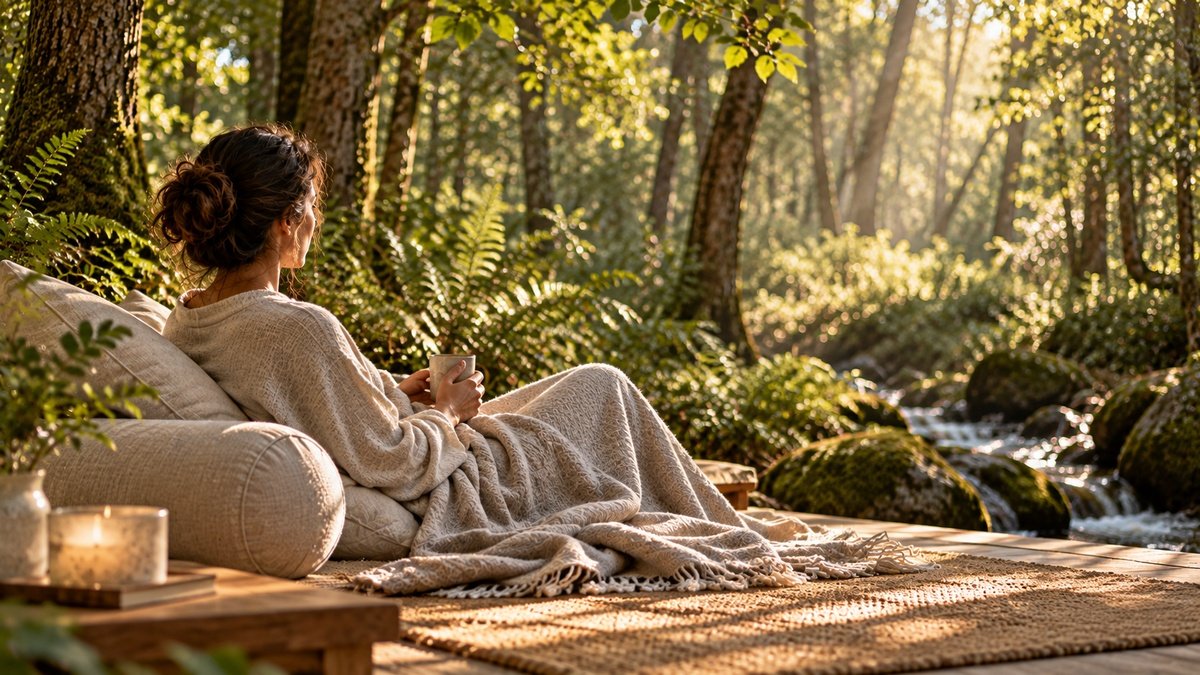
A thoughtfully arranged environment can reduce some unnecessary demands. For example, softer lighting may feel preferable, a blanket can change physical comfort and removing an unwanted aroma can make a space more suitable.
However, environmental choices cannot guarantee a particular response. A beautiful room does not ensure relaxation, just as silence does not automatically create internal quiet.
Individual preference therefore matters. One person may enjoy music, while another prefers quiet. Someone may appreciate an aroma, while another chooses an unscented environment.
The environment can support the experience without prescribing it.
This idea connects with the relationship between sensory experience and attention explored in Turning Attention Inward: Understanding Pratyāhāra in Yoga.
Breathing Does Not Need to Become Another Task
Breathing practices often appear alongside discussions of rest and relaxation.
Some people enjoy observing the breath or gently exploring its rhythm during quiet practice. Others may prefer to let breathing continue without deliberate intervention.
Both approaches leave room for individual experience.
When breathing becomes a performance target — deeper, slower, longer or more controlled — it can add effort to a practice intended to reduce demands. Ordinary, unmanipulated breathing therefore remains a valid option.
Explore the distinction between everyday breathing, breath awareness and formal yogic breath practices in More Than Breathing: Understanding Prāṇāyāma in Yoga.
Where Does Yoga Nidra Fit?
People frequently associate Yoga Nidra with deep relaxation and sleep, yet the practice has its own history and methods.
Contemporary Yoga Nidra commonly uses a guided practice alongside physical stillness. Different approaches may direct attention towards the body, breathing, sensations, imagery or other aspects of experience.
The physical arrangement may provide an opportunity for rest. However, the guided structure means that Yoga Nidra is not simply another name for lying down or taking a nap.
Nor does the practice require one prescribed experience. Different sessions, circumstances and individuals may bring different responses.
Explore the subject further in Between Wakefulness and Sleep: Exploring Yoga Nidra.
A Common Misunderstanding: Rest Has to Be Earned
Modern routines can sometimes frame rest as a reward that follows productivity: finish the work, complete the list and reach the end of the day before taking a break.
That pattern can place rest permanently on the other side of another task.
However, rest forms part of ordinary human life rather than serving only as a prize for completing enough activity.
At the same time, people do not have equal control over when and how opportunities for rest become available. Work, caring responsibilities, environment, financial circumstances, access to support and many other factors can influence those possibilities.
For that reason, recognising the value of rest should not become another demand placed on someone who already has limited time or choice.
A more practical question might be whether the present circumstances allow even a small reduction in unnecessary demand.
Rest and Relaxation Without Performance
When rest becomes another goal, evaluation can quickly follow. We may start wondering whether we stayed still enough, relaxed deeply enough or remained quiet for long enough.
Those questions can transform a pause from performance into another form of performance.
A different approach leaves more room for experience. Rest can create a period in which fewer demands are present. Relaxation may emerge within that space, or the experience may take another form.
Neither experience needs a score.
The Orenna Perspective — Rest Can Be Invited
At Orenna, rest can be invited. It cannot be demanded.
This distinction shapes the way we think about restorative experiences.
Physical support can reduce unnecessary effort. We can adjust light and temperature, offer choices around sound and aroma, and adapt positioning according to individual preference.
These choices do not attempt to manufacture relaxation. Instead, they can create conditions in which fewer demands are present.
Within that space, someone might become deeply quiet, notice thoughts, change position, open their eyes or adjust a bolster. Another person may enjoy following the breath, while someone else prefers to leave it alone.
Personalisation matters precisely because no single arrangement of posture, props, sound, light or stillness defines rest for everyone.
The practice can respond to the person rather than asking the person to reproduce a predetermined image of relaxation.
Rest does not need to be earned through effort, demonstrated through stillness or proved by reaching a particular state.
Sometimes it begins more simply: with an opportunity for less to be required.
References & Further Reading
National Heart, Lung, and Blood Institute. Sleep Deprivation and Deficiency. Background information on sleep and its role in health, useful when distinguishing the biological process of sleep from the broader concept of waking rest.
Zaccaro, Andrea et al. “How Breath-Control Can Change Your Life: A Systematic Review on Psycho-Physiological Correlates of Slow Breathing.” Frontiers in Human Neuroscience, 2018. A systematic review examining research into slow breathing and psychophysiological variables.
Lasater, Judith Hanson. Relax and Renew: Restful Yoga for Stressful Times. An influential contemporary work in the teaching and development of supported Restorative Yoga.
The Orenna Journal explores yoga and well-being from historical, philosophical and contemporary perspectives. This article provides educational and general information rather than medical or psychological advice. Experiences of rest and relaxation vary, and no particular practice, position or environment can guarantee a specific physical, emotional or psychological response.