


Jivamukti Yoga is difficult to understand from the physical practice alone.
A class may be vigorous. Postures can flow together through vinyāsa. Music may accompany the movement, and physically demanding āsanas can form part of the sequence.
Yet reducing Jivamukti Yoga to dynamic yoga with music misses much of what its founders intended the method to be.
Scripture may be discussed. Sanskrit can be chanted. Meditation forms part of the practice. Devotion is explicit. Ethical questions concerning animals, food and the environment are woven into its interpretation of ahiṃsā.
This combination emerged not from an ancient school carrying the name Jivamukti, but from the artistic and yoga communities of New York City during the 1980s.
So what is Jivamukti Yoga? Who created it? What does Jivamukti mean? What are its Five Tenets? Why are music, chanting and veganism so prominent? And how does a physically dynamic modern practice understand yoga as something extending far beyond āsana?
What Is Jivamukti Yoga?
Jivamukti Yoga is a modern yoga method founded by Sharon Gannon and David Life in New York City during the 1980s.
The method integrates physically active āsana practice with meditation, chanting, music, study of yogic texts, devotional practices and an ethical philosophy centred particularly on non-violence and compassion.
Vinyāsa plays an important role, especially within the better-known Open and Spiritual Warrior classes.
However, Jivamukti is not simply a style of Vinyasa Yoga.
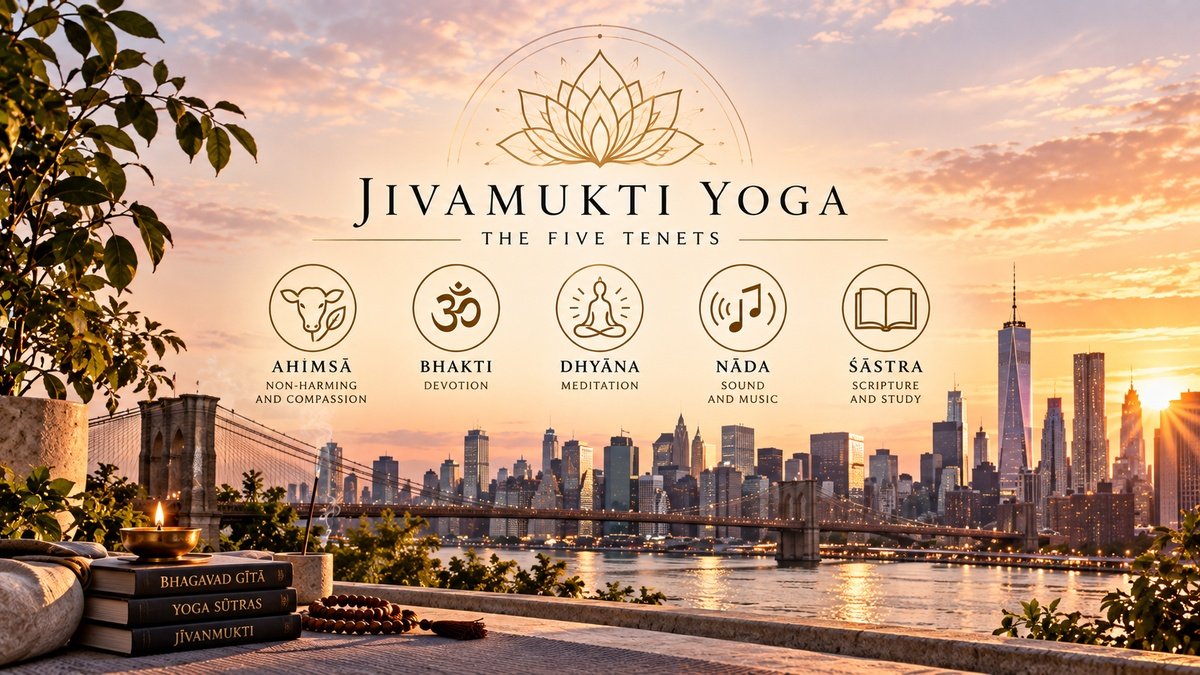
The organisation describes five principles as foundational to the method: ahiṃsā, bhakti, dhyāna, nāda and śāstra.
Together, these place physical practice within a broader spiritual and ethical framework.
Who Founded Jivamukti Yoga?
Sharon Gannon and David Life founded the Jivamukti Yoga method.
The two met in New York City in 1983 and began a creative collaboration that increasingly centred on yoga.
Both were connected with the city’s artistic and countercultural communities.
Gannon had a background in dance, music and performance. Life was an artist, musician and poet.
Their approach developed through practice, teaching and study with several influential teachers.
The official Jivamukti lineage particularly acknowledges Shri Brahmananda Sarasvati, Swami Nirmalananda, K. Pattabhi Jois, Shri Shyamdas and Milanbaba Goswami as important influences.
These relationships contributed different dimensions to a method that would eventually combine postural practice, Sanskrit texts, devotion, meditation, music and ethical activism.
When and Where Did Jivamukti Yoga Begin?
Jivamukti Yoga emerged in New York City during the 1980s.
The official organisation identifies Gannon and Life as founders and dates the establishment of the method to this period.
That setting matters.
Jivamukti developed within a very different cultural environment from the Indian ashrams and institutions through which many earlier twentieth-century yoga teachers had worked.
New York brought yoga into contact with contemporary art, music, dance, environmentalism, animal-rights activism and urban counterculture.
Rather than concealing these modern influences, they became part of Jivamukti’s identity.
The result was a form of modern yoga that could be physically demanding and culturally contemporary while explicitly presenting itself as a spiritual discipline.
What Does Jivamukti Mean?
The name draws on the Sanskrit concept jīvanmukti.
Jīvan relates to living or being alive, while mukti refers to liberation or release.
Jīvanmukti therefore refers broadly to liberation while living.
Gannon and Life adapted the concept into the name Jivamukti for their modern method.
Within Indian philosophical traditions, liberation is a complex concept interpreted differently across schools.
It should therefore not be reduced to a modern wellness promise such as feeling relaxed, confident or free from everyday stress.
The name places the method within a much larger philosophical conversation about freedom, self-knowledge and spiritual liberation.
What Are the Five Tenets of Jivamukti Yoga?
The Jivamukti method is organised philosophically around Five Tenets:
Ahiṃsā — non-harming and compassion
Jivamukti interprets ahiṃsā as extending beyond relationships between humans to include animals and the wider environment. Ethical veganism and animal rights consequently occupy a particularly prominent place within the method.
Bhakti — devotion
Bhakti introduces devotional orientation into practice. This may appear through chanting, prayer, intention and other practices directed towards what the tradition understands as God or Self-realisation.
Dhyāna — meditation
Meditation is treated as a central yogic practice rather than an optional addition after physical exercise.
Nāda — sound
Nāda concerns sound and attentive listening. Music, mantra and chanting therefore have unusually visible roles within Jivamukti classes.
Śāstra — scripture
The study of yogic and spiritual texts connects contemporary practice with philosophical teachings. Sanskrit chanting and interpretation of scripture may form part of this study.
The Five Tenets are not five stages that practitioners complete sequentially.
They are intended to inform the method simultaneously.
What Does Ahiṃsā Mean in Jivamukti Yoga?
Ahiṃsā is usually translated as non-harming, non-violence or non-injury.
The principle appears across several Indian religious and philosophical traditions and is not unique to Jivamukti.
Jivamukti gives it a particularly expansive contemporary interpretation.
The method explicitly connects non-harming with compassion towards animals, environmental responsibility and ethical veganism.
For its founders, dietary choices therefore became part of yoga practice rather than something separate from it.
This is one of the clearest ways in which Jivamukti moves yoga beyond the boundaries of the studio.
It is also important to distinguish description from universal prescription.
Veganism is foundational to Jivamukti’s interpretation of ahiṃsā. That does not mean every historical yoga tradition has understood ahiṃsā through precisely the same dietary framework.
Why Is Bhakti Part of the Practice?
Jivamukti is explicitly receptive to devotional yoga.
Within the method, bhakti may appear through chanting, mantra, prayer, devotional music and the setting of an intention for practice.
This distinguishes it from modern classes that deliberately present yoga in entirely secular terms.
However, bhakti has a history far larger than Jivamukti Yoga.
Devotional traditions developed across India over many centuries and encompass numerous theological traditions, practices, languages and communities.
Jivamukti draws upon this much larger devotional landscape rather than originating it.
Why Is Music So Important in Jivamukti Yoga?
Music is one of the most immediately recognisable features of many Jivamukti classes.
A teacher may construct a soundtrack ranging from Indian devotional music and mantra to contemporary popular, electronic or experimental music.
Yet music is not intended simply to make a physically demanding class more entertaining.
It connects with the tenet of nāda.
Nāda directs attention towards sound and listening as dimensions of practice.
Consequently, Jivamukti treats sound as potentially meaningful rather than as neutral background decoration.
The founders’ own histories in music and performance also contributed to the method’s unusually eclectic sonic identity.
What Role Does Scripture Play?
Śāstra refers to scriptural or authoritative textual teaching.
Jivamukti teachers may draw from texts such as Patañjali’s Yoga Sūtras, the Bhagavad Gītā, the Haṭhapradīpikā and other philosophical or devotional sources.
A passage may be introduced at the beginning of class and then connected with the physical and contemplative practice that follows.
This approach attempts to prevent āsana from becoming completely detached from yoga’s intellectual and spiritual histories.
At the same time, these texts come from different historical periods and philosophical environments.
They should not be treated as though they all express one perfectly uniform doctrine called “yoga”.
Studying yoga seriously includes noticing both connections and differences between its sources.
What Happens in a Jivamukti Yoga Class?
The answer depends on the class format.
The best-known format is the Jivamukti Open Class.
Its sequence is creatively designed by the teacher rather than reproduced identically each time.
A typical Open Class integrates flowing āsana, breath awareness, alignment exploration, chanting, music, meditation, relaxation and philosophical teaching.
The organisation specifies fourteen components that should appear within an Open Class, although their exact order can vary.
These include vinyāsa, side bending, twisting, inversions, backbending, forward bending, relaxation, meditation and spiritual teaching.
Consequently, an Open Class combines a substantial physical practice with elements that explicitly place the movement inside the wider Jivamukti philosophy.
Is Every Jivamukti Yoga Class the Same?
No.
Jivamukti offers several class formats.
The Open Class allows teachers significant creativity within a defined framework.
The Spiritual Warrior class, by contrast, uses a fixed one-hour sequence and is deliberately fast-paced.
Fundamentals classes slow the process down and give greater attention to learning āsanas and alignment.
Beginner Vinyasa provides another bridge into flowing practice.
The method also includes meditation and the slower Magic Ten and Beyond format.
Calling Jivamukti one type of vigorous class therefore obscures the variety inside the system.
What Is the Jivamukti Open Class?
The Open Class is one of the method’s signature formats.
Rather than following one fixed sequence, the teacher creates a class incorporating required components while exploring a particular philosophical theme.
Jivamukti calls this the Focus of the Month.
Physical practice and philosophical teaching are therefore designed to interact.
A teacher might introduce an idea from a yoga text, connect it with chanting or intention, explore it through movement and return to it during meditation or closing reflection.
The class is described as “Open” because practitioners of different experience levels can attend, with options offered within the practice.
However, the organisation itself notes that beginners seeking detailed instruction may benefit from its Fundamentals or Beginner Vinyasa classes first.
What Is the Spiritual Warrior Sequence?
Spiritual Warrior is a standardised sixty-minute Jivamukti sequence.
Unlike the creatively sequenced Open Class, its structure remains recognisable from one practice to another.
The sequence incorporates warm-up practices, chanting, sun salutations, standing postures, balances, inversions, backbends, forward bends, twists, relaxation and meditation.
Its fixed architecture allows practitioners to become familiar with the sequence while maintaining the wider elements of the method.
This illustrates an important point about Jivamukti Yoga.
The system contains both creative sequencing and standardised practice rather than insisting on only one pedagogical approach.
Is Jivamukti Yoga the Same as Vinyasa Yoga?
No, although Vinyasa Yoga strongly informs its physical practice.
Jivamukti frequently links movement and breathing through flowing sequences.
However, Vinyasa Yoga is a broad contemporary category encompassing many teachers and approaches.
Jivamukti is a particular method with named founders, a defined philosophy, teacher-training system, class formats and Five Tenets.
A vinyāsa sequence can therefore exist without being Jivamukti Yoga.
Likewise, not every Jivamukti practice needs to be maximally vigorous or continuously flowing.
Is Jivamukti Yoga the Same as Ashtanga Yoga?
No.
Gannon and Life studied with K. Pattabhi Jois, so modern Ashtanga Yoga forms part of Jivamukti’s historical influences.
That influence is visible in aspects of its dynamic āsana practice.
Nevertheless, the two systems are structurally different.
Ashtanga Yoga organises practice around established series and a distinctive method of progression.
Jivamukti Open Classes allow creative sequencing and explicitly integrate the Five Tenets, music, philosophical themes and other practices into their architecture.
Influence should therefore not be confused with identity.
Jivamukti is not simply Ashtanga performed to music.
Is Jivamukti Yoga Physically Difficult?
It can be.
Some Jivamukti classes contain vigorous vinyāsa, inversions, arm balances and substantial backbending.
However, physical intensity varies between class formats and individual teachers.
The existence of advanced āsana within a method does not mean every practitioner needs to perform its most demanding expressions.
Jivamukti’s Open Class framework explicitly allows different āsana options, while its Fundamentals programme teaches postures in greater detail.
A physically demanding variation is therefore one possible expression of practice rather than evidence of greater spiritual attainment.
Is Jivamukti Yoga Suitable for Beginners?
Beginners can practise Jivamukti Yoga, but choosing the appropriate class matters.
An Open Class may contain options for different experience levels, yet it can move relatively quickly and may not spend extensive time explaining the foundations of every posture.
The method’s Fundamentals and Beginner Vinyasa classes are specifically designed to provide more detailed instruction.
This distinction is useful beyond Jivamukti.
A class being described as open to everyone does not necessarily mean every class format provides the same amount of introductory teaching.
Appropriate entry points matter.
Does Jivamukti Yoga Use Hands-On Assists?
Hands-on guidance has historically formed part of Jivamukti teaching and remains referenced within its description of the Open Class.
Physical assistance requires clear professional boundaries and meaningful consent.
Consent for one adjustment should not be assumed to establish consent for future adjustments, different forms of touch or subsequent classes.
Students should remain able to decline touch without needing to justify that decision.
The quality of a yoga practice does not depend on accepting physical adjustment.
Why Is Veganism So Closely Associated with Jivamukti Yoga?
Veganism follows from the founders’ particular interpretation of ahiṃsā.
Rather than restricting non-harming to direct interactions between humans, Jivamukti extends the ethical question to the treatment of animals and the consequences of food production.
Animal advocacy consequently became a prominent feature of Sharon Gannon’s teaching and writing.
This distinguishes Jivamukti from many contemporary yoga schools in which diet is either absent from teaching or treated primarily as a matter of individual preference.
Again, historical precision matters.
Vegetarian dietary traditions have long histories within Indian religious and philosophical contexts. Contemporary ethical veganism is a more specific formulation.
The two overlap, but they should not automatically be treated as identical.
Is Jivamukti Yoga Religious?
Jivamukti Yoga contains explicitly spiritual and devotional material.
Its official explanation of bhakti refers directly to God or Self-realisation as the goal of yoga practice.
Classes may include Sanskrit chanting, devotional music, sacred texts, mantra and philosophical teachings concerned with liberation.
It would therefore be inaccurate to describe the complete method as purely secular physical exercise.
At the same time, participation in a class does not by itself establish someone’s religious identity.
Practitioners may relate to devotional and philosophical material in different ways.
The useful distinction is between the content of the tradition and the beliefs of the individual attending it.
What Are the Benefits of Jivamukti Yoga?
Jivamukti Yoga can combine substantial physical activity with breathing, meditation, relaxation, music and philosophical reflection.
Practitioners may value different aspects of that combination.
Some may be drawn to movement and physical challenge. Others may find meditation, chanting, ethical inquiry or community more significant.
These experiences should not be converted into guaranteed therapeutic outcomes.
Jivamukti Yoga should not be presented as a treatment for anxiety, depression, trauma, hormonal conditions or other health concerns without appropriate evidence and professional context.
Its potential value does not depend on making medical promises.
Why Did Jivamukti Yoga Become Influential?
Jivamukti arrived at an important moment in the international development of modern yoga.
During the 1980s and 1990s, yoga was becoming increasingly visible within Western urban culture.
Gannon and Life presented a form of practice that could inhabit that contemporary environment without abandoning overt references to spirituality, Sanskrit, philosophy and devotion.
Its New York identity also connected yoga with music, artists, performers, environmental concerns and animal advocacy.
Teacher training subsequently allowed the method to spread internationally.
Official Jivamukti centres and affiliated teachers now operate in multiple countries.
The method therefore became part of a wider transformation through which modern yoga could be simultaneously traditionalist in some of its references and strikingly contemporary in its presentation.
A Common Misunderstanding: Jivamukti Yoga Is Not Simply Vinyasa with Music
Its physical appearance makes the misunderstanding understandable.
A flowing sequence accompanied by an eclectic soundtrack can look very much like a contemporary Vinyasa class.
Yet music is connected with nāda. Ethical teaching is connected with ahiṃsā. Chanting and devotion relate to bhakti. Meditation expresses dhyāna. Textual study brings śāstra into the room.
Remove all of those dimensions and something more substantial than decoration has disappeared.
That does not mean every Jivamukti class expresses each element with equal emphasis.
It means the method defines itself through an architecture larger than its choreography.
The movement may be the most visible part of Jivamukti Yoga, but visibility and importance are not necessarily the same thing.
An Orenna Perspective: What Happens Beyond the Shape?
Jivamukti Yoga raises a question that extends beyond any single school.
What makes a physical practice yoga?
The answer cannot be found simply by looking at the difficulty of the posture.
Two people might make almost identical shapes while understanding what they are doing in profoundly different ways.
Jivamukti responds by deliberately connecting movement with attention, ethical inquiry, meditation, sound, philosophy and relationship with other living beings.
We do not need to adopt every interpretation within a tradition in order to recognise the importance of the question it asks.
Perhaps āsana becomes more interesting when it stops being the conclusion.
It can become a place from which larger questions begin.
What matters is not only how we move through a practice, but what the practice asks us to notice about how we move through the world.
References & Further Reading
Jivamukti Yoga. About the Founders. Official history of Sharon Gannon and David Life and the teachers identified as important influences on the development of the method. Explore the founders.
Jivamukti Yoga. The Jivamukti Method. Official explanation of the Five Tenets: ahiṃsā, bhakti, dhyāna, nāda and śāstra. Explore the method.
Jivamukti Yoga. Jivamukti Open Class. Description of the Open Class, including its integration of vinyāsa, chanting, music, meditation and spiritual teaching. Explore the Open Class.
Jivamukti Yoga. The 14 Points of a Jivamukti Open Level Class. Official outline of the physical, meditative and philosophical components expected within the Open Class. Explore the 14 points.
Gannon, Sharon & Life, David. (2002). Jivamukti Yoga: Practices for Liberating Body and Soul. Ballantine Books.
Singleton, Mark. (2010). Yoga Body: The Origins of Modern Posture Practice. Oxford University Press. Useful wider context for understanding the development of modern transnational posture-based yoga.
Mallinson, James & Singleton, Mark. (2017). Roots of Yoga. Penguin Classics. Primary-source translations providing historical context for the wider diversity of yoga traditions and practices.



