


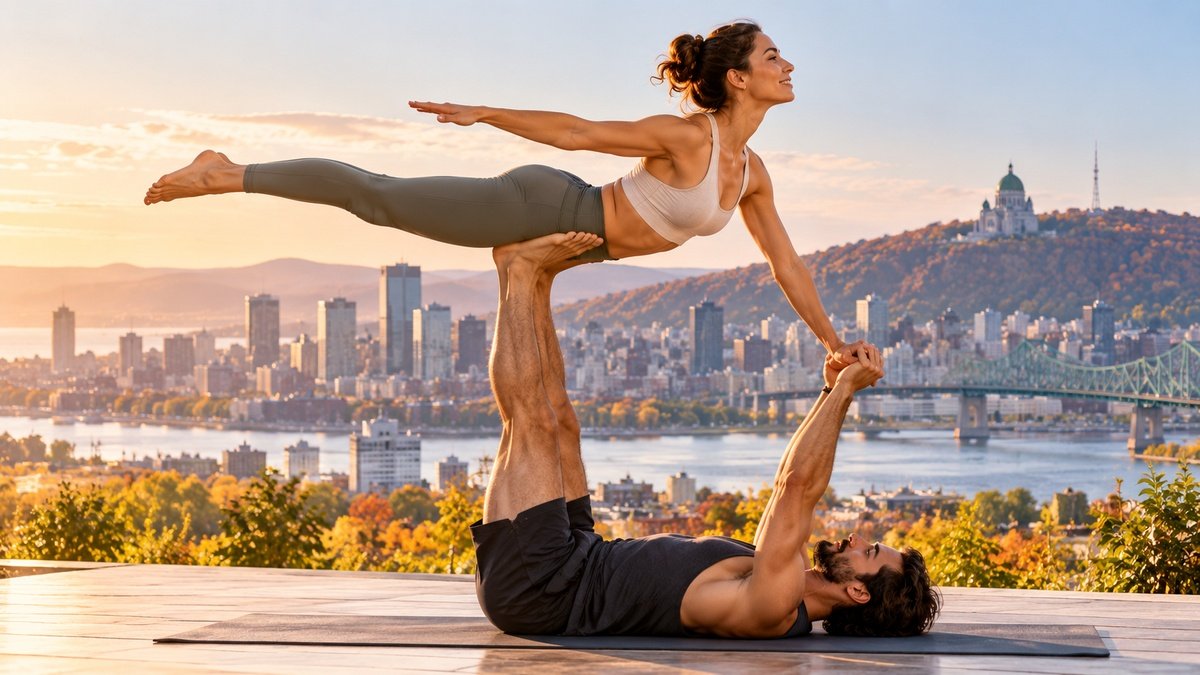
Acro Yoga changes one of the most familiar assumptions about contemporary yoga practice: that the practitioner works primarily with their own body.
Here, another person becomes part of the structure.
One practitioner may lie on the floor and support another above them. Someone else watches closely, ready to assist. Roles change. Weight shifts. Balance becomes shared rather than individual.
From the outside, Acro Yoga can look spectacular. Photographs often show apparently effortless balances, inversions and complex human structures.
Yet the visible pose tells only part of the story.
Behind it are communication, timing, physical organisation, consent, progressive learning and the ability to respond to another person.
So what exactly is Acro Yoga? Where did it come from? Who developed it? What do the terms base, flyer and spotter mean? Do you need to be strong, flexible or experienced in yoga? And when acrobatics and yoga meet, what makes the resulting practice yoga at all?
What Is Acro Yoga?
Acro Yoga is a modern partner movement practice combining elements of yoga with partner acrobatics.
Some schools have also incorporated influences from dance, Thai massage and other forms of movement or bodywork.
Rather than practising independently on neighbouring mats, participants work together to create supported positions, transitions and movement sequences.
Three roles are particularly important within much contemporary Acro Yoga: the base, the flyer and the spotter.
The practice can range from relatively simple supported balances to technically demanding acrobatic transitions.
Consequently, Acro Yoga is not defined by one particular pose or sequence.
It is better understood as a family of collaborative movement practices that developed around the meeting of yoga, acrobatics and partner work.
Where Did Acro Yoga Come From?
Contemporary Acro Yoga developed primarily in North America around the turn of the twenty-first century.
Its history is more complicated than the frequently repeated statement that one pair of teachers simply invented it in 2003.
Two important modern developments occurred in Canada and the United States.
In Montreal, professional performers Jessie Goldberg and Eugene Poku had spent many years working together in dance, acrobatics and other movement arts. They incorporated yoga into their performance practice during the late 1990s and describe using the term AcroYoga from 1999.
A few years later in California, Jason Nemer and Jenny Sauer-Klein began developing a collaborative practice drawing on their respective backgrounds in acrobatics, yoga, circus arts and healing arts.
Their work became another major strand in the international development of AcroYoga.
These histories developed independently before becoming part of the broader movement now associated with the name.
When Did Acro Yoga Develop?
Acro Yoga in its recognisable contemporary form developed during the late 1990s and early 2000s.
Goldberg and Poku state that yoga entered their existing performance repertoire in 1998 and that they coined the term AcroYoga in 1999 to describe their fusion of yoga, acrobatics and dance.
Their approach subsequently developed into AcroYoga Montreal.
Nemer and Sauer-Klein began working together in California in 2003. Their early practice was initially known as ContactAcro before becoming known as AcroYoga.
Through teaching programmes, manuals, workshops and an expanding international community, this Californian approach became particularly influential in spreading AcroYoga internationally.
The existence of these parallel histories is important.
Modern Acro Yoga developed through several overlapping experiments rather than appearing suddenly from one individual or institution.
Who Invented Acro Yoga?
No single person can adequately represent its entire development.
Jessie Goldberg and Eugene Poku have a documented claim to early use of the term AcroYoga. Their own historical account places that use in Montreal in 1999.
Jason Nemer and Jenny Sauer-Klein independently developed another highly influential system in California from 2003.
Earlier practices also anticipated aspects of what would later become Acro Yoga.
During the 1980s, Benjamin Marantz developed Acrosage, combining acrobatic support and massage. Ken Nateshvar Scott’s Contact Yoga similarly explored partner support and therapeutic movement.
Even earlier, film footage from 1938 shows T. Krishnamacharya participating in partner-supported demonstrations that resemble some positions now familiar within Acro Yoga.
These precedents do not mean that Krishnamacharya was secretly teaching today’s Acro Yoga system.
They demonstrate something more modest and historically useful: people had explored intersections between yoga, balancing and partner-supported movement before the modern AcroYoga organisations appeared.
Is Acro Yoga an Ancient Form of Yoga?
No, not in the sense that the contemporary practice was transmitted intact from an ancient Indian lineage.
Yoga has a long and diverse history. Acrobatics also has deep histories across numerous cultures.
That does not make every modern combination of the two ancient.
Contemporary Acro Yoga belongs primarily to modern movement culture.
Recognising that does not make it less legitimate.
A practice can be contemporary while drawing meaningfully from older disciplines.
Indeed, distinguishing influence from identity allows us to appreciate innovation without manufacturing antiquity for it.
What Are the Three Main Roles in Acro Yoga?
Many Acro Yoga practices organise participants around three roles: base, flyer and spotter.
The base provides physical support.
In a common arrangement called L-basing, the base lies on their back and uses the legs and hands to support the flyer above the ground.
The flyer is the person being supported.
They contribute actively to the balance through body organisation, weight distribution, responsiveness and communication. The word flyer therefore does not mean passive passenger.
The spotter observes the partnership and positions themselves to help manage an unexpected loss of balance.
A skilled spotter does considerably more than stand nearby.
They need to understand the movement, anticipate likely directions of instability and remain attentive throughout the attempt.
All three roles contribute to the practice.
What Is L-Basing?
L-basing describes one of the most recognisable structures in Acro Yoga.
The base lies on their back, usually with the legs extending upwards so that the relationship between torso and legs resembles an L shape.
The flyer’s weight is then supported through contact with the base’s feet and, depending on the position, hands.
This arrangement allows the base to use the skeletal structure of the legs to support substantial load.
That does not mean strength becomes irrelevant.
Rather, good technique attempts to organise weight efficiently instead of relying exclusively on muscular force.
Many introductory Acro Yoga balances are taught from this position because the base remains close to the ground while participants learn how pressure, alignment and shared balance interact.
What Is a Front Bird?
Front Bird is one of the best-known introductory Acro Yoga balances.
The base typically lies on their back and supports the flyer’s pelvis through the feet.
The flyer extends horizontally above the base, creating a position that resembles flight.
Hands may initially remain connected while the partners establish balance.
As skill develops, some practitioners explore versions with less hand support.
Although the finished position may look simple, it introduces several fundamental skills: finding an appropriate point of contact, organising weight, communicating pressure and making small adjustments without overcorrecting.
For that reason, apparently basic positions can remain valuable even for experienced practitioners.
What Does Flying Mean in Acro Yoga?
Flying simply describes being supported above the ground by another practitioner.
It does not necessarily mean performing a dramatic airborne movement.
A flyer may remain relatively still in a supported balance or move gradually through a sequence of positions.
More advanced practices can include dynamic transitions in which contact changes rapidly and, in some forms, the flyer may briefly lose contact with the base before being caught again.
These skills require substantially different levels of technique and risk management.
Seeing advanced Acro Yoga online can therefore create a misleading impression of what an introductory class involves.
Learning usually begins much closer to the ground and with considerably more support.
What Is a Spotter and Why Does Spotting Matter?
Spotting is one of the most important components of Acro Yoga practice.
Partner balancing introduces an obvious possibility that an unexpected movement could result in a fall.
A spotter helps manage that risk.
Their position depends on the skill being practised and the direction in which instability is most likely to occur.
Effective spotting therefore requires instruction rather than improvisation.
A spotter also contributes another set of eyes.
While the base and flyer are processing their own balance and communication, the spotter can observe the structure from outside.
In this sense, spotting is not a lesser role performed while waiting for a turn.
It is part of the practice itself.
What Happens in an Acro Yoga Class?
Classes vary considerably according to teacher, school and level.
An introductory session may begin with individual movement, partner exercises and activities designed to establish communication.
Teachers can then introduce techniques for basing, flying and spotting before progressing towards simple balances.
Participants may practise the same skill several times while changing roles.
More experienced classes can explore transitions between positions, flowing sequences and increasingly dynamic acrobatic skills.
Some traditions also incorporate slower partner-supported practices influenced by Thai massage or therapeutic flying.
Consequently, an Acro Yoga class may contain moments of considerable physical effort alongside periods of slower, more receptive partner work.
What Is an Acro Yoga Flow?
Once practitioners can establish individual positions, they may begin connecting them.
A flow moves between several balances without completely resetting after every shape.
This introduces another layer of coordination.
Partners need to understand not only where they are going but how weight will transfer during the journey between positions.
Some recurring sequences are known within Acro Yoga communities as washing machines.
These involve a repeatable cycle of transitions that eventually returns the partners to the starting position.
Learning the pathway matters as much as reaching each individual shape.
Is Acro Yoga the Same as Partner Yoga?
Not necessarily.
Partner yoga is a much broader description.
Two people might practise seated stretches together, use one another for resistance, share a standing balance or coordinate movement without either person leaving the ground.
Acro Yoga generally introduces more explicit acrobatic relationships between practitioners.
One person supports another, weight is shared in more complex ways and flying may become central to the practice.
There is overlap between the categories, but they are not interchangeable.
Is Acro Yoga the Same as Aerial Yoga?
No.
Both practices can involve being supported above the floor, which makes the names easy to confuse.
However, Aerial Yoga uses suspended fabric — usually a hammock — as the principal support.
Acro Yoga uses another person.
That difference changes the practice substantially.
A hammock does not need to interpret language, adjust its balance or communicate uncertainty. A human partner does.
Acro Yoga therefore introduces an interpersonal dimension that is fundamental to the method.
Do You Need a Partner for Acro Yoga?
You need other people to practise most Acro Yoga skills, but that does not necessarily mean arriving with your own partner.
Many classes organise participants into pairs or groups and encourage people to change roles and practise with different partners.
This can be pedagogically useful.
Working with different bodies prevents practitioners from assuming that a technique works identically with everyone.
Height, limb proportions, body mass, mobility, experience and communication style can all change how a partnership functions.
The skill therefore lies partly in adaptation.
Does the Base Have to Be Bigger Than the Flyer?
No.
A larger base and smaller flyer can make certain skills easier, particularly during early learning, but size alone does not determine whether a partnership can work.
Technique, skeletal organisation, positioning, timing and the particular skill being attempted all matter.
Experienced practitioners can sometimes create balances in which the flyer is heavier than the base.
Nevertheless, acknowledging technique should not become an excuse to ignore load.
Different size relationships alter the mechanical demands of a skill.
A thoughtful practice works with those differences rather than pretending they do not exist.
Do You Need to Be Strong or Flexible?
You do not need exceptional strength or flexibility to begin learning appropriately selected Acro Yoga skills.
Strength can certainly help, particularly as practices become more demanding.
Yet beginners often discover that organisation matters more than expected.
A well-positioned base may support a flyer more efficiently than someone attempting to compensate with muscular force alone.
Likewise, extreme flexibility is not a prerequisite for basic partner balance.
Some advanced shapes involve substantial mobility, but they represent only one part of the practice.
Acro Yoga does not need to become a demonstration of maximum physical capacity.
Is Acro Yoga Suitable for Beginners?
Beginners can learn Acro Yoga when the class is designed for beginners.
That qualification matters.
A well-structured introduction develops foundational skills progressively: how to communicate, where to place contact, how to transfer weight, how to spot and how to exit a balance.
Students do not need to reproduce advanced social-media poses during their first session.
Indeed, attempting complex skills before understanding their foundations removes much of the information that makes progression safer and more sustainable.
Simple does not mean insignificant.
A stable Front Bird practised with clear communication can teach more about Acro Yoga than an unstable attempt at an advanced shape.
Why Is Communication So Important?
In an individual yoga practice, someone can often make a small adjustment without explaining it to anyone else.
Partner practice changes that.
If a base moves unexpectedly, the flyer’s balance changes. If a flyer shifts weight without communicating, the base has to respond. If either person becomes uncomfortable, the other needs to know.
Clear language therefore becomes part of the technique.
Practitioners learn to ask rather than assume.
Is this pressure comfortable? Are you ready to move? Do you want another attempt? Would you prefer to stop?
These are not interruptions to Acro Yoga.
They are part of practising it well.
What Role Does Consent Play in Acro Yoga?
Acro Yoga necessarily involves physical contact.
That makes consent particularly important.
Agreeing to practise one skill does not automatically mean agreeing to every subsequent position, adjustment or form of contact.
Likewise, having practised with someone previously does not remove the need to communicate during the current session.
People can change their minds.
A practitioner should also be able to decline a particular partner, role or technique without needing to justify that decision.
Good partner practice therefore requires more than technical skill.
Trust is not something a partner should demand. It develops through behaviour that makes trust possible.
Is Acro Yoga Safe?
No physical practice involving partner lifting can be described as risk-free.
Falls, collisions and unexpected changes in load are possible, particularly as skills become higher or more dynamic.
Risk management therefore matters.
Progressive teaching, appropriate surfaces, competent spotting, clear communication and selecting skills that match current experience can all influence the conditions in which practice takes place.
Fatigue also matters. A skill that feels organised at the beginning of a session may become less reliable when concentration or physical capacity declines.
More advanced dynamic techniques require correspondingly greater technical preparation.
Confidence should not be confused with control.
What Are the Benefits of Acro Yoga?
Acro Yoga can provide a varied physical practice involving strength, balance, coordination, mobility and spatial awareness.
Its partner structure also creates opportunities to practise communication, cooperation and responsiveness.
Many participants value its playful and social character.
However, those observations should not be inflated into therapeutic guarantees.
Practising with another person does not automatically create trust, repair relationships or treat anxiety. Likewise, being inverted by a partner should not be presented as a treatment for physical or psychological conditions.
People may find the experience enjoyable, challenging, connecting or confidence-building.
Individual experiences remain individual.
Why Has Acro Yoga Become So Visible?
Acro Yoga is unusually visual.
A complex partner balance can be understood immediately as something physically remarkable, even by someone who knows nothing about the practice.
That made Acro Yoga particularly suited to festivals, outdoor gatherings and, later, image-based social media.
Communities also developed around informal practice sessions commonly known as jams.
Rather than relying entirely on conventional teacher-led classes, practitioners could meet, exchange skills and practise together.
This community structure helped the practice travel internationally.
Yet visibility can distort perception.
Online images naturally favour the spectacular moment.
They rarely show the repeated attempts, spotting, negotiation, failed transitions and technical learning that made the photograph possible.
Is Acro Yoga Really Yoga?
There is no purely mechanical test that settles this question.
Acrobatics alone does not become yoga simply because practitioners use a yoga mat or Sanskrit terminology.
At the same time, yoga has never been reducible to a catalogue of particular body shapes.
Modern Acro Yoga communities have drawn on yoga through movement, breathing, attention and ideas about how people relate to themselves and others.
Different schools emphasise these elements to different degrees.
Some practices may feel strongly rooted in yoga. Others may function predominantly as partner acrobatics.
Rather than deciding from the appearance of a pose, it may be more useful to ask what principles actually organise the practice.
A Common Misunderstanding: The Flyer Is Not the Skilled One and the Base the Strong One
Photographs naturally direct attention towards the person in the air.
That can make the flyer appear to be performing while the base merely provides support.
Acro Yoga does not work that way.
Both roles require technique.
The base manages force, contact, structure and changing load. The flyer organises their body, distributes weight and responds to information coming through the partnership.
The spotter contributes another form of skill again.
As practice develops, people may learn all three roles rather than allowing body size, gender or appearance to determine permanently who bases and who flies.
The balance belongs to the partnership, not to the person who looks most impressive in the photograph.
An Orenna Perspective: Balance Becomes a Conversation
Most yoga practice asks us to notice relationships.
The relationship between breath and movement. Effort and ease. Intention and action. Stability and change.
Acro Yoga makes another relationship impossible to ignore: the person in front of us.
A balance cannot simply be imposed.
Pressure receives a response. Movement changes another person’s movement. Hesitation becomes information. Communication becomes part of technique.
That makes partner practice interesting beyond the final shape.
Perhaps the most valuable moment is not when two bodies finally become perfectly still.
It is the continual process through which they discover how to respond to one another.
In Acro Yoga, balance is not something one person possesses. It is something people negotiate together.
References & Further Reading
AcroYoga Montreal. Our History. The organisation’s account documents Jessie Goldberg and Eugene Poku’s introduction of yoga into their performance repertoire in 1998 and their use of the term AcroYoga from 1999. Explore the history.
AcroYoga Montreal. Our Founders. Background on Goldberg and Poku’s work in dance, acrobatics, performance and yoga. Explore the founders.
Singleton, Mark. (2010). Yoga Body: The Origins of Modern Posture Practice. Oxford University Press. Useful wider context for understanding how modern forms of posture-based yoga developed through interactions between yoga, physical culture and other movement disciplines.
Mallinson, James & Singleton, Mark. (2017). Roots of Yoga. Penguin Classics. Primary-source translations illustrating the diversity of historical yoga and providing useful context for distinguishing older yogic practices from modern hybrid forms.



