

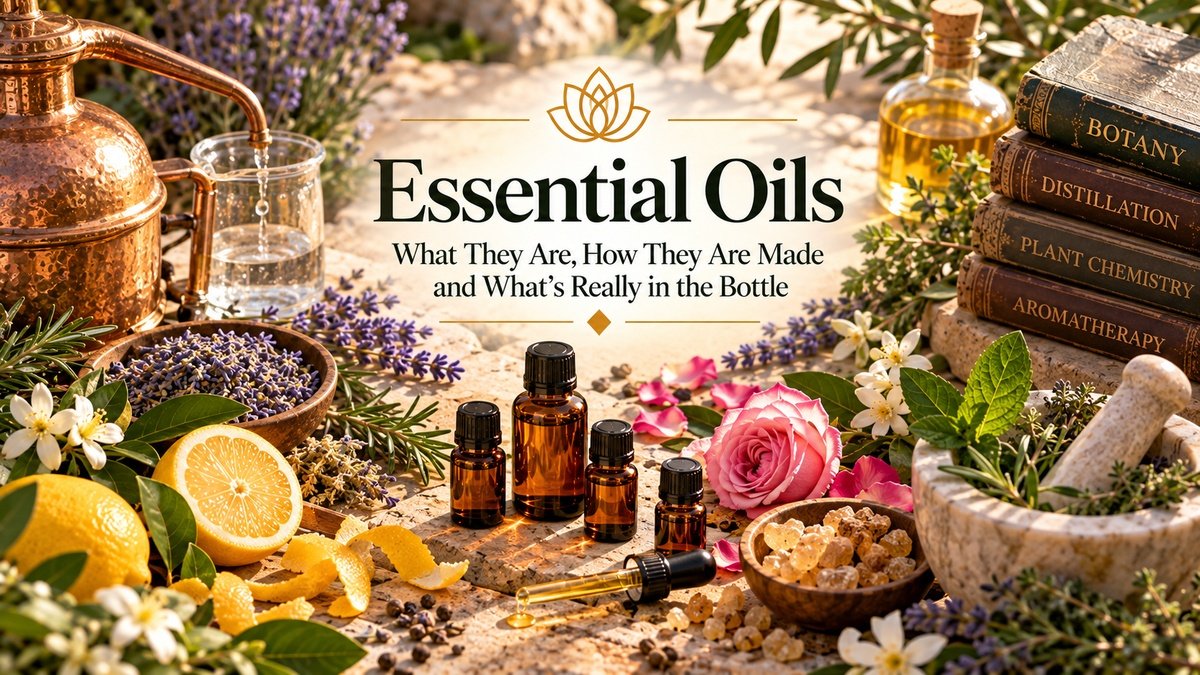
A small bottle of essential oil can look remarkably simple.
Lavender. Peppermint. Lemon. Frankincense. Rosemary.
Open the bottle and the aroma may immediately suggest the plant named on the label. Yet what sits inside is not simply liquid lavender, concentrated lemon juice or oil squeezed from a rosemary leaf.
Essential oils are complex mixtures of volatile aromatic compounds obtained from particular plant materials through specific extraction processes.
That definition matters.
It explains why essential oils behave differently from vegetable oils, why a hydrosol is not simply diluted essential oil, why rose essential oil can be extraordinarily expensive and why a bottle labelled “fragrance oil” may contain something quite different.
It also helps separate the physical substance inside the bottle from the extensive therapeutic and emotional claims that sometimes surround it.
So what exactly is an essential oil?
What Are Essential Oils?
Essential oils are concentrated mixtures of volatile compounds derived from aromatic plant material.
The word volatile is important. In chemistry, volatility describes a substance’s tendency to evaporate.
When we open a bottle and smell lavender or peppermint without touching the liquid, volatile molecules have left the material, entered the surrounding air and reached receptors in the nose.
That evaporation helps create aroma.
An essential oil may contain dozens, sometimes hundreds, of individual chemical constituents in varying proportions.
Terpenes, terpenoids and other classes of volatile organic compounds contribute to the oil’s aroma and physical properties.
Consequently, an essential oil is not one chemical substance.
It is a chemically complex botanical product.
Why Are They Called “Essential” Oils?
The name can be misleading.
In this context, essential does not mean nutritionally essential, medically necessary or indispensable to health.
The historical terminology relates instead to the characteristic aromatic “essence” associated with the plant.
Likewise, calling the material an oil does not make it equivalent to olive oil, sunflower oil or another fixed vegetable oil.
Essential oils and fixed oils differ considerably in their chemistry and behaviour.
That is why lavender essential oil can evaporate from a blotting strip while olive oil leaves a persistent greasy mark.
Where Do Essential Oils Occur in Plants?
Aromatic compounds can occur in specialised structures within different parts of a plant.
Depending on the species, producers may obtain aromatic material from flowers, leaves, needles, grasses, fruit peel, seeds, roots, rhizomes, wood, bark or resinous material.
Lavender oil comes primarily from flowering tops.
Peppermint oil comes from the aerial parts of the plant.
Lemon essential oil commonly comes from the outer peel rather than the fruit juice.
Cedarwood oils come from woody material, while ginger essential oil can come from the rhizome.
Frankincense begins with aromatic resin produced by trees of the genus Boswellia.
Therefore, simply naming the plant does not always tell us enough.
The plant part matters too.
Why Do Plants Produce Aromatic Compounds?
Plants do not manufacture aromatic molecules for human aromatherapy.
These compounds form part of the plant’s own biology and ecological relationships.
Depending on the species and compound, volatile substances may contribute to communication, attraction of pollinators, interactions with herbivores or microorganisms, and responses to environmental pressures.
Their roles can be complex and context-dependent.
Humans subsequently learned to value many of these compounds because we could smell them, extract them and use aromatic plant materials in perfumery, food, ritual, cosmetics and medicine.
The relationship between humans and scent therefore begins with plant chemistry but becomes cultural as soon as people interpret and use it.
How Are Essential Oils Made?
There is no single extraction method for every aromatic plant.
The appropriate process depends on the botanical material, the compounds being collected and the product the manufacturer wants to create.
For many familiar essential oils, steam distillation is the central technique.
Citrus peel oils often use mechanical expression instead.
Other aromatic extracts require different technologies and, strictly speaking, should not always be called essential oils.
Understanding the extraction method helps us understand what is actually inside the bottle.
How Does Steam Distillation Work?
Steam distillation uses heat, water and vapour to separate volatile aromatic compounds from plant material.
The exact equipment varies, but the underlying process can be understood in several stages.
Plant material enters a still. Steam passes through or around it, encouraging volatile compounds to evaporate.
The aromatic vapour travels with the steam into a condenser.
Cooling then turns the vapour back into liquid.
The resulting distillate contains water and aromatic material.
Because most essential-oil constituents do not mix freely with water, an oily aromatic layer can usually separate from the aqueous portion.
The producer can then collect the essential oil.
The aromatic water remaining from this process may form a hydrosol.
One distillation can therefore produce two related but distinctly different materials.
Is Distillation Simply Boiling the Plant?
Not quite.
Distillation relies on the behaviour of volatile substances in the presence of heat and water or steam.
The process allows volatile aromatic compounds to travel with water vapour and later condense.
Temperature, pressure, duration, equipment design and preparation of the plant material can all influence the resulting product.
Distillation is therefore more than a decorative traditional craft.
It is a controlled extraction process.
Small changes in production can affect aroma, composition and quality.
What Is a Hydrosol?
A hydrosol is the aromatic aqueous product associated with distillation.
Rose water, lavender hydrosol and orange blossom water are familiar examples, although commercial products bearing these names can differ in how manufacturers produce and formulate them.
A genuine distillation hydrosol contains water-soluble aromatic constituents and very small amounts of dispersed volatile material.
It is not simply essential oil diluted into water.
This distinction matters because essential oils do not dissolve readily in plain water.
Hydrosols therefore have their own composition, aroma, storage considerations and uses.
We will examine them separately in the next article in this series.
Why Are Citrus Oils Different?
Many citrus oils come from the coloured outer portion of the fruit peel.
Manufacturers commonly obtain oils such as lemon, sweet orange, grapefruit and bergamot through mechanical expression rather than conventional steam distillation.
Modern industrial equipment can rupture oil-containing structures in the peel and separate the aromatic material.
This is why the phrase cold pressed or expressed frequently appears on citrus essential-oil labels.
Some citrus oils can also be distilled, however, and the extraction method may alter the resulting chemical profile.
That difference can matter for aroma and safety.
What Is an Absolute?
Not every fragrant flower responds well to steam distillation.
Some delicate botanical materials produce little usable essential oil or lose important aspects of their aroma during the process.
Producers may therefore use solvent-based extraction methods.
These processes can create highly aromatic materials known as absolutes.
Jasmine absolute is a familiar example.
Rose absolute is another.
Absolutes are important in perfumery and may also appear in aromatic practice, but technically they are not produced in the same way as distilled essential oils.
Calling every concentrated botanical aroma an essential oil obscures meaningful differences between products.
What Is CO₂ Extraction?
Another method uses carbon dioxide under controlled pressure to extract aromatic and other plant constituents.
When carbon dioxide reaches a supercritical state, it can behave as an effective extraction medium.
After extraction, reducing the pressure allows the carbon dioxide to separate from the botanical extract.
CO₂ extracts can preserve a profile that differs from the corresponding steam-distilled oil.
Again, extraction method influences the final material.
The botanical name alone does not tell the entire story.
Essential Oil, Carrier Oil or Infused Oil?
These terms are frequently confused.
An essential oil is a volatile aromatic extract obtained through processes such as distillation or, for many citrus oils, expression.
A carrier oil is a fixed lipid-rich oil, usually obtained from seeds, kernels or fruits. Jojoba, sweet almond, grapeseed and fractionated coconut products commonly serve as carriers in aromatic preparations, although their compositions differ.
An infused or macerated oil results when plant material is steeped in a fixed oil so that oil-soluble constituents transfer into the carrier.
Calendula-infused oil provides a familiar example.
These three materials can appear together in contemporary aromatherapy, but they are not interchangeable.
What Is a Fragrance Oil?
A fragrance oil is a formulated aromatic product created primarily to produce a particular scent.
Its ingredients may include synthetic aroma compounds, naturally derived materials or combinations of both, depending on the formulation.
A fragrance oil therefore should not automatically be described as an essential oil.
This does not make synthetic fragrance inherently inferior or natural fragrance inherently superior.
They are different categories of material.
Perfumers use both natural and synthetic aromatic substances because each offers different possibilities for stability, consistency, cost and scent creation.
The important issue is accurate identification rather than assuming that “natural” always means better.
Why Does Botanical Naming Matter?
Common names can conceal substantial differences.
“Lavender oil”, for example, does not necessarily identify one botanical material.
Lavandula angustifolia, Lavandula latifolia and hybrid lavandins belong to related but distinct botanical groups and can produce oils with different chemical profiles and aromas.
Eucalyptus provides another example because numerous species produce commercially available essential oils.
For this reason, reputable product information should identify the botanical species rather than relying entirely on a common name.
The Latin binomial helps answer a fundamental question:
Which plant are we actually talking about?
What Is a Chemotype?
Plants belonging to the same species do not always produce identical proportions of aromatic constituents.
Genetics and environmental conditions can influence plant chemistry.
In some aromatic plants, recognisable chemical variants are identified as chemotypes.
Thyme provides a well-known example.
Different chemotypes of Thymus vulgaris can show markedly different dominant constituents.
This means that species identification alone may not always provide sufficient chemical information for specialist use.
Where relevant, chemotype information helps describe the material more precisely.
Does the Same Essential Oil Always Smell the Same?
No.
Essential oils are agricultural products, and plants respond to their environments.
Climate, soil, altitude, rainfall, harvest timing, plant maturity and growing conditions can influence composition.
Production also matters.
Distillation technique, storage and age may alter the finished material further.
Two authentic lavender oils can therefore smell noticeably different while both genuinely originate from the stated plant.
Natural variation is part of botanical production.
Consistency and authenticity are related, but they are not the same thing.
Why Are Some Essential Oils So Expensive?
Yield is one major reason.
Plants vary enormously in the quantity of volatile oil they produce.
Some provide relatively generous yields. Others require very large quantities of plant material to obtain a small amount of aromatic product.
Rose illustrates the issue particularly well.
Large quantities of flowers must be harvested, often within a limited seasonal window, to produce relatively little essential oil.
Labour, cultivation, processing and yield therefore contribute to its high price.
Other factors include geographical origin, certification, harvest conditions, rarity and supply.
Price alone cannot prove quality, but implausibly cheap material can justify closer examination when the genuine botanical product is inherently expensive to produce.
How Much Plant Material Goes Into a Bottle?
There is no useful universal answer.
Popular aromatherapy graphics sometimes claim that a particular number of flowers, kilograms of lavender or lemons is required for every bottle.
Actual yield varies with species, cultivar, growing conditions, plant part, harvest, extraction method and equipment.
Bottle size also matters.
Therefore, precise-sounding universal ratios can be misleading unless they refer to a defined plant, production method and source.
The broader principle remains valid: essential oils are concentrated materials, and producing even a small bottle can require considerably more botanical material than its size suggests.
What Is Actually Inside the Bottle?
The answer depends on the oil.
Lavender essential oil commonly contains constituents such as linalool and linalyl acetate among many others.
Peppermint typically contains substantial amounts of menthol and menthone.
Sweet orange oil commonly contains a high proportion of limonene.
These examples do not mean that one molecule completely explains an oil’s aroma or effects.
The overall material contains multiple constituents interacting within a complex mixture.
Its composition can also vary from batch to batch.
That chemical complexity is one reason essential-oil research requires precise identification of the material being tested.
How Can Essential Oils Be Analysed?
Laboratories can use analytical techniques to examine the volatile composition of essential oils.
Gas chromatography separates components within a mixture, while mass spectrometry can help identify individual compounds.
You may therefore encounter the abbreviation GC/MS when researching essential-oil quality.
These techniques can provide valuable information about composition and help identify unusual profiles or potential adulteration.
However, a chromatogram is not a magical certificate of therapeutic effectiveness.
Chemical analysis tells us about the composition of a sample.
It does not establish every health claim made about that sample.
What Is Essential-Oil Adulteration?
Adulteration occurs when a product is altered in a way that misrepresents what it is.
A supplier might dilute an expensive essential oil with a cheaper material, add isolated constituents, substitute another botanical source or incorporate synthetic substances without declaring them.
High-value oils can create particularly strong economic incentives for adulteration.
Authenticity testing therefore forms an important part of professional quality control.
At the same time, consumers should avoid simplistic rules.
A single home test cannot reliably establish the authenticity of every essential oil.
Claims such as “pure oils never leave a mark on paper” are not dependable universal quality tests.
What Does “Therapeutic Grade” Mean?
The phrase sounds reassuring.
However, therapeutic grade is not a single universally recognised independent grading system governing all essential oils.
Companies may use proprietary terminology to describe their own quality standards.
That does not automatically make the underlying product poor quality.
It simply means the phrase itself should not substitute for meaningful information.
Botanical identity, plant part, extraction method, origin, batch information, appropriate testing, storage and transparent sourcing can tell us considerably more.
Do Essential Oils Expire?
Essential oils do not remain chemically unchanged forever.
Exposure to oxygen, heat and light can contribute to oxidation and other chemical changes.
Some oils deteriorate more quickly than others.
Citrus oils rich in limonene, for example, require appropriate storage and attention to age.
Oxidation matters not only because the aroma can change.
Oxidised constituents may also increase the potential for skin sensitisation in some circumstances.
Storage therefore forms part of essential-oil safety rather than merely preserving a pleasant fragrance.
Why Are Essential Oils Usually Sold in Dark Glass?
Amber and other dark glass bottles help reduce exposure to light.
Glass also provides a suitable container for concentrated aromatic materials that may interact poorly with some plastics over time.
A tightly fitted closure limits unnecessary exposure to air and evaporation.
Cool, dark storage away from direct sunlight and heat generally helps preserve the material.
Packaging is therefore functional as well as aesthetically associated with aromatherapy.
Does Natural Mean Safe?
No.
This is one of the most important principles in understanding essential oils.
Plants produce biologically active chemicals.
Concentrating aromatic compounds does not remove their capacity to irritate, sensitise or interact with biological systems.
Safety depends on the particular oil, concentration, route of exposure, frequency of use, individual circumstances and other factors.
Some expressed citrus oils can present phototoxicity concerns when applied to skin before ultraviolet exposure.
Some essential oils can irritate skin or mucous membranes.
Children, pregnancy, certain health circumstances, pets and particular routes of administration can require additional consideration.
“It comes from a plant” is therefore not a safety assessment.
Why Are Essential Oils Diluted for the Skin?
Essential oils are highly concentrated materials.
Topical preparations commonly disperse small quantities within a suitable carrier oil or formulated product.
Dilution reduces concentration and allows the aromatic material to spread across a larger area.
There is no single dilution percentage appropriate for every person, oil and purpose.
Professional guidance considers the specific oil, application, frequency, age and relevant individual circumstances.
More concentrated does not automatically mean more effective.
It may simply mean greater exposure.
Can Essential Oils Be Mixed With Water?
Simply adding drops of essential oil to water does not normally create a uniform solution.
Oil droplets can remain separate, float on the surface or temporarily disperse before separating again.
This becomes particularly important when a preparation contacts skin or mucous membranes because apparently diluted water can still contain concentrated droplets.
Proper formulation may require a suitable solubilising or dispersing system rather than water alone.
A bottle containing “water plus essential oils” is therefore not necessarily a correctly formulated aromatic mist.
What About Ingesting Essential Oils?
The fact that some aromatic plants appear in foods does not mean that swallowing concentrated essential oils is equivalent to eating the plant.
Concentration and route of exposure change the situation substantially.
Ingestion introduces additional questions involving dose, toxicity, metabolism, interactions and appropriate professional competence.
Casual recommendations to add undiluted drops of essential oil to drinking water can therefore be misleading.
Domestic aromatic use should not be expanded into internal therapeutic use simply because a product is labelled natural or pure.
Essential Oils and Aromatherapy
Essential oils sit at the centre of much contemporary aromatherapy, but the two terms are not identical.
An essential oil is a material.
Aromatherapy describes a field of practice involving aromatic materials and their use.
As we explored in our history of aromatherapy, humans used fragrant plants, resins, perfumes and botanical preparations long before the modern field acquired its name.
Contemporary aromatherapy subsequently developed numerous approaches, from professional complementary practice to massage, ambient scent and personal sensory rituals.
Understanding the material first makes it easier to evaluate the practices and claims built around it.
Essential Oils in Yoga and Well-being Spaces
Essential oils now frequently appear in yoga studios, meditation spaces, spas and well-being environments.
The association can feel so familiar that aromatics may appear to be an intrinsic part of yoga.
They are not.
Yoga does not require essential oils, and contemporary aromatherapy should not automatically be presented as an ancient yogic practice.
Scent can instead be understood as an optional environmental and sensory element.
For some people, a subtle aroma contributes positively to atmosphere.
Others prefer an unscented environment or may experience fragrance as distracting or unpleasant.
Neither response is deficient.
An Orenna Perspective: Know What Is in the Bottle
A beautifully labelled bottle can invite us to begin with a promise.
Calm. Focus. Sleep. Grounding. Energy.
There is another place to begin.
Ask what the material actually is.
Which plant produced it?
Which part of the plant was used?
How was it extracted?
What concentration is appropriate for the intended use?
How old is it, and how has it been stored?
Does the person using the space actually want to smell it?
At Orenna, aromatic materials can form part of a considered sensory environment, but aroma remains optional rather than prescriptive.
An essential oil does not need an exaggerated therapeutic story to make its scent interesting.
Understanding what is inside the bottle allows us to appreciate aroma with greater curiosity, precision and care.
Essential Oil, Hydrosol, Absolute or Fragrance?
The simplest distinction is worth keeping:
Essential oil: a concentrated volatile botanical material obtained principally through distillation or, for many citrus oils, mechanical expression.
Hydrosol: an aromatic water associated with botanical distillation, containing water-soluble volatile constituents.
Carrier oil: a fixed lipid-rich oil used alone or to dilute aromatic materials.
Infused oil: a fixed oil in which botanical material has been macerated to extract suitable constituents.
Absolute: a concentrated aromatic extract generally produced through solvent extraction and subsequent processing.
Fragrance oil: a formulated aromatic product that may contain synthetic, naturally derived or combined fragrance materials.
They may all smell botanical.
They are not the same substance.
Continue Exploring Aromatherapy
This article is part of The Orenna Journal’s exploration of aromatherapy.
Begin with Aromatherapy: Understanding Scent, Essential Oils and Modern Practice, then explore A History of Aromatherapy: From Aromatic Plants to Modern Essential Oils.
Next, we turn to one of the gentler and frequently misunderstood products of aromatic distillation: hydrosols and floral waters.
We will examine what they are, how they differ from essential oils, why rose water and orange blossom water have such extensive histories, what a genuine hydrosol contains and why not every product marketed as a floral water is made in the same way.
References & Further Reading
Tisserand, Robert & Young, Rodney. Essential Oil Safety: A Guide for Health Care Professionals. A detailed reference covering essential-oil chemistry, toxicology, routes of exposure and safety considerations.
Royal Botanic Gardens, Kew. Botanical resources provide authoritative information on plant identity, taxonomy, plant chemistry and economically important aromatic species.
International Federation of Aromatherapists. Professional resources covering aromatherapy practice, essential oils and practitioner education.
National Center for Complementary and Integrative Health. Evidence-based consumer information on complementary health approaches, including aromatherapy.
PubChem, National Library of Medicine. Chemical information on constituents commonly occurring within essential oils, including limonene, linalool, menthol and related compounds.
International Organization for Standardization. Standards relating to aromatic natural raw materials and essential oils provide technical terminology and specifications used within industry.
European Medicines Agency. Herbal monographs and safety information provide additional context for selected botanical substances and preparations.