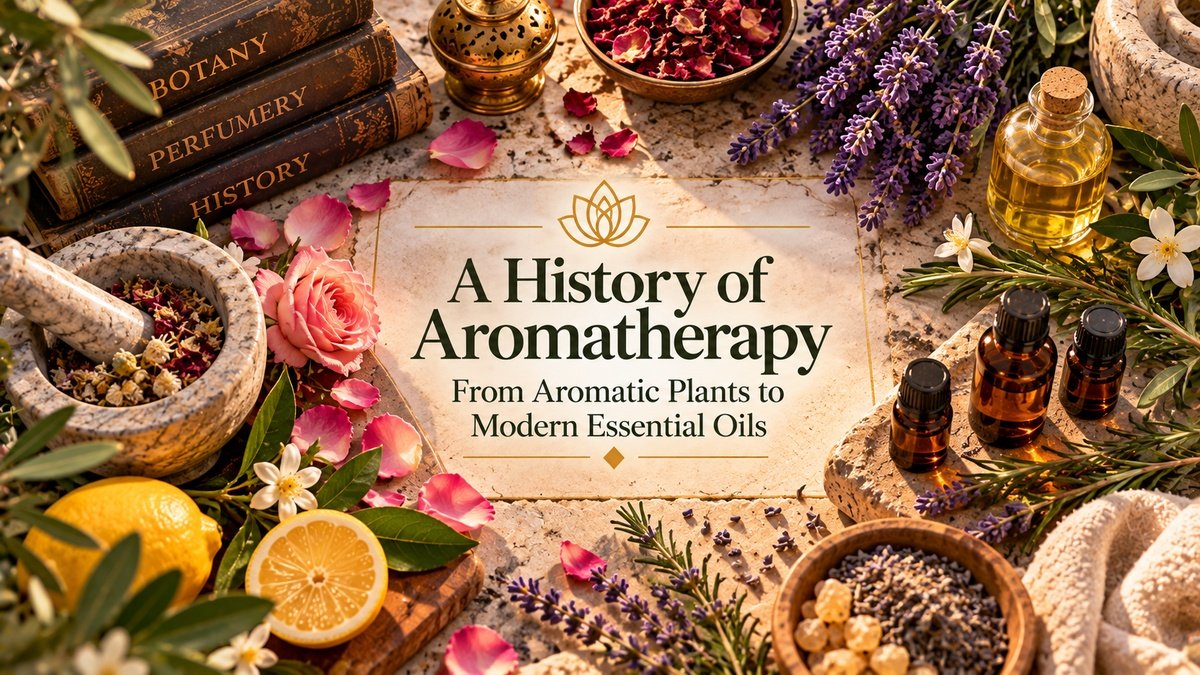
Long before anyone used the word aromatherapy, humans were burning fragrant woods, crushing aromatic leaves, preparing botanical oils, making perfumes and surrounding important moments with scent.
Resins smouldered in temples. Flowers infused oils and cosmetics. Aromatic plants appeared in medicines, bathing traditions, domestic preparations and funerary rituals. Traders transported precious fragrant materials across considerable distances.
Yet none of this means that people in the ancient world were practising aromatherapy exactly as we understand it today.
That distinction is fundamental to the history of aromatherapy.
The human use of aromatic plants is ancient. Modern aromatherapy is not.
Between those two statements lies a much richer history involving botany, medicine, religion, perfumery, trade, distillation, chemistry and, eventually, the twentieth-century development of a practice explicitly called aromatherapy.
Before Aromatherapy, There Were Aromatic Plants
Humans encountered fragrant plants long before they could isolate the volatile mixtures that we now call essential oils.
Aromatic leaves, flowers, woods, gums and resins could be burned, crushed, steeped, infused, fermented or incorporated into fats and oils.
These materials served many purposes.
People used fragrance to adorn the body, perfume rooms and clothing, accompany religious ceremonies, prepare the dead, repel unwanted smells and create medicinal preparations.
Consequently, the early history of aromatic plants does not belong exclusively to medicine — or to what we now call wellness.
It also belongs to the histories of religion, cosmetics, hygiene, trade, status and sensory culture.
Understanding this broader context prevents us from projecting the modern category of aromatherapy backwards onto every historical use of a fragrant plant.
Ancient Egypt and the Culture of Fragrance
Ancient Egypt frequently appears at the beginning of popular histories of aromatherapy.
There is good reason to discuss it — but the terminology needs care.
Egyptians made extensive use of aromatic substances in cosmetics, ritual, embalming, perfumery and medicinal preparations.
Plant oils, resins and fragrant materials could form part of sophisticated preparations. Frankincense and myrrh, for example, became highly valued aromatic commodities in the ancient world.
Fragrance also carried religious and ceremonial significance.
However, an aromatic preparation from ancient Egypt should not automatically be described as an essential oil in the modern technical sense.
Infused oils, ointments, resins and incense are chemically and technologically different from the concentrated volatile products obtained through modern distillation or expression.
Ancient Egyptian aromatic culture therefore forms an important part of the story, but it is not evidence that modern aromatherapy already existed thousands of years ago.
Mesopotamia and the Trade in Aromatic Materials
Aromatic plants also formed part of medicinal, religious and domestic life across ancient Mesopotamia and the wider Near East.
Fragrant substances moved through extensive trading networks.
This matters because many desirable aromatic materials did not grow wherever people wanted to use them.
Resins, woods, spices and perfumes therefore became commodities as well as sensory materials.
The history of scent consequently follows routes of exchange between regions.
Materials travelled. Techniques travelled. Names changed. Preparations evolved.
Rather than imagining one civilisation inventing aromatherapy and passing it unchanged to the next, it is more accurate to see a long and complicated history of botanical knowledge, experimentation, commerce and cultural exchange.
Aromatic Plants in Ancient Greece and Rome
Greek and Roman writers documented numerous plants, perfumes and medicinal substances.
Fragrance occupied a place in bathing, medicine, cosmetics, religious observance and social life.
Writers associated with ancient medicine also described botanical preparations that later generations repeatedly copied, translated and reinterpreted.
Dioscorides, a Greek physician writing during the first century CE, compiled an influential account of medicinal substances in De Materia Medica.
His work discussed many aromatic plants and botanical preparations and remained influential for centuries.
Again, we should resist a tempting shortcut.
Dioscorides was not an aromatherapist in the contemporary professional sense.
His work belongs to ancient pharmacology and materia medica.
Nevertheless, texts such as his helped preserve and transmit knowledge about aromatic plants within later medical traditions.
India and Long Traditions of Aromatic Plants
The Indian subcontinent also developed extensive traditions involving aromatic and medicinal plants.
Plants, oils, woods, spices and incense appear across religious, domestic, cosmetic and medical contexts.
Ayurvedic traditions developed sophisticated systems for understanding medicinal substances, although those systems should not simply be relabelled as aromatherapy.
Likewise, the presence of incense or aromatic substances within Indian religious traditions does not make every such practice an early form of essential-oil therapy.
This distinction is especially relevant in contemporary yoga culture, where Ayurveda, yoga and aromatherapy are sometimes blended into one supposedly ancient system.
Historically, their relationships are more complicated.
They can intersect without being identical.
China and East Asian Botanical Traditions
Chinese medical and botanical traditions likewise developed extensive knowledge of aromatic plants.
Fragrant materials could appear within medicine, incense culture, personal care and ritual life.
Yet here too, the existence of historical plant medicine should not be treated as evidence for one universal ancient practice called aromatherapy.
Different medical traditions developed their own theories, classifications and methods.
Modern wellness culture sometimes removes an ingredient from these systems and presents it as though cultures around the world independently shared the same essential-oil philosophy.
The historical record is considerably more diverse.
The Importance of Distillation
A major change in the history of aromatic materials came through developments in distillation.
Distillation allows volatile substances to be separated from plant material and collected.
Forms of distillation have a long and complex technological history, and the process developed gradually rather than appearing through one isolated invention.
Different cultures contributed to the development and refinement of distillation technologies.
This history matters because the familiar bottle of essential oil depends on extraction technology.
A bunch of lavender, a lavender infusion and steam-distilled lavender essential oil all originate from the same plant, but they are not the same preparation.
As distillation became increasingly sophisticated, people gained access to more concentrated aromatic materials.
Arabic and Islamic Scholarship
Scientific and medical scholarship across the medieval Islamic world played an important role in preserving, translating, extending and transmitting knowledge concerning medicine, pharmacy, chemistry and botanical materials.
Distillation technologies also developed within this wider scientific environment.
The Persian polymath Ibn Sīnā, known in Latin Europe as Avicenna, is frequently mentioned in popular histories of aromatherapy.
Sometimes those accounts go further and claim that he “invented essential oils” or invented steam distillation.
Such statements oversimplify a much longer technological history.
Ibn Sīnā was unquestionably an enormously influential figure in medieval medicine and natural philosophy, but complex technologies rarely have one identifiable inventor.
His period nevertheless forms part of an important era in the refinement and transmission of pharmaceutical and distillation knowledge.
Rose Water, Perfume and Distilled Aromatics
Rose provides an especially useful example of the relationship between plants, distillation and fragrance.
Rose water became an important aromatic product across the Middle East and beyond.
Distillation could produce fragrant waters alongside small quantities of volatile aromatic material.
These developments contributed to traditions of perfumery, pharmacy and personal care.
They also remind us that the history of essential oils cannot be separated neatly from the history of hydrosols and fragrant waters.
Modern aromatherapy often focuses on the concentrated oil.
Historically, however, the aromatic water could itself be the valued product.
Aromatic Knowledge Reaches Medieval and Early Modern Europe
Medical and botanical knowledge circulated into medieval Europe through numerous routes, including translations of Arabic and classical texts.
Monasteries cultivated medicinal plants, apothecaries prepared botanical remedies and perfumers worked with increasingly diverse aromatic substances.
Later European herbals documented plants and their customary uses.
Figures such as John Gerard and Nicholas Culpeper became influential within the history of English herbalism.
Their works belong primarily to herbal medicine rather than aromatherapy, but they demonstrate the continuing importance of aromatic and medicinal plants in European health practices.
At the same time, perfume developed as its own sophisticated craft.
Medicine, pharmacy and fragrance remained interconnected in some contexts while increasingly developing specialised identities of their own.
Grasse and the European Perfume Industry
France became particularly important within European perfume culture.
Grasse, in Provence, developed into a major centre associated with fragrant plant cultivation and perfumery.
Lavender, jasmine, rose and other aromatic materials became part of an increasingly specialised fragrance industry.
Extraction techniques continued to develop as perfumers sought ways to capture delicate scents.
These developments matter to the history of aromatherapy because modern essential-oil practice did not emerge independently from the fragrance and cosmetics industries.
The knowledge of aromatic raw materials, extraction and formulation already had extensive commercial and technical foundations.
Chemistry Changes the Understanding of Essential Oils
During the eighteenth and nineteenth centuries, chemistry transformed how scientists investigated plant substances.
Rather than describing an aromatic material only through smell, appearance or traditional use, researchers increasingly studied its chemical composition.
Essential oils could contain numerous volatile compounds in different proportions.
As analytical chemistry developed, researchers began identifying constituents and investigating their properties.
This created another important shift.
An essential oil could now be understood simultaneously as a botanical product, a fragrance and a complex chemical mixture.
Modern aromatherapy inherited all three perspectives.
When Does Aromatherapy Actually Begin?
If aromatic plants have such an extensive history, when should we begin using the word aromatherapy?
The answer takes us to twentieth-century France.
French chemist and perfumer René-Maurice Gattefossé became an important figure in the investigation of essential oils.
His work explored their properties within a period when scientists and manufacturers were increasingly interested in the chemistry and potential applications of aromatic materials.
Gattefossé became closely associated with the French term aromathérapie, particularly through his 1937 publication Aromathérapie: Les Huiles Essentielles, Hormones Végétales.
This gives us a much more historically precise distinction:
the use of aromatic plants is ancient; aromatherapy as a named modern field developed during the twentieth century.
René-Maurice Gattefossé and the Famous Lavender Story
Almost every popular history of aromatherapy eventually tells the same dramatic story.
Gattefossé suffers a laboratory burn.
He plunges his injured hand into a container of lavender essential oil.
The burn heals remarkably well.
The experience inspires his investigation of essential oils and ultimately creates modern aromatherapy.
It is an excellent story.
It is also a good example of why wellness history requires source criticism.
Versions of the account vary, and later retellings have often transformed the incident into a polished origin story for an entire profession.
Gattefossé did investigate lavender and other essential oils, and his work genuinely matters to the development of modern aromatherapy.
However, we do not need a dramatic accident to explain that significance.
His sustained research and publications provide the more important historical contribution.
One anecdote should not replace the broader history.
Jean Valnet and French Aromatherapy
Another influential twentieth-century figure was the French physician Jean Valnet.
Valnet developed a strong interest in the medical applications of essential oils and became an important advocate for their therapeutic use.
His writing helped bring French approaches to aromatic medicine to a wider audience.
His 1964 book on aromatherapy became particularly influential and later appeared in English.
This strand of French practice often placed considerable emphasis on essential-oil chemistry and therapeutic applications.
That emphasis helps explain why the word aromatherapy can refer to quite different practices today.
A medically oriented French approach and a relaxing aromatherapy massage in a British spa may share essential oils while operating within very different professional frameworks.
Marguerite Maury and the Development of Aromatherapy Massage
Marguerite Maury became another significant figure in twentieth-century aromatherapy.
Her work contributed particularly to approaches that combined aromatic preparations with massage, skin care and individualised treatments.
This direction became influential in Britain.
It helped shape the form of aromatherapy that many people now recognise immediately: essential oils diluted into a carrier oil and incorporated into a massage or personalised well-being treatment.
This was an important development.
It moved aromatherapy beyond the investigation of essential oils as chemical or medicinal substances and towards a broader sensory and person-centred practice.
Massage, touch, aroma, environment and personal attention could now become part of the same experience.
The British Development of Aromatherapy
During the later twentieth century, aromatherapy expanded considerably in Britain.
Practitioners, educators and authors developed training programmes, professional organisations and increasingly formal approaches to practice.
Massage became especially prominent within British aromatherapy.
As a result, many people came to associate the word almost automatically with relaxation treatments using diluted essential oils.
This British development differed in emphasis from some French traditions, where practitioners had focused more heavily on essential-oil chemistry and medical applications.
Neither represents the entire history.
Instead, modern aromatherapy developed into several overlapping traditions with different ideas about purpose, method and professional scope.
Aromatherapy Becomes a Professional Practice
As interest increased, professional organisations began developing educational standards and codes of practice.
The International Federation of Aromatherapists, founded in Britain in the 1980s, became one of the organisations involved in professionalising the field.
Training increasingly included anatomy, physiology, essential-oil chemistry, blending, contraindications, consultation and safe practice.
This professional history deserves distinction from the retail market that developed alongside it.
A trained aromatherapy practitioner and someone selling scented products on social media may both use the word aromatherapy, yet their education, methods and scope can differ substantially.
The term itself does not establish competence.
From Complementary Therapy to Wellness Culture
By the late twentieth century, aromatherapy was moving beyond specialist practitioners.
Essential oils entered health shops, spas, beauty treatments and increasingly ordinary homes.
Books offered recipes for relaxation, sleep, concentration and massage.
Diffusers made ambient scent simple.
Later, internet retail and social media accelerated the process dramatically.
A practice that had once required access to specialist suppliers became available through mainstream shops and online marketplaces.
This accessibility changed aromatherapy.
It allowed many more people to enjoy aromatic materials, but it also separated essential-oil use from some of the safety knowledge traditionally included within professional training.
The Rise of the Essential-Oil Lifestyle
During the twenty-first century, essential oils increasingly became lifestyle products.
They appeared alongside yoga mats, crystals, candles, meditation accessories and other objects associated with contemporary wellness.
Language changed too.
Consumers encountered oils marketed for calm, grounding, abundance, immunity, detoxification, emotional release, hormonal balance and numerous other purposes.
Some descriptions drew on established aromatic traditions.
Others combined herbalism, complementary therapy, spirituality, psychology and contemporary marketing.
The result is the diverse landscape we now call aromatherapy.
It contains professional practice, domestic fragrance, complementary therapy, beauty culture, botanical interest, sensory ritual and commercial wellness — sometimes within the same bottle.
Did Ancient People Use Essential Oils Exactly as We Do?
Usually, no.
This is one of the most persistent misunderstandings in popular accounts of the history of aromatherapy.
An ancient text mentioning lavender, cedar, frankincense or myrrh does not automatically describe a modern essential oil.
The material might have been burned as incense, steeped in another oil, incorporated into an ointment, consumed as part of a preparation or used in ritual.
Extraction technology matters.
Concentration matters.
Historical context matters.
Calling every fragrant botanical preparation an “essential oil” can erase precisely the history we are trying to understand.
Does Traditional Use Prove That an Essential Oil Works?
Historical use can tell us that people valued a substance.
It can tell us how they prepared it, what they believed about it and which roles it played within a particular society.
That information is historically important.
It does not, by itself, establish that every attributed therapeutic effect is biologically effective.
Traditional knowledge and scientific evidence answer different questions.
Modern research can investigate a defined preparation, concentration, route of administration, comparison group and measurable outcome.
Historical evidence can tell us what people did and thought.
Respecting both requires us not to make one pretend to be the other.
Why the History of Aromatherapy Matters
History changes how we understand the bottle in front of us.
A small bottle of lavender essential oil may appear to be a simple natural product.
Behind it lies a much larger story.
There is the lavender plant itself.
There are agricultural practices, harvesting and distillation.
There is the history of perfume and pharmacy.
There is analytical chemistry.
There are twentieth-century French researchers and practitioners.
There is British complementary therapy.
There is the modern spa industry.
There is global retail, social media and contemporary wellness culture.
What now looks timeless is partly the product of very particular historical developments.
Aromatherapy Is Both Older and Younger Than It Appears
In one sense, the story is extremely old.
Humans have surrounded themselves with fragrant plants for thousands of years.
We have burned them, traded them, worn them, infused them, distilled them and attached meanings to their scents.
In another sense, aromatherapy is comparatively young.
The modern field developed through twentieth-century European work with essential oils and subsequently expanded through complementary therapy, massage, cosmetics and global wellness culture.
Holding those two histories together produces a more accurate account than saying simply that “aromatherapy has been practised for 5,000 years”.
An Orenna Perspective: Tradition Without Inventing Antiquity
Something does not need an uninterrupted history stretching back thousands of years to have value.
Lavender can smell beautiful without being presented as an ancient prescription for modern stress.
Rose can carry centuries of cultural association without every historical use becoming evidence for a therapeutic claim.
A contemporary aromatic ritual can also be genuinely contemporary.
At Orenna, this distinction matters.
Aroma can contribute to atmosphere, memory, preference and sensory experience without requiring an invented ancient lineage.
Understanding where a practice actually comes from does not diminish it.
It gives the practice context.
We can value the long human relationship with aromatic plants while recognising that modern aromatherapy is one particular chapter within that much larger story.
Continue Exploring Aromatherapy
Begin with our introduction to Aromatherapy, where we explore essential oils, hydrosols, scent, personal preference, safety and modern practice.
Next in The Orenna Journal, we turn to the substance at the centre of contemporary aromatherapy itself: essential oils.
What exactly is inside that small bottle? How does steam distillation work? Why are citrus oils produced differently? What is the difference between an essential oil, an absolute, a fragrance oil, an infused oil and a hydrosol?
Understanding the material itself gives us the foundation for everything that follows.
References & Further Reading
Gattefossé, René-Maurice. Aromathérapie: Les Huiles Essentielles, Hormones Végétales. Gattefossé’s twentieth-century work is central to the emergence of modern aromatherapy as a named field.
Valnet, Jean. The Practice of Aromatherapy. Valnet became an important figure in twentieth-century French approaches to the therapeutic use of essential oils.
Maury, Marguerite. The Secret of Life and Youth. Maury’s work contributed to the development of individualised aromatherapy and its relationship with massage and skin care.
International Federation of Aromatherapists. Historical and professional resources documenting the development of twentieth-century aromatherapy and professional practice.
Dioscorides. De Materia Medica. An important ancient source for understanding medicinal plants and botanical substances in the Greco-Roman world.
Royal Botanic Gardens, Kew. Botanical and historical resources provide context for aromatic plants, plant science and the movement of economically important botanical materials.
Tisserand, Robert and Young, Rodney. Essential Oil Safety: A Guide for Health Care Professionals. A modern reference for understanding essential-oil chemistry, exposure and safety.
National Library of Medicine / PubMed. Scientific literature provides contemporary research on essential oils, aromatic compounds, olfaction and aromatherapy while allowing historical claims to remain distinct from clinical evidence.