

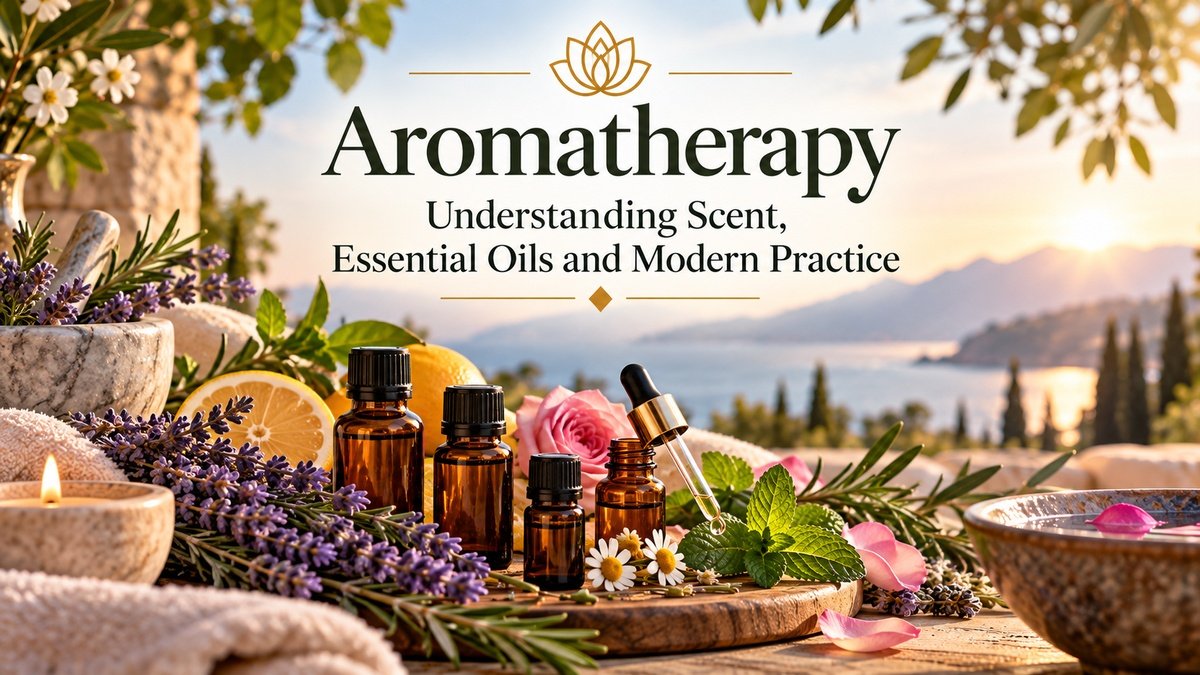
Lavender for calm.
Peppermint for clarity.
Citrus for brightness. Eucalyptus for freshness. Rose for comfort.
These associations have become familiar across spas, yoga studios, candles, pillow sprays, bath products and contemporary wellness culture.
They also make aromatherapy appear remarkably straightforward: choose an essential oil for the effect you want, breathe in its fragrance and allow the plant to do the rest.
The reality is more interesting.
Aromatic plants have long histories in medicine, perfumery, ritual, domestic life and personal care. Modern aromatherapy draws from parts of those histories, but it also developed through twentieth-century practices and contemporary wellness culture.
Meanwhile, smell genuinely interacts with perception, memory, emotion and behaviour. Essential oils also contain biologically active chemical compounds.
Neither fact means that every therapeutic claim made for an essential oil has been scientifically demonstrated.
So what exactly is aromatherapy?
What Is Aromatherapy?
Aromatherapy generally refers to the intentional use of aromatic plant materials, particularly essential oils, within practices intended to support comfort, relaxation or well-being.
People may inhale an aroma, diffuse it into a room or use appropriately diluted preparations on the skin.
However, the word covers a surprisingly broad range of practices.
A spa may describe a scented massage as aromatherapy. Someone at home may add a few drops of lavender essential oil to a diffuser. A practitioner may use carefully selected aromatic preparations within a structured consultation.
Retail products also use the term for everything from shower gels to candles.
Consequently, seeing the word aromatherapy on a product tells us relatively little about how someone prepared it, how they intend people to use it or what evidence supports its claims.
What Is an Essential Oil?
An essential oil is a concentrated mixture of volatile compounds obtained from aromatic plant material.
Depending on the plant, producers may use flowers, leaves, peel, wood, resin, roots or other parts.
Steam distillation produces many familiar essential oils. Citrus oils often come from mechanical expression of the peel, while some aromatic materials require other extraction methods.
The word essential does not mean that humans need these oils for health.
Instead, the terminology historically relates to the characteristic essence or aroma of the plant.
Essential oils are also not the same as ordinary vegetable oils such as olive, sunflower or sweet almond oil.
Their concentration and chemistry make that distinction particularly important for safe use.
Why Do Plants Produce Aromatic Compounds?
Plants do not produce aromatic molecules for human aromatherapy.
Volatile compounds can serve numerous ecological functions.
They may contribute to communication, defence or interactions with pollinators and other organisms.
Humans subsequently discovered that many of these materials have distinctive and appealing scents.
Over time, people learned to extract, preserve and combine aromatic substances for perfumes, cosmetics, medicines, religious practices and domestic use.
Modern aromatherapy represents one chapter in that much longer relationship between humans and aromatic plants.
Is Aromatherapy an Ancient Practice?
Humans have used aromatic plants for thousands of years.
Historical evidence documents fragrant woods, resins, flowers, oils and incense across numerous cultures, including ancient Egypt, Mesopotamia, Greece, Rome, India, China and the wider Mediterranean world.
People used aromatic materials in religious ritual, perfumery, funerary practices, medicine, bathing and domestic life.
However, this does not mean that ancient societies practised modern aromatherapy exactly as we understand it today.
Burning incense, preparing an infused botanical oil and using a bottle of steam-distilled essential oil are not identical practices.
The technologies, theories and cultural meanings surrounding them differ.
Therefore, the history of aromatic plants extends deep into antiquity, while modern aromatherapy has a much more recent history.
Where Did Modern Aromatherapy Come From?
The modern term aromathérapie became associated with the French chemist René-Maurice Gattefossé during the early twentieth century.
His work helped establish the word within discussions of aromatic plant extracts and essential oils.
Other twentieth-century writers and practitioners subsequently contributed to the development and popularisation of aromatherapy.
As the practice spread internationally, different approaches emerged.
Some emphasised massage and well-being. Others focused more heavily on the chemical constituents of essential oils or incorporated them into broader complementary-health systems.
Contemporary aromatherapy therefore does not represent one completely uniform method.
How Does Smell Work?
Aroma begins with molecules capable of reaching receptors within the olfactory system.
When we inhale, volatile molecules enter the nasal cavity and interact with olfactory receptors.
The nervous system processes those signals and contributes to our perception of smell.
Yet smelling is not simply a matter of detecting chemicals.
Context, memory, learning, culture and personal experience influence how we interpret an aroma.
The same fragrance can feel comforting to one person, unpleasant to another and almost unnoticeable to someone else.
This individual variation matters enormously in any sensory well-being environment.
Why Can Smell Feel So Connected to Memory?
A familiar fragrance can sometimes evoke a memory with remarkable immediacy.
The smell of a particular soap might recall childhood. Woodsmoke may evoke a particular place. A perfume can become strongly associated with a person.
Researchers have extensively explored the relationship between olfaction, memory and emotion.
However, the fact that odours can evoke autobiographical memories does not mean every aroma produces one predetermined emotional response.
Association develops through experience.
Lavender may remind one person of relaxation because they routinely use it before bed. Someone else may associate the same smell with a relative, workplace, hospital or cosmetic product.
Personal history therefore matters alongside the chemical composition of the aroma.
Does Lavender Make Everyone Relax?
No aroma produces exactly the same subjective response in everyone.
Lavender has become strongly associated with relaxation, sleep and calm within contemporary aromatherapy and consumer culture.
Researchers have also investigated lavender preparations in relation to several outcomes.
However, the evidence varies according to the preparation, dose, route of administration, population and outcome being studied.
That complexity makes broad statements such as “lavender reduces anxiety” less precise than they initially appear.
Someone may nevertheless find the smell of lavender deeply relaxing.
That personal response remains valid without requiring us to claim that lavender inevitably produces the same physiological effect in every person.
What About Peppermint, Citrus and Eucalyptus?
Contemporary aromatherapy gives many essential oils characteristic profiles.
Peppermint commonly appears in discussions of freshness, alertness and concentration.
Citrus aromas often carry associations with brightness, energy and uplift.
Eucalyptus frequently suggests clarity and freshness, partly because of its distinctive penetrating aroma and its long presence in respiratory products.
These associations can arise from several sources at once: chemical characteristics, cultural learning, product marketing, previous experience and traditional use.
We should therefore avoid treating a list of essential oils and emotional outcomes as though it were a pharmacological prescription chart.
What Is the Difference Between an Essential Oil and a Hydrosol?
Essential oils are not the only aromatic botanical materials available.
Steam distillation can also produce an aromatic water known as a hydrosol or floral water.
Rose water and orange blossom water provide familiar examples, although genuine hydrosols differ from simply adding essential oil or fragrance to water.
Hydrosols contain water-soluble aromatic constituents and usually offer a much gentler aromatic profile than concentrated essential oils.
They nevertheless remain botanical preparations rather than chemically inert water.
Quality, storage, contamination risk and individual sensitivity still matter.
Natural Does Not Automatically Mean Safe
Plants produce chemically active substances.
That is one reason humans find them interesting.
It is also why the word natural cannot function as a synonym for harmless.
Essential oils can irritate skin, trigger sensitisation or cause adverse reactions when people use them incorrectly.
Some oils create additional concerns in particular circumstances. Certain expressed citrus oils, for example, can increase photosensitivity when applied to the skin.
Children, pregnancy, respiratory sensitivity, allergies, medications, pets and particular health conditions can also require additional consideration depending on the product and route of use.
Concentration matters.
Route of exposure matters.
Individual circumstances matter.
Should Essential Oils Be Applied Directly to the Skin?
Routine undiluted application of essential oils deserves caution.
Because essential oils are concentrated substances, topical preparations commonly use an appropriate carrier and dilution.
The suitable concentration depends on the oil, purpose, area of application and individual circumstances.
More is not necessarily better.
A stronger aroma or higher concentration does not automatically create a more effective experience.
Indeed, excessive exposure can turn an enjoyable sensory element into irritation or discomfort.
Can You Put Essential Oils in Water?
Essential oils do not simply dissolve in water.
Adding drops to a glass, bath or spray bottle does not necessarily distribute them evenly.
Undispersed droplets can remain concentrated and come into direct contact with skin or mucous membranes.
This is one reason apparently simple DIY recipes can require more knowledge than their ingredient lists suggest.
Aromatic waters, professionally formulated products and essential-oil mixtures are not interchangeable merely because all of them smell botanical.
Should Essential Oils Be Swallowed?
Casual ingestion of essential oils carries significantly different considerations from smelling an aroma.
Essential oils are concentrated chemical mixtures, and oral exposure can create toxicity, irritation and medication-interaction concerns.
Online advice sometimes presents ingestion as a natural extension of aromatherapy.
That assumption is unsafe.
Someone should not infer that an oil is suitable for internal use simply because the original plant appears in food or tea.
The concentration and route of exposure differ substantially.
Can Aromatherapy Treat Anxiety, Depression or Insomnia?
Researchers have investigated aromatherapy and individual aromatic preparations in relation to anxiety, sleep, pain and other outcomes.
Some studies report promising findings, while methodological limitations, small samples, variation between interventions and differences in study quality make broad conclusions difficult.
More importantly, enjoying a calming aroma is not equivalent to treating an anxiety disorder.
A bedtime fragrance is not automatically a treatment for persistent insomnia.
A pleasant sensory environment can form part of someone’s well-being routine without replacing appropriate healthcare.
This distinction protects both the individual and the integrity of the practice.
Does Aromatherapy Affect the Nervous System?
Smell involves the nervous system, so aromatic experiences clearly involve neural processing.
That basic fact, however, does not justify every claim made about “regulating the nervous system”.
A person may find a familiar scent comforting or relaxing. Researchers may also measure changes in particular physiological or psychological outcomes under defined conditions.
Those observations require careful interpretation.
Statements that an essential oil automatically “activates the parasympathetic nervous system”, “resets the vagus nerve” or moves everyone from one nervous-system state into another can exceed the evidence.
Human responses depend on far more than the presence of one aroma.
Why Personal Preference Matters
Aroma differs from many other environmental choices because people cannot simply stop hearing or seeing it once someone disperses it through a shared space.
For that reason, consent matters.
A scent that one person finds luxurious may give another person a headache, trigger nausea or evoke an unwanted memory.
Someone else may simply dislike it.
None of these responses needs justification.
A well-designed sensory environment therefore asks rather than assumes.
Unscented should remain a genuine option, not a lesser version of the experience.
Is More Fragrance Better?
No.
Olfactory adaptation means that our perception of an odour can diminish after continued exposure.
This can tempt someone to add more fragrance because they no longer notice it as strongly.
Another person entering the room may experience the same concentration as overwhelming.
Subtle use often creates a more considered sensory environment than saturating a space with fragrance.
In a personalised setting, the objective does not need to be making the room “smell like a spa”.
The aroma can remain quiet enough to support the environment rather than dominate it.
Does Expensive Mean Better?
Price alone does not establish quality.
Botanical species, plant part, geographical origin, harvest conditions, extraction method, storage and supply-chain integrity can all influence an aromatic material.
Adulteration and inaccurate labelling also present genuine quality concerns within the essential-oil market.
Conversely, marketing terms such as “therapeutic grade” can sound scientifically authoritative without representing a universal independent grading system.
Useful purchasing information includes the botanical name, plant part, extraction method, appropriate batch information and a reputable supplier who provides transparent safety guidance.
What Role Can Aromatherapy Have in Yoga?
Aroma can form part of a yoga environment, but yoga does not require essential oils.
Someone may enjoy a subtle botanical scent during a quiet restorative or contemplative practice.
Another person may prefer completely neutral air.
Using lavender does not make a practice more restorative, and using incense does not make it more traditional.
Likewise, a particular aroma should not become a substitute for appropriate teaching, adaptation, comfort or consent.
The sensory environment supports the practice rather than defining it.
How Does Orenna Approach Aromatherapy?
At Orenna, aroma is treated as an optional sensory choice, not as a treatment.
The purpose is not to diagnose what someone needs from the smell of a plant or prescribe an essential oil for a physical or psychological condition.
Instead, a guest may choose whether aroma forms part of the environment at all.
When included, the emphasis remains on subtle scent, personal preference and an appropriately considered preparation.
A guest might choose an aroma because they enjoy it, because it evokes a particular atmosphere or because they associate it personally with rest.
Another guest may choose no fragrance.
Both choices are equally complete.
A Better Way to Understand Aromatherapy
Rather than treating every aromatic claim as either proven medicine or meaningless fragrance, several layers can remain distinct.
Botanical: Which plant produced the aromatic material?
Chemical: Which compounds does the preparation contain?
Historical: How have people used this plant or aromatic material across different periods and cultures?
Sensory: What does the person actually smell and notice?
Associative: Which memories, meanings or expectations accompany that aroma?
Scientific: Which specific effects have researchers tested, using which preparation, dose, route and population?
Personal: Does this individual actually enjoy the scent?
These questions produce a more useful understanding of aromatherapy than assuming every bottle has one universal emotional function.
An Orenna Perspective: Scent Without Prescription
Aroma can change how a space feels.
A trace of rose may make one environment feel soft and familiar. Citrus may feel bright. Lavender may signal that the day is slowing down.
But those responses belong to a relationship between aroma, person and context.
The bottle does not need to diagnose the person.
Nor does every fragrance need a therapeutic promise attached to it.
Sometimes scent can simply be scent: carefully chosen, personally meaningful and quietly present.
A considered sensory experience begins not by asking which aroma a person needs, but whether they would like aroma at all.
Continue Exploring Aromatherapy
This article begins a new Orenna Journal series exploring scent and aromatic practice in greater depth.
Next, we will examine the history of aromatherapy: from aromatic plants, resins and perfumes in earlier cultures to distillation, twentieth-century aromatherapy and today’s global wellness industry.
Later articles will explore essential oils and hydrosols, scent and emotional experience, aromatherapy safety, and what contemporary scientific evidence can — and cannot — tell us about aromatic practices.
References & Further Reading
National Center for Complementary and Integrative Health (NCCIH). Evidence-based information on complementary health approaches and the evaluation of essential-oil and aromatherapy claims.
Tisserand, Robert and Young, Rodney. Essential Oil Safety: A Guide for Health Care Professionals. A detailed reference concerning essential-oil constituents, exposure, contraindications and safe-use considerations.
International Federation of Aromatherapists. Professional information concerning aromatherapy practice, education and safety.
Royal Botanic Gardens, Kew. Botanical resources provide authoritative information about plant identification, taxonomy and the wider scientific study of plants.
Herz, Rachel S. Research on olfaction, emotion, memory and individual experience provides important context for understanding why smell can carry powerful personal associations.
National Library of Medicine / PubMed. Research literature includes clinical and experimental studies investigating aromatherapy, essential oils, olfaction and specific health or well-being outcomes.