
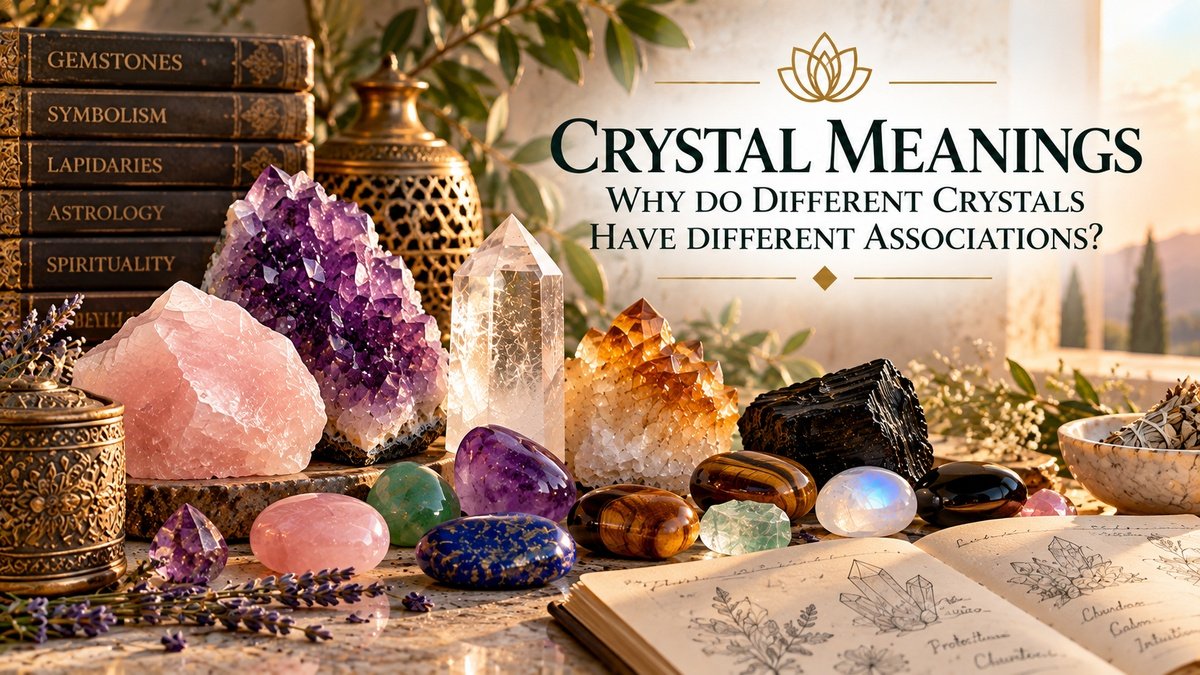
Walk into a crystal shop and the stones may appear to come with their own vocabulary.
Rose quartz means love.
Amethyst means calm or spirituality.
Citrine represents abundance.
Black tourmaline offers protection.
Clear quartz amplifies intention.
The associations have become so familiar that they can seem like properties waiting inside the minerals to be discovered.
But where do these crystal meanings actually come from?
Who decided what each crystal represents? Are the meanings ancient? Do different cultures agree? And why can two crystal books give entirely different interpretations of the same stone?
The answer begins with an important distinction.
A crystal has physical properties. A crystal can also acquire human meanings. Those are not the same thing.
What Do We Mean by Crystal Meanings?
When people discuss crystal meanings, they are usually referring to qualities, intentions or symbolic associations attributed to particular stones.
A crystal might be associated with love, protection, courage, abundance, clarity, grounding or intuition.
Modern sources may go further. They might connect a stone with a chakra, planet, zodiac sign, element, emotion or part of the body.
These associations belong to systems of interpretation.
By contrast, mineralogical properties describe characteristics such as chemical composition, crystal structure, hardness, cleavage, colour and optical behaviour.
Rose quartz really is a variety of quartz.
Its association with romantic or compassionate love belongs to another category.
That does not make symbolism meaningless. It simply means that geology and symbolism answer different questions.
Who Decided What Crystals Mean?
There is no single person, book or civilisation that created the complete system used by modern crystal culture.
Instead, today’s meanings emerged through layers of history.
Ancient and medieval cultures developed their own traditions concerning precious stones, amulets, medicine, astrology, religion and protection.
Later lapidaries recorded supposed properties of stones.
Western esoteric traditions created additional correspondences. During the twentieth century, New Age spirituality increasingly brought together crystals, chakras, colour symbolism, astrology and ideas about subtle energy.
Modern books, shops and websites then helped standardise particular associations.
As we explored in A History of Crystals, this is not one unchanged tradition travelling intact from antiquity to the present.
It is a history of transmission, reinterpretation and reinvention.
Are Crystal Meanings Ancient?
Some associations have historical precedents.
Others are relatively recent.
Still others combine an older association with a much newer interpretation.
For example, amethyst has a long historical connection with sobriety and protection from intoxication. Contemporary crystal culture more commonly associates it with meditation, calm, intuition and spirituality.
Both belong to the history of the stone, but they do not come from exactly the same context.
Similarly, a gemstone may have played an important role within an ancient culture without carrying the precise meaning assigned to it by a contemporary crystal guide.
Therefore, the phrase used for thousands of years requires context.
Ancient use does not necessarily mean ancient use for the same purpose.
Why Does Colour Influence Crystal Meanings?
Colour is one of the easiest ways for humans to create symbolic associations.
Pink can suggest tenderness or affection. Green may evoke vegetation and growth. Yellow and gold can suggest sunlight, warmth or prosperity. Black may suggest protection, boundaries or absorption.
These associations are not universal, however.
Colours acquire different meanings across cultures and historical periods.
Nevertheless, colour has strongly influenced modern crystal interpretation.
It also helps explain why contemporary chakra-and-crystal charts appear intuitive. Once chakras receive rainbow colours, stones of corresponding colours can be placed alongside them.
Yet, as discussed in our introduction to crystals, that familiar system represents a modern synthesis rather than one universal ancient yogic map.
Why Do Crystal Books Disagree?
Because there is no universally authoritative dictionary of crystal symbolism.
Different writers inherit different sources. Some emphasise historical folklore. Others use astrology, chakras, colour correspondences, intuitive interpretation or modern metaphysical systems.
Commercial culture adds another layer.
Once a particular association becomes popular, subsequent books and websites may repeat it without identifying where it originated.
Eventually, repetition can create the appearance of consensus.
That is why one source might describe a stone as calming while another calls it energising.
The disagreement does not necessarily mean that one author has discovered the mineral’s “true” meaning.
It may instead reveal that crystal meaning is interpretive.
Rose Quartz: Love, Affection and Gentleness
Rose quartz is among the most recognisable crystals in contemporary wellness culture.
Its pale-to-deeper pink colouring has become strongly associated with love.
Modern crystal guides frequently extend that symbolism to affection, compassion, emotional gentleness, relationships and what is often called “self-love”.
The visual association is powerful. Pink already carries meanings connected with affection within many contemporary Western contexts.
Someone might therefore choose rose quartz as a symbolic reminder of tenderness, kindness or a relationship that matters to them.
However, saying that rose quartz symbolises love differs from saying that it emits a scientifically demonstrated frequency that produces love or heals emotional wounds.
The first is symbolic interpretation.
The second is a claim about causation.
Common modern associations: love, compassion, tenderness, relationships and emotional gentleness.
Amethyst: Calm, Meditation and Spirituality
Amethyst is the purple variety of quartz.
Its historical associations are particularly interesting because they demonstrate how crystal meanings change.
The name derives through Greek from amethystos, associated with not being intoxicated. Amethyst subsequently developed a long-standing connection with sobriety.
Modern crystal culture places greater emphasis on calm, meditation, intuition, sleep and spiritual awareness.
Its purple colour also fits easily within contemporary systems that associate violet with the crown chakra.
Someone may therefore choose amethyst as an object associated with quiet reflection or meditation.
That symbolism should remain distinct from claims that amethyst treats insomnia, anxiety or another health condition.
Common modern associations: calm, meditation, intuition, spirituality and rest.
Clear Quartz: Clarity and Amplification
Clear quartz occupies an unusual position because genuine physical properties of quartz often become intertwined with metaphysical explanations.
Modern crystal culture commonly associates clear quartz with clarity, intention and amplification. It is sometimes called a “master healer”.
Quartz does possess measurable physical properties, including piezoelectric behaviour under particular conditions.
That does not establish that a hand-held quartz point amplifies thoughts, intentions or the properties of surrounding crystals.
Someone can nevertheless use its transparency as a symbol of clarity or focus.
The symbolism does not require a technological explanation.
Common modern associations: clarity, focus, intention and amplification.
Citrine: Abundance, Confidence and Optimism
Citrine is a yellow-to-orange variety of quartz.
Its warm colouring lends itself easily to associations with sunlight, optimism and vitality.
Modern crystal culture frequently extends those ideas towards confidence, prosperity and abundance.
Citrine is consequently common in practices concerned with intention-setting around work, creativity or finances.
However, keeping citrine on a desk does not provide evidence that the mineral itself attracts money or changes financial outcomes.
It can instead function as a symbolic reminder of an intention or priority.
There is also a practical purchasing issue. Much of the material marketed commercially as citrine consists of heat-treated amethyst rather than naturally coloured citrine.
Treatment does not necessarily make a specimen undesirable, but accurate labelling matters.
Common modern associations: abundance, optimism, confidence, creativity and prosperity.
Black Tourmaline: Protection and Grounding
Black tourmaline has become one of the principal protective stones of contemporary crystal culture.
It is commonly associated with grounding, boundaries and protection from “negative energy”.
Some modern claims go further and suggest protection from electromagnetic fields or radiation.
That distinction matters.
Using a dark, substantial stone as a symbol of personal boundaries or steadiness is one thing.
Claiming that placing black tourmaline beside electronic equipment provides meaningful electromagnetic shielding is a measurable physical claim.
The latter requires appropriate evidence rather than symbolic correspondence.
Common modern associations: protection, grounding, boundaries and stability.
Obsidian: Protection, Reflection and the ‘Shadow’
Obsidian differs from many familiar crystals because it is volcanic glass rather than a mineral crystal in the strict mineralogical sense.
It forms when silica-rich lava cools rapidly enough to prevent substantial crystal growth.
Nevertheless, crystal shops routinely include obsidian within the broader commercial category of crystals.
Modern interpretations commonly associate it with protection, grounding, truth and confronting what may be hidden.
Some contemporary spiritual sources connect black obsidian with “shadow work”.
That language represents a modern interpretive development and should not automatically be projected onto every historical culture that used obsidian.
Historically, humans also valued obsidian for extremely practical reasons: it can fracture into exceptionally sharp edges.
Common modern associations: protection, grounding, reflection, truth and introspection.
Moonstone: Cycles, Intuition and New Beginnings
Moonstone is a feldspar gemstone known for an optical phenomenon called adularescence, which can create a floating, moon-like glow across the surface.
Its appearance provides an obvious route towards lunar symbolism.
Modern crystal culture commonly associates moonstone with intuition, cycles, transition and new beginnings.
It is also frequently connected with femininity.
That last association deserves care.
Symbolic relationships between the moon, menstrual cycles and femininity occur in various cultural contexts, but they should not become deterministic claims about what women are or how bodies should function.
A person of any gender may find lunar or cyclical symbolism meaningful.
Common modern associations: cycles, intuition, transition, reflection and new beginnings.
Lapis Lazuli: Wisdom, Status and Expression
Lapis lazuli has an exceptionally rich material history.
Its intense blue made it highly valued across ancient trade networks, including in Mesopotamian and Egyptian contexts.
Historically, lapis could signify wealth, prestige and religious importance.
Its story therefore extends far beyond contemporary crystal practice.
Modern crystal culture commonly associates lapis lazuli with wisdom, truth, communication and self-expression.
It is also frequently assigned to the throat or third-eye chakra because of its colour.
Those modern chakra correspondences should remain distinct from the documented ancient uses of lapis.
Common modern associations: wisdom, truth, communication, expression and insight.
Carnelian: Vitality, Courage and Creativity
Carnelian is an orange-to-reddish variety of chalcedony with a long history of use in jewellery, beads, seals and engraved objects.
Its warm colour has helped make it a natural candidate for associations with vitality and activity.
Contemporary crystal guides often connect carnelian with courage, confidence, motivation and creativity.
It is also commonly assigned to the sacral chakra within modern chakra systems.
Again, the historical use of carnelian and its contemporary chakra correspondence belong to different layers of interpretation.
Common modern associations: vitality, courage, confidence, creativity and motivation.
Turquoise: Protection, Travel and Communication
Turquoise has been valued across multiple cultures and historical periods.
It appears in jewellery and decorative traditions from regions including Egypt, Persia, Central Asia and the Americas.
Its meanings cannot therefore be reduced to one universal tradition.
Protection is one recurring association in various contexts, while contemporary crystal culture also connects turquoise with communication, expression and travel.
Its blue-to-green colouring makes it an easy fit for modern throat-chakra correspondence systems.
However, those contemporary associations should not overwrite the distinct meanings turquoise holds within particular Indigenous and historical cultures.
Common modern associations: protection, communication, travel, expression and good fortune.
Jade: Value, Virtue and Good Fortune
Jade demonstrates particularly clearly why cultural context matters.
The term commonly refers to jadeite or nephrite, two distinct mineral materials.
Jade has carried profound cultural significance in China and other parts of East and Southeast Asia, with histories extending far beyond contemporary Western crystal culture.
Its importance has included beauty, status, craftsmanship, ritual significance and associations with virtues and longevity.
Modern crystal guides often simplify jade into a “luck” or “abundance” stone.
Although good-fortune associations have historical contexts, reducing jade to a single metaphysical keyword loses much of its cultural complexity.
Common modern associations: good fortune, prosperity, harmony and longevity.
Tiger’s Eye: Courage, Confidence and Focus
Tiger’s eye is recognised for its golden-brown colouring and distinctive band of reflected light known as chatoyancy.
The visual resemblance to an eye provides an intuitive foundation for protective and watchful symbolism.
Modern crystal culture commonly associates tiger’s eye with courage, confidence, focus and grounded decision-making.
Its appearance likely contributes substantially to those interpretations.
As elsewhere, symbolism can provide a meaningful personal association without establishing a specific physiological effect.
Common modern associations: courage, confidence, focus, protection and grounded action.
Selenite: Clarity, Cleansing and Spirituality
Selenite is a crystalline variety of gypsum.
Its pale, translucent appearance and name — connected historically with the moon — make it particularly suited to modern symbolism around light and clarity.
Contemporary crystal culture frequently describes selenite as cleansing other crystals or clearing negative energy.
Some people therefore place other stones beside it as part of a ritual practice.
This can function symbolically.
However, claims that selenite physically removes an unidentified harmful energy require evidence if presented as measurable fact.
Selenite also requires practical care because gypsum is relatively soft and should not routinely be treated like a hard quartz specimen.
Common modern associations: clarity, cleansing, peace and spiritual awareness.
Malachite: Transformation and Change
Malachite is immediately recognisable through its intense green colour and distinctive banding.
Humans have valued it since antiquity as a pigment, decorative material and source of copper.
Modern crystal culture commonly associates malachite with transformation, change, protection and emotional development.
Its vivid green also encourages associations with the heart chakra in contemporary systems.
However, malachite provides an important reminder that “natural” does not mean harmless.
It is a copper carbonate mineral. Dust from cutting or grinding malachite should not be inhaled, and unsupported advice involving ingestion or improvised crystal preparations should be avoided.
Common modern associations: transformation, change, protection and growth.
Fluorite: Focus, Order and Mental Clarity
Fluorite can occur in several colours, including purple, green, blue and yellow.
Its striking geometry and colour zoning make it particularly attractive to collectors.
Modern crystal sources frequently associate fluorite with organisation, concentration and mental clarity.
Someone might therefore place a piece on a desk as a symbolic cue for focused work.
That use is quite different from claiming that fluorite chemically or energetically changes cognitive function merely by being nearby.
Common modern associations: focus, organisation, clarity and concentration.
Can One Crystal Have Several Meanings?
Yes — and most do.
The expectation that every crystal should correspond to one precise concept is largely a product of simplified reference systems.
A stone can accumulate meanings from several periods and communities.
One interpretation may arise from colour. Another from its name. Another from historical folklore. Astrology may contribute another correspondence, while contemporary chakra systems add yet another.
Personal experience can then add something entirely individual.
For someone who inherited an amethyst ring from a grandmother, the stone may represent that relationship more strongly than any meaning found in a crystal dictionary.
Personal symbolism does not need to be universal to be meaningful.
Can You Choose a Crystal by Meaning?
You can, provided the meaning is understood as a framework for selection rather than a guaranteed outcome.
Someone exploring an intention around tenderness might choose rose quartz because its contemporary symbolism resonates with that idea.
Another person might choose a completely different stone because of its colour, texture or personal significance.
Neither choice requires the stone to control the outcome.
In this sense, a crystal can function much like another symbolic object.
It gives an intention a physical form.
What About Crystals for Anxiety, Sleep or Health?
This is where language needs to change.
Choosing a stone associated with calm is not the same as treating anxiety.
Using amethyst within an evening ritual is not the same as treating insomnia.
Carrying a crystal as a personal reminder of steadiness is not evidence that the stone regulates the nervous system.
Once a claim moves from symbolism or subjective experience into the diagnosis, prevention or treatment of a health condition, a different evidential standard applies.
Crystals should not replace appropriate healthcare.
Our later article on evidence will examine these distinctions in much greater detail.
Do You Have to Believe a Crystal’s Meaning?
No.
Someone may engage with crystal symbolism spiritually.
Another person may approach it psychologically, treating a stone as a reminder of an intention.
Someone else may simply appreciate mineralogy, colour and natural form.
There is no requirement to convert aesthetic appreciation into metaphysical belief.
Nor does respecting someone’s symbolic practice require presenting every explanation as scientifically established.
Several relationships with the same object can coexist.
How to Read a Crystal Meaning More Carefully
When you encounter a statement about what a crystal “means”, try asking several questions.
Is this a historical association?
If so, from which culture and period?
Is it a modern metaphysical association?
If so, how recently does it appear?
Is it symbolic?
The meaning may derive from colour, appearance, name or cultural association.
Is it personal?
The stone may hold meaning because of an individual memory or intention.
Or is someone making a scientific or medical claim?
If so, appropriate evidence becomes necessary.
These questions allow curiosity without collapsing every type of knowledge into the same category.
An Orenna Perspective: Meaning Is a Relationship
Perhaps a crystal does not need one final definition.
A geologist can describe what it is.
A historian can investigate what different people believed about it.
A jeweller can understand how to work with it.
A collector can appreciate its rarity.
And an individual can decide what it represents to them.
Those perspectives do not have to compete.
The difficulty begins when one kind of statement disguises itself as another — when symbolism becomes anatomy, metaphor becomes physics or personal experience becomes universal proof.
We can preserve the beauty of meaning without making that leap.
A crystal does not need to contain a universal meaning for us to create a meaningful relationship with it.
Continue Exploring Crystals
Begin with Crystals: Understanding the Stones, Meanings and Modern Practices for an introduction to geology, symbolism and contemporary crystal practice.
Then explore A History of Crystals: From Precious Stones to Modern Crystal Culture to see how humans have interpreted remarkable stones across different periods and traditions.
Next, we will investigate one of the most recognisable systems in contemporary wellness culture:
Crystals, Chakras and Energy: Where Do These Ideas Come From?
There we will separate historical Indian subtle-body traditions from the later rainbow chakra system, examine how particular crystals became paired with particular chakras and ask what people actually mean when they describe a stone as carrying “energy”.
References & Further Reading
The British Museum. Collections and research relating to gemstones, jewellery, amulets, seals and precious materials across different historical cultures.
The Metropolitan Museum of Art. Collection research concerning ancient jewellery, Egyptian amulets, gemstones and decorative materials.
Smithsonian National Museum of Natural History. Mineralogical resources useful for distinguishing the physical properties of minerals and gemstones from later symbolic associations.
Pliny the Elder. Natural History. An important primary source for classical discussions of stones and their attributed properties, to be read within its historical intellectual context.
Kunz, George Frederick. The Curious Lore of Precious Stones. An influential early twentieth-century compilation of historical gemstone folklore. Useful as a source in the history of modern gemstone interpretation rather than as scientific evidence for the properties it records.
Hanegraaff, Wouter J. Scholarship on Western esotericism and New Age religion provides context for understanding how modern metaphysical systems developed and combined earlier traditions.
Mallinson, James and Singleton, Mark. Roots of Yoga. Penguin Classics. Useful for distinguishing historical Indian yogic and subtle-body systems from later modern crystal-and-chakra correspondences.