A piece of quartz can be several things at once.
To a geologist, it is a crystalline mineral with a particular chemical composition and structure.
To a jeweller, it may be a material valued for its appearance, durability and craftsmanship.
For someone else, it may be a treasured object associated with a person, place, memory or intention.
And within contemporary wellness culture, the same stone may be described as carrying energy, supporting meditation, attracting love or offering protection.
These descriptions often appear together. Yet they do not represent the same kind of claim.
Understanding crystals therefore requires more than learning which stone supposedly corresponds to love, calm, confidence or abundance.
We need to begin somewhere more fundamental:
What is a crystal — and how did a geological structure become an object of symbolism, spirituality and modern wellbeing?
What Is a Crystal?
In scientific terms, a crystal is a solid whose constituent particles — such as atoms, ions or molecules — have an ordered internal arrangement.
That repeating structure distinguishes crystalline materials from substances whose internal organisation lacks the same long-range order.
Crystals can form naturally through geological and other physical processes. They can also be produced synthetically under controlled conditions.
Quartz is one familiar example. Its chemical composition is silicon dioxide, written SiO₂.
However, the word crystal has acquired a broader meaning in contemporary culture.
Crystal shops may use the term for polished stones, mineral specimens, gemstones, carved objects and materials that consumers collectively understand as “healing crystals”.
As a result, the commercial category called crystals does not always correspond neatly to the scientific definition of a crystal.
Are Crystals and Minerals the Same Thing?
Not exactly.
A mineral is a naturally occurring substance that meets particular geological criteria, including a characteristic chemical composition and ordered structure.
A crystal, meanwhile, describes a type of structural organisation.
Many familiar objects sold as crystals are mineral specimens. Quartz, for example, is a mineral that forms crystals.
Nevertheless, the everyday language of crystal collecting and wellness is less technical. Terms such as crystal, stone, gem and mineral often overlap in conversation even though geology and gemmology distinguish them more carefully.
That difference in vocabulary is useful to remember when moving between scientific information and contemporary crystal culture.
How Do Crystals Form?
Natural crystals form when physical and chemical conditions allow their constituent particles to organise into ordered structures.
The exact process depends on the material and environment.
Some crystallise as molten rock cools. Others develop from mineral-rich fluids or through geological processes involving heat, pressure and chemical change.
Growth conditions influence the resulting specimen. Temperature, pressure, available chemical components, surrounding rock and the space available for growth can all matter.
This geological history helps explain why natural specimens differ so dramatically in colour, clarity, inclusions, size and shape.
The result can appear extraordinarily deliberate.
Yet geometric beauty does not require someone to have designed the crystal. Ordered physical processes can produce remarkable natural structures.
Why Do Crystals Have Different Colours?
Colour can arise from several factors.
The underlying chemical composition matters, but trace elements, structural effects, defects within the crystal lattice and exposure to natural radiation can also influence appearance.
Quartz provides a useful example because the same mineral family can appear in strikingly different forms.
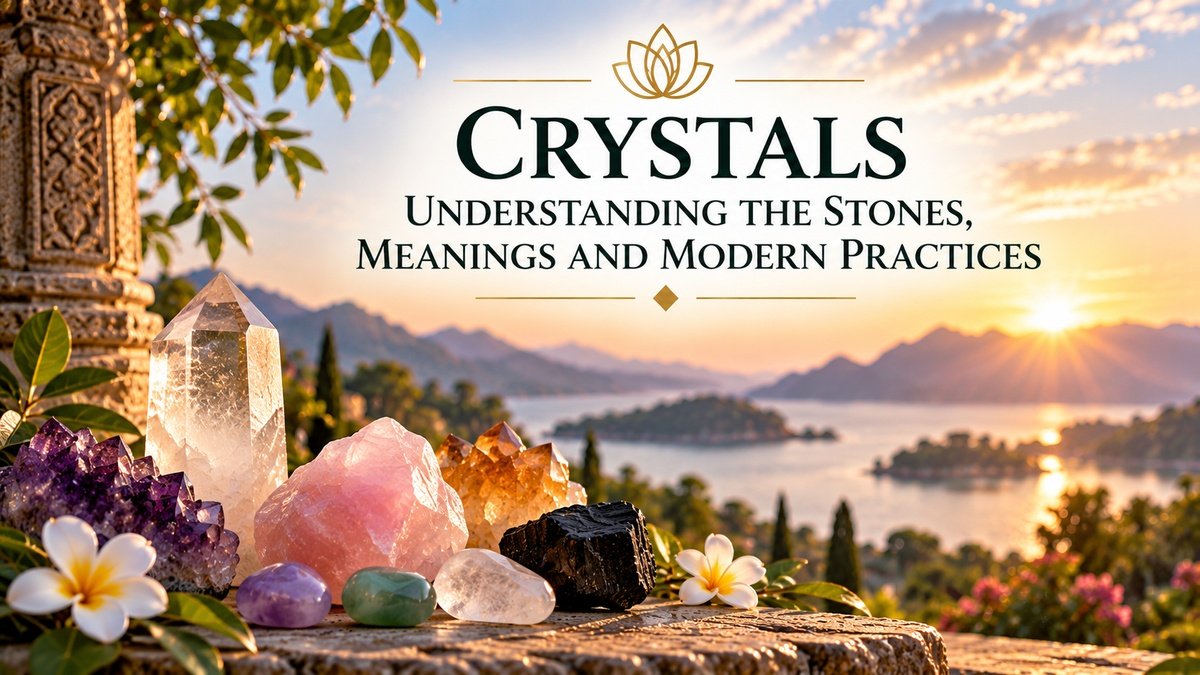
Clear quartz may appear colourless or transparent. Amethyst displays purple tones, while smoky quartz ranges through brown and grey shades. Citrine appears yellow to orange.
These colours have physical explanations.
Later cultural interpretations may then give those colours additional symbolism.
Keeping those two levels distinct becomes important throughout any discussion of crystal meanings.
Why Have Humans Valued Stones for So Long?
Human relationships with visually distinctive stones extend far beyond contemporary wellness culture.
Across different periods and societies, people have used precious and semi-precious materials for jewellery, trade, status, decoration, religious objects, seals, amulets and personal adornment.
Colour, rarity, luminosity, durability and provenance can all contribute to a stone’s value.
In some contexts, particular materials also acquired religious, protective, medicinal or astrological associations.
However, there was never one global ancient system called “crystal healing”.
Different societies understood stones through their own cosmologies, medical traditions, religious practices and systems of value.
Consequently, finding an ancient use for a particular stone does not automatically validate every meaning attributed to that stone today.
Are Modern Crystal Meanings Ancient?
Some have historical precedents. Others are considerably more modern, and many have changed over time.
This distinction matters.
A contemporary crystal guide might present a neat catalogue:
Rose quartz → love
Amethyst → calm
Citrine → abundance
Black tourmaline → protection
Clear quartz → amplification
These associations are now widespread within modern crystal culture.
However, their familiarity does not prove that identical meanings have followed each material unchanged for thousands of years.
Modern interpretations can combine older lapidary traditions, folklore, occult and esoteric systems, colour symbolism, astrology, New Age spirituality and contemporary wellness culture.
Therefore, asking what a crystal “means” should lead naturally to another question:
According to whom, where and when?
When Did Modern Crystal Culture Develop?
Today’s crystal culture did not emerge from one source.
Older European and Mediterranean lapidary traditions had already associated stones with particular qualities. Religious, magical and astrological ideas also circulated through different historical periods.
During the nineteenth and twentieth centuries, Western esoteric movements developed new ways of interpreting ancient religions, occult philosophy, spiritualism and ideas about invisible forces.
Later, twentieth-century New Age movements created further combinations.
Concepts drawn from Eastern religions, Western esotericism, alternative spirituality, colour symbolism and ideas about vibration or energy increasingly appeared together.
Crystal practices became particularly visible within this wider environment.
Contemporary crystal culture therefore contains genuine historical inheritances alongside reinterpretation, synthesis and newly developed practices.
What Does ‘Crystal Energy’ Mean?
This phrase requires particular care because the word energy changes meaning depending on context.
In physics, energy is a measurable quantity with precise definitions.
Within contemporary crystal practice, however, people may use energy more broadly to describe atmosphere, sensation, symbolism, spiritual qualities or an invisible influence attributed to a stone.
Those meanings should not automatically be treated as equivalent.
A person may genuinely describe a crystal as feeling calming or energising. That reports an experience.
A crystal tradition may also describe a stone as carrying a particular energetic quality. That represents a belief or interpretive framework.
By contrast, saying that scientific instruments have established a specific healing energy emitted by that stone makes an empirical claim.
Each statement requires a different kind of support.
But Don’t Quartz Crystals Really Have Energy?
Quartz has genuine physical properties.
One particularly important example is piezoelectricity.
Under appropriate mechanical stress, quartz can develop an electrical charge. Conversely, applying an electrical field can produce mechanical deformation.
These properties have practical technological applications. Quartz has been used in oscillators, timing devices, sensors and other electronic systems.
This is established physics.
However, it does not follow that holding a piece of quartz in the hand transfers a therapeutic frequency into the body or amplifies thoughts and intentions.
That would be a separate claim requiring separate evidence.
This distinction is fundamental:
A material can possess remarkable physical properties without every spiritual or therapeutic claim made about it becoming scientifically established.
Do Crystals Have Frequencies?
In physical systems, materials can exhibit measurable resonant behaviour under particular conditions.
Quartz oscillators provide a familiar technological example.
However, wellness language sometimes takes the scientific vocabulary of vibration and frequency much further.
A stone may be described as vibrating at a frequency corresponding to love, confidence, abundance or a particular organ.
Those statements should not be confused with measuring the physical resonance of a crystal under defined conditions.
The word frequency does not make a claim scientific by itself.
We need to ask: frequency of what, measured in what units, under what conditions, and linked to the claimed outcome by what evidence?
Why Are Crystals Associated with Chakras?
Crystal-and-chakra charts have become extremely familiar in modern yoga and wellness culture.
Seven coloured stones may appear alongside seven vertically arranged chakras, often matching colours from red at the base of the body to violet at the crown.
It is easy to assume that this complete system comes directly from ancient yoga.
The history is more complicated.
As explored elsewhere in The Orenna Journal, Indian Tantric and yogic traditions contain diverse cakra systems. They do not present one universal seven-chakra map with the same colours, meanings and anatomical correspondences used throughout contemporary wellness culture.
The familiar rainbow chakra system reflects layers of modern interpretation and synthesis.
Therefore, placing red jasper at the root chakra or amethyst at the crown should not automatically be presented as one timeless ancient yogic practice.
It belongs more accurately to modern systems that bring crystals and contemporary chakra interpretation together.
Does That Make Crystal-and-Chakra Practice Meaningless?
No.
A practice can be modern and still carry meaning.
Someone may find colour, symbolism and the deliberate placement of an object useful within meditation or reflection.
The historical issue is not whether people are allowed to create or use contemporary practices.
It is whether we describe those practices accurately.
Calling something modern does not make it inferior. Likewise, calling it ancient does not make it more effective.
Historical accuracy allows contemporary practice to stand on its own terms.
Why Are Particular Meanings Assigned to Particular Crystals?
There is no single answer.
Sometimes colour provides an obvious symbolic association. A pink stone may become associated with affection or tenderness, while dark stones may acquire protective symbolism.
Names can also influence meaning. So can rarity, historical use, folklore, religious symbolism and the visual character of the material.
Modern books, teachers and commercial culture further reinforce particular associations.
Once enough sources repeat the same meaning, it can begin to appear intrinsic to the stone itself.
Yet meanings are not always consistent.
One guide may describe a crystal as calming, while another calls it energising. A third may associate it with a chakra, planet or zodiac sign.
These differences provide an important clue: the meaning does not come from mineralogy alone.
What Does Rose Quartz Mean?
Rose quartz is one of the most familiar stones in contemporary crystal practice.
Its soft pink colour has contributed to strong modern associations with love, affection, compassion and emotional gentleness.
It is frequently marketed as the “stone of love”.
Someone may choose rose quartz because that symbolism resonates with an intention around kindness or relationships.
However, the symbolic association should remain distinct from claims that the mineral emits a scientifically demonstrated frequency that heals emotional wounds or treats psychological conditions.
Those are different propositions.
What Does Amethyst Mean?
Amethyst is the purple variety of quartz.
Its cultural history extends well beyond contemporary crystal shops, and it has carried different associations across time.
Today, crystal guides commonly connect amethyst with calm, intuition, meditation, sleep or spiritual awareness.
Its colour also contributes to modern associations with the upper chakras.
A practitioner may value amethyst as a symbolic object during meditation.
Nevertheless, claims that placing amethyst beside the bed treats insomnia or directly changes neurological function require evidence beyond symbolism and personal testimony.
What Does Clear Quartz Mean?
Clear quartz occupies an especially prominent position in modern crystal culture.
It is often called a “master healer” and described as amplifying energy, intentions or the properties of other crystals.
Here, scientific and wellness vocabularies can easily become entangled.
Quartz genuinely has important technological properties. However, those properties do not demonstrate that a hand-held quartz crystal amplifies human intention or healing energy.
A person may still use clear quartz as a symbolic focus for an intention.
That practice simply needs a different explanation.
What Does Citrine Mean?
Citrine is a yellow-to-orange variety of quartz.
Modern crystal culture commonly associates it with optimism, confidence, prosperity and abundance.
Its warm colour makes some of those symbolic associations easy to understand.
However, another practical issue appears here: not everything sold as natural citrine necessarily formed with that colour naturally.
Heat-treated amethyst can acquire yellow, orange or brown colouring and is widely sold within the crystal market as citrine.
This does not make the material worthless or unattractive. It does mean that provenance and treatment matter when purchasing crystals.
What Does Black Tourmaline Mean?
Black tourmaline is frequently associated with grounding and protection in contemporary crystal culture.
Modern claims sometimes extend to absorbing or blocking “negative energy” or protecting against electromagnetic fields.
These ideas require separation.
Protection can function symbolically. A person might keep a stone as a tangible reminder of boundaries, steadiness or personal intention.
By contrast, claiming that a piece of black tourmaline provides meaningful protection from electromagnetic radiation is a measurable physical claim and requires appropriate evidence.
Symbolic protection and electromagnetic shielding are not the same thing.
How Are Crystals Used Today?
Contemporary practices vary enormously.
Some people collect crystals because they appreciate mineralogy, geology and natural beauty.
Others wear them as jewellery or display them within the home.
Within meditation and wellbeing settings, someone might hold a stone, place it nearby, choose one according to an intention or use it as a visual and tactile focus.
Other practices include crystal grids, chakra layouts, carrying particular stones, placing them beside the bed or combining them with rituals around intention.
These practices do not all have the same history or evidential basis.
Consequently, the phrase using crystals tells us relatively little until we know what someone is actually doing and why.
What Is a Crystal Grid?
A crystal grid usually arranges several stones into a deliberate geometric pattern.
Contemporary practitioners may choose the stones according to an intention and arrange them around a central object or shape.
Some explanations use the language of energetic amplification or sacred geometry.
As with other modern crystal practices, symbolic and empirical claims should remain distinct.
Geometry can carry aesthetic, mathematical, religious or symbolic meaning. However, arranging stones into a geometric pattern does not by itself demonstrate the creation of a measurable healing energy field.
A grid can still function as a deliberate visual representation of an intention.
What Does It Mean to ‘Cleanse’ a Crystal?
Within modern crystal practice, people often speak of cleansing or clearing stones after use.
Methods may include water, smoke, sound, moonlight, sunlight, salt or placing one stone beside another.
In this context, cleansing usually refers to a ritual or energetic concept rather than ordinary physical cleaning.
Importantly, not every method is physically suitable for every mineral.
Some materials can react with water, dissolve, fade in sunlight, scratch easily or deteriorate when exposed to salt or other substances.
Therefore, mineral-specific care instructions matter.
A ritual practice should not override the physical properties of the material itself.
Do Crystals Need to Be Charged?
Many contemporary practices include “charging” crystals in moonlight, sunlight or alongside other stones.
Within that framework, charging may symbolise renewal, preparation or intention.
Science does not establish that moonlight fills a crystal with a therapeutic energy that it later transfers to a person.
Nevertheless, a ritual can carry personal meaning without requiring that mechanism.
Someone may deliberately place a stone in moonlight as part of reflection, transition or intention-setting.
The distinction lies in how we describe what the ritual does.
Can Crystals Be Used in Meditation?
Yes, if the practitioner finds them useful.
A crystal can serve as a visual or tactile object of attention. Its texture, temperature, weight and appearance provide sensory information that someone can notice deliberately.
A person may also associate the object with an intention or symbolic quality.
For example, choosing a stone associated personally with steadiness may provide a tangible reminder of that intention during practice.
None of this requires claiming that the mineral itself causes a specific psychological or physiological change.
The distinction allows the object to remain meaningful without making promises it cannot support.
Can Crystals Heal?
The word healing can mean very different things in ordinary conversation.
Someone may use it metaphorically to describe comfort, reflection or a personally meaningful experience.
However, describing a crystal as treating disease, correcting a physiological disorder or replacing appropriate healthcare makes a medical claim.
Current scientific evidence does not justify presenting crystals as treatments for medical or psychological conditions.
This does not mean someone cannot value a stone, enjoy a ritual or find the experience personally supportive.
It means those experiences should not be converted into claims of clinical effectiveness.
If Someone Feels Something from a Crystal, Is That Experience Real?
The experience is real as an experience.
People may report warmth, tingling, calm, emotional significance or a sense that one stone feels different from another.
However, experiencing a sensation does not automatically establish its cause.
Attention, expectation, temperature, texture, pressure, previous beliefs, setting and emotional associations can all influence experience.
Therefore, two statements should remain separate:
“I notice a sensation when I hold this crystal.”
and:
“This sensation proves that the crystal emits a healing energy.”
The first describes experience.
The second proposes an explanation that requires additional evidence.
Can You Use Crystals Without Believing in Crystal Healing?
Absolutely.
A person might appreciate geology, colour, texture and natural form.
Someone else may use a stone symbolically, much as another person might use a meaningful photograph, piece of jewellery or written intention.
A crystal can also become a sensory object during meditation or simply contribute to an environment that feels considered and beautiful.
Meanwhile, another practitioner may understand crystals within a spiritual framework.
These relationships do not need to be identical.
The important point is clarity about what is personal meaning, what belongs to a tradition or contemporary belief system, and what has been established scientifically.
Are Natural Crystals Better Than Synthetic Ones?
That depends entirely on what better means.
For a collector, geological origin may be central to the object’s value.
For jewellery, appearance, durability, rarity and craftsmanship may matter.
For scientific or technological applications, carefully manufactured synthetic crystals can offer highly controlled properties.
Within spiritual crystal culture, some people prefer natural stones because they attach meaning to geological formation and provenance.
That preference can be personally significant.
However, it should not automatically become a scientific claim that a natural specimen possesses stronger healing energy than a synthetic material.
Does the Shape of a Crystal Change Its Properties?
Shape matters in some physical and technological contexts, but this does not automatically validate every energetic claim associated with carved crystal forms.
Modern crystal culture gives different meanings to points, spheres, towers, pyramids, hearts and other shapes.
A sphere may symbolise wholeness, while a point may represent direction or focus.
These meanings can be useful within a symbolic practice.
Yet carving quartz into a heart does not transform its chemical composition into a substance that scientifically produces love.
Again, material property and attributed meaning belong to different levels of explanation.
Where Do Crystals Fit Within Yoga?
Crystals are not a required component of yoga.
Classical yoga does not depend upon selecting rose quartz, amethyst or clear quartz before practice.
Likewise, the familiar modern system pairing coloured crystals with seven chakras should not be projected backwards as though it were a universal feature of historical Indian yoga.
However, contemporary yoga environments continually evolve.
Some practitioners now include crystals as symbolic objects, meditation supports or elements of the physical environment.
That can be described accurately as a contemporary addition to practice rather than an essential ancient yogic technique.
How Does Orenna Approach Crystals?
At Orenna, a crystal does not need to diagnose, treat or alter someone’s health in order to have a place within a considered experience.
An object can be beautiful.
It can be tactile.
It can carry an intention.
It can prompt curiosity or provide a visual point of focus.
For someone who already attaches spiritual meaning to crystals, that personal relationship can also be respected without turning it into a promise about what the object will do.
This keeps the experience personal while maintaining a clear non-clinical boundary.
What Should You Consider When Buying Crystals?
Meaning is only one consideration.
Provenance also matters.
Mining can involve environmental damage, unsafe working conditions and complex international supply chains. Meanwhile, vague labels such as “ethically sourced” may provide little information unless a seller can explain what the claim means.
Treatments and authenticity matter too.
Some stones are heated, dyed, irradiated, coated, reconstructed or manufactured. None of these processes automatically makes an object undesirable, but transparent labelling allows buyers to make informed decisions.
Therefore, useful questions include:
What is the material?
Is it natural, treated or synthetic?
Where did it come from?
Does the seller know its supply chain?
Are the metaphysical claims being presented as beliefs or scientific facts?
A beautiful object deserves an equally considered purchase.
What Will We Explore Next?
This article establishes the foundations of our Crystal Series.
Next, we will go further back in time.
A History of Crystals: From Precious Stones to Modern Crystal Culture will explore how humans have used unusual stones as jewellery, amulets, religious objects, medicines, symbols of status and objects of fascination — and how those histories eventually contributed to contemporary crystal culture.
From there, we will examine crystal meanings more closely before asking how crystals became associated with chakras and energy.
Finally, we will address the question that sits beneath many modern claims:
Do crystals really work?
An Orenna Perspective: Meaning Does Not Need a Medical Claim
A crystal begins as matter.
Its structure belongs to geology.
Its colour emerges from physical processes.
Its journey into human culture adds something different.
We collect it, polish it, wear it, exchange it, name it and sometimes give it meaning.
That meaning can become deeply personal.
There is no need to erase that experience simply because a laboratory cannot measure symbolism.
But neither do we need to turn symbolism into physics in order to make it valuable.
A piece of rose quartz can remind someone of tenderness without emitting a medically proven frequency of love.
An amethyst can become part of a quiet evening ritual without treating insomnia.
A clear quartz point can mark an intention without amplifying thoughts through a scientifically established energy field.
Perhaps the more interesting question is not whether a crystal possesses the meaning assigned to it.
It is what happens when a human being chooses to give an object meaning — and then carries that meaning into practice.
A crystal can be beautiful, symbolic and personally significant without needing to become medicine.
References & Further Reading
Deer, W. A., Howie, R. A. and Zussman, J. An Introduction to the Rock-Forming Minerals. A standard mineralogical reference for understanding mineral composition, structure and identification.
National Academies and geological reference literature. Mineralogical and crystallographic research provides the scientific framework for understanding crystal structure, formation and physical properties.
Encyclopaedia Britannica. Reference material on crystallography, quartz, gemstones and the physical characteristics of crystalline materials.
International Gem Society and gemmological reference literature. Useful for understanding gemstones, mineral treatments, synthetic materials and identification.
James Mallinson and Mark Singleton. Roots of Yoga. Penguin Classics. Useful for distinguishing historical yogic subtle-body systems from later combinations of yoga, chakras and contemporary crystal practices.
Christopher Partridge. Scholarship on Western alternative spirituality, esotericism and contemporary religious culture provides broader context for understanding the environment in which modern crystal practices developed.