


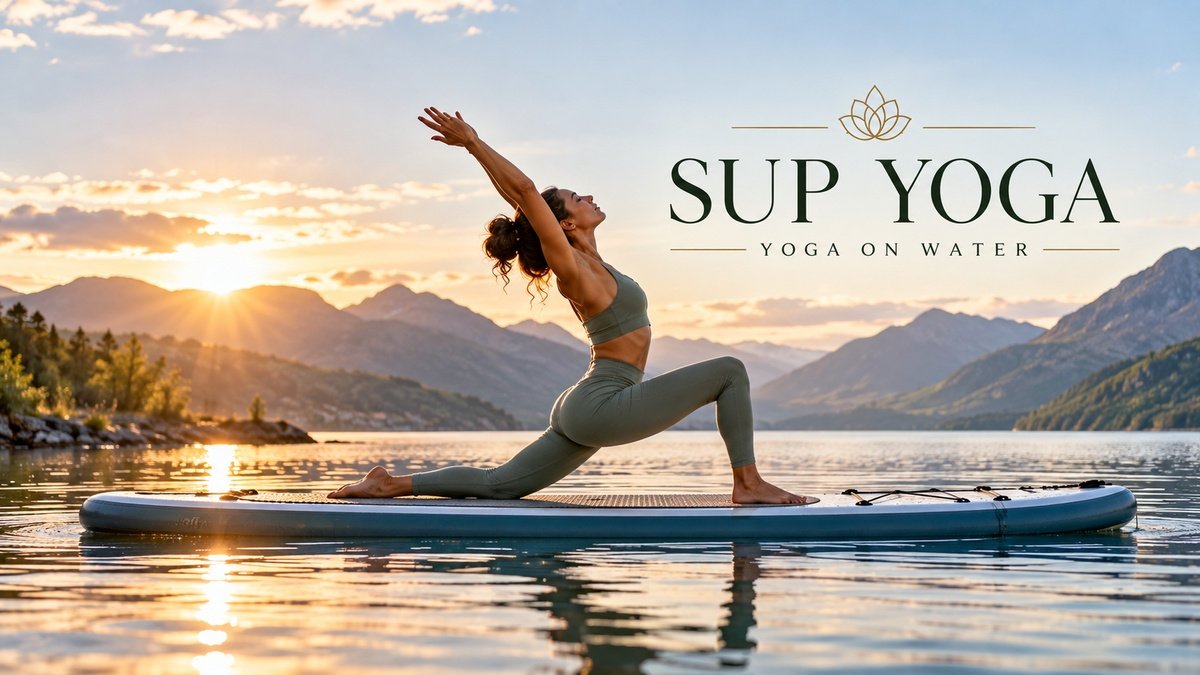
SUP Yoga changes one seemingly simple element of yoga practice: the ground.
Instead of placing a mat on a stable floor, the practitioner moves onto a stand-up paddleboard floating on water.
Suddenly, familiar movements behave differently.
A small shift through one foot can tilt the board. A transition that feels automatic on land may require considerably more attention. Wind, water and the movement of other boards become part of the environment.
Sometimes, the practitioner falls in.
That is not necessarily a failure of the practice.
It is part of practising on a surface that cannot be made completely still.
What Is SUP Yoga?
SUP Yoga — short for Stand-Up Paddleboard Yoga — is a contemporary practice in which yoga movements and postures are adapted for a stand-up paddleboard.
It is usually practised on relatively calm water, such as sheltered lakes, bays or other protected areas.
The board functions as the practitioner’s moving practice surface.
A session may include seated or kneeling movements, familiar āsanas, transitions, breathing practices, periods of rest and sometimes meditation.
However, SUP Yoga is not defined by one prescribed sequence.
Teachers may draw from different approaches to modern postural yoga and modify them according to the board, the participants and environmental conditions.
For that reason, one SUP Yoga class may feel quiet and exploratory while another may contain a more recognisable flowing sequence.
What Does SUP Stand For?
SUP means Stand-Up Paddleboarding.
In its familiar contemporary form, the paddler stands on a large board and uses a single-bladed paddle to move and steer through the water.
SUP Yoga combines this paddlesport environment with yoga practice.
The paddling component matters.
A participant still needs to launch, control and manoeuvre the board appropriately for the conditions.
Likewise, a teacher working on open water has responsibilities that extend beyond knowing how to teach yoga postures.
Where Did SUP Yoga Come From?
SUP Yoga is a relatively recent development.
Its history belongs partly to yoga and partly to the modern expansion of stand-up paddleboarding.
Stand-up paddling has associations with Hawaiian surf culture, particularly the use of paddles by Waikīkī beach boys. Its modern recreational and sporting forms expanded substantially during the early twenty-first century.
As paddleboards became increasingly common away from surf environments, people began using them for activities including fitness, Pilates and yoga.
Several teachers were experimenting with yoga on paddleboards during this developing period.
Consequently, identifying a single inventor of SUP Yoga would oversimplify its history.
Did Rachel Bråthén Invent SUP Yoga?
Rachel Bråthén, the Swedish yoga teacher later widely known as Yoga Girl, became one of the prominent early figures associated with SUP Yoga.
She began teaching yoga on paddleboards around 2009 and subsequently helped introduce the practice to a much larger international audience.
However, Bråthén herself has not presented the basic idea as her invention.
Other teachers were independently bringing yoga and related movement practices onto paddleboards during the same broader period.
It is therefore more accurate to describe her as an important early populariser rather than the definitive inventor of SUP Yoga.
What Makes SUP Yoga Different from Yoga on Land?
The most obvious difference is instability.
A studio floor does not normally move underneath the practitioner.
A paddleboard does.
Even on apparently calm water, the board responds to changes in body weight, small waves, wind and surrounding movement.
As a result, the practitioner continually receives information from the surface beneath them.
A posture that feels straightforward on land can suddenly reveal how weight is distributed between the hands, knees or feet.
That does not automatically make the aquatic version superior.
It simply creates a different movement problem.
Does SUP Yoga Improve Balance?
SUP Yoga certainly requires balance.
Whether that translates into measurable improvements elsewhere depends on the practitioner, the frequency and duration of practice, and what outcome is being measured.
The moving board requires continual adjustments to changes in position and pressure.
It may therefore provide an interesting environment in which to practise balance and coordination.
However, claims that SUP Yoga universally produces superior balance should be treated cautiously.
Balance is task-specific, and becoming skilled at balancing on a paddleboard does not automatically make someone equally skilled in every other balance task.
Why Can Simple Postures Feel Different on a Paddleboard?
The board makes small changes visible.
Press more heavily through one side and the board may respond.
Move quickly from kneeling to standing and its movement may become more pronounced.
Reach a limb away from the centre and the relationship between body mass and the board changes again.
Consequently, experienced yoga practitioners sometimes find themselves returning to comparatively simple movements.
This can be useful.
The practice does not need increasingly complex postures to remain interesting.
Changing the environment can make a familiar posture unfamiliar again.
What Happens in a SUP Yoga Class?
A well-designed session usually begins before the yoga itself.
Participants may receive information about the board, paddle, flotation equipment, environmental conditions and what to do if they enter the water.
Depending on the location and format, the group may paddle from shore to a designated practice area.
Boards can then be anchored individually, connected within an appropriate group system or managed according to the particular venue and conditions.
The yoga practice commonly begins low to the board.
Seated, supine, prone or kneeling movements provide a relatively stable introduction before more demanding positions are considered.
A session may eventually return to stillness before participants paddle back to shore.
Why Begin Close to the Board?
Lower positions generally reduce the challenge of balancing on a floating surface.
They also allow someone unfamiliar with the board to discover how it responds to movement without immediately trying to stand.
This is particularly useful for beginners.
A practitioner might begin seated, on hands and knees or lying down.
From there, movement can gradually become more complex.
The American Canoe Association’s SUP Yoga curriculum similarly emphasises stable positions and progression appropriate to participants and conditions. :chatgpt-content-reference{index=”1″}
Which Yoga Poses Work on a Paddleboard?
Many familiar yoga postures can be adapted to a paddleboard.
Low positions such as seated movements, tabletop variations, gentle spinal movements and reclining postures can provide comparatively stable starting points.
Standing postures increase the balance requirement considerably.
The important question is not whether a pose can technically be performed on a board.
It is whether that pose makes sense for the practitioner, the board and the conditions.
A spectacular posture that substantially increases the consequences of falling may offer little educational value.
Complexity should therefore remain a choice rather than a measure of successful SUP Yoga.
Are Inversions Appropriate in SUP Yoga?
This requires considerable caution.
Some social-media images show headstands and other inversions performed on paddleboards.
They are visually dramatic.
That does not make them appropriate teaching choices.
The American Canoe Association’s SUP Yoga skills guidance specifically advises against poses that place pressure on the head, neck or spine or could compromise those areas. :chatgpt-content-reference{index=”2″}
The unstable surface and possibility of falling change the risk calculation considerably.
A SUP Yoga practice does not become more advanced simply because the practitioner places their head closer to an unpredictable board.
Do You Need a Special Paddleboard?
Not necessarily, although board design can make a substantial difference.
For yoga, a relatively wide and stable board generally provides more usable space and stability than a narrow board designed primarily for speed.
Many SUP boards have a padded deck, which can provide sufficient cushioning without adding a conventional yoga mat.
Inflatable boards are also widely used.
The appropriate board depends on the participant, location, water conditions and intended use.
Whatever the design, familiarity with the board remains more important than treating specialist equipment as a substitute for paddling competence.
Why Are Boards Sometimes Anchored?
Without an anchor, a board can drift while someone practises.
Wind and current may gradually move an entire class away from its starting position.
Anchoring can help maintain appropriate spacing and keep the group within a selected practice area.
However, anchoring is itself a paddlesport skill.
The anchor system, water depth, bottom conditions, current, wind, other water users and potential entanglement all matter.
There is no single anchoring arrangement suitable for every environment.
Professional SUP Yoga training therefore includes anchoring techniques alongside yoga adaptations. :chatgpt-content-reference{index=”3″}
Do You Need to Know How to Paddle?
Yes — particularly when practising independently.
SUP Yoga may emphasise yoga once the board reaches the practice area, but the board remains a paddlecraft.
Participants need an appropriate level of competence for the environment in which they are paddling.
That includes launching, stopping, turning, returning to the board after entering the water and understanding how wind and water affect the craft.
For teachers, the standard should be higher.
They are responsible not only for their own board but also for managing a group in an outdoor aquatic environment.
Does a Yoga Qualification Alone Prepare Someone to Teach SUP Yoga?
No.
Teaching yoga on water introduces competencies that ordinary studio yoga training does not necessarily cover.
These include paddling, water safety, rescue, weather assessment, group management, anchoring and appropriate equipment.
The American Canoe Association now maintains a specific SUP Yoga Leader certification pathway. Its criteria expect candidates to have yoga-teaching qualifications alongside paddling experience, rescue competence, first aid and CPR. :chatgpt-content-reference{index=”4″}
Requirements differ between countries and organisations.
The broader principle remains important: being qualified to teach yoga does not automatically establish competence to lead people on water.
What About Buoyancy Aids and Personal Flotation Devices?
Flotation equipment should be considered within the paddling regulations and risk assessment applicable to the location.
Requirements vary by jurisdiction, venue, conditions and activity.
For example, the American Canoe Association’s SUP Yoga course policy requires personal flotation devices while paddling to the yoga location and establishes specific requirements depending on whether boards are anchored and what type of flotation device is used. Local law takes precedence. :chatgpt-content-reference{index=”5″}
This illustrates an important distinction.
SUP Yoga is not merely an outdoor fitness class.
It takes place within a water-safety environment.
What About the Leash?
A board leash can help keep the board connected to the paddler after a fall.
However, leash selection is not as simple as saying that everyone should always use the same type.
Different water environments create different hazards.
Equipment appropriate for calm open water may not be appropriate in moving or flowing water, where entanglement and current introduce additional considerations.
Participants should therefore follow competent paddlesport guidance appropriate to the specific environment rather than relying on generic yoga advice.
What Happens If You Fall In?
You may get wet.
For many participants, that possibility is part of the experience.
However, falling into water is not trivial in every environment.
Water temperature, depth, currents, wind, waves, underwater hazards, distance from shore and swimming ability can all change the consequences.
A competent session therefore includes preparation for entering the water and returning safely to the board.
The goal should not be to promise that nobody will fall.
It should be to create conditions in which foreseeable events have been appropriately considered.
Why Do Weather Conditions Matter So Much?
A yoga studio does not normally drift when the wind changes.
A paddleboard can.
Wind is particularly important because a person and board create considerable surface area for it to act upon.
Conditions can also change during a session.
Teachers therefore need to consider forecasts alongside what is actually happening at the venue.
The ACA’s current SUP Yoga Leader criteria specify controlled operating conditions for training, including limits for wind, waves and current. :chatgpt-content-reference{index=”6″}
Those figures are not universal rules for every SUP Yoga session worldwide, but they demonstrate why environmental judgement forms part of competent instruction.
Is SUP Yoga Suitable for Beginners?
It can be.
Someone does not need an advanced yoga practice to begin exploring movement on a paddleboard.
Indeed, low and relatively simple positions may be more appropriate than elaborate āsanas.
Some previous familiarity with either yoga or paddleboarding can make the experience easier, but beginners can learn within an appropriately managed introductory class. REI similarly notes that expertise in both disciplines is not required before trying a class. :chatgpt-content-reference{index=”7″}
The environment, however, should match the participant’s experience.
Beginning on sheltered water under competent supervision is very different from attempting yoga independently in exposed coastal conditions.
Does SUP Yoga Require Strong Swimming Skills?
Participants should understand the swimming and water-confidence requirements of the particular provider and location before joining a session.
Flotation equipment reduces some risks but does not eliminate the need for appropriate water competence and supervision.
Someone who is uncomfortable around deep or open water should communicate that before entering the session.
A responsible provider should be able to explain what happens if someone enters the water, how far the class travels from shore and what safety systems are in place.
Is SUP Yoga More Difficult Than Regular Yoga?
It creates different demands.
A relatively simple posture may become harder to stabilise because the surface moves.
At the same time, SUP Yoga classes often reduce the complexity of the postures precisely because the board already supplies an additional challenge.
Calling it universally “harder” therefore misses the point.
A highly complex land-based practice can be more physically demanding than a gentle paddleboard session.
What changes most consistently is the relationship between movement and environment.
Is SUP Yoga a Better Core Workout?
The moving board requires ongoing postural adjustments, and many people experience familiar positions differently as a result.
It is tempting to describe every one of those adjustments as the “core working harder”.
Human balance is more complex than that.
Muscles throughout the body participate in maintaining and changing position.
SUP Yoga can certainly provide a different physical challenge, but it does not need exaggerated claims about constant core activation to justify its value.
Is Practising Yoga in Nature Automatically More Mindful?
No.
Water, changing light, birds, wind and a distant shoreline can provide an unusually rich sensory environment.
Some people find that environment supports attention and presence.
Others may be preoccupied with balancing, cold water, insects, weather or the possibility of falling in.
Nature does not guarantee mindfulness.
It changes what is available to notice.
Is SUP Yoga an Ancient Form of Yoga?
No.
Yoga has a long and complex history in South Asia.
Stand-up paddleboarding has its own histories and cultural contexts.
SUP Yoga as a recognisable hybrid practice is contemporary.
Practising an old yoga posture on water does not make the paddleboard method itself ancient.
Nor should modern SUP Yoga be retroactively attributed to historical Indian yoga traditions without evidence.
It is better understood as one example of the continuing ways in which modern yoga adapts to new environments.
A Common Misunderstanding: SUP Yoga Is Not About Performing Difficult Poses on Water
Images of SUP Yoga often emphasise spectacle.
A handstand above blue water photographs more dramatically than someone quietly sitting on a board.
Yet the instability of the board can make simplicity unusually informative.
A basic transition reveals weight transfer.
Kneeling reveals the effect of a shifting centre of mass.
Stillness reveals that the surface is not actually still.
The water already changes the practice.
There is no requirement to make the posture itself increasingly extreme.
An Orenna Perspective: What Happens When the Ground Moves?
Much of yoga practice assumes a reliable relationship with the floor.
We press into it.
We organise ourselves against it.
We rarely need to wonder where it will be a moment later.
SUP Yoga removes some of that certainty.
The board responds.
The water responds.
The weather may respond.
So the practitioner responds too.
That does not make instability inherently more meaningful than stability.
It simply makes adaptation impossible to ignore.
Perhaps the most interesting lesson of SUP Yoga is not learning how to become perfectly still on moving water, but discovering how much adjustment is already contained within balance.
References & Further Reading
American Canoe Association. SUP Yoga Skills Course and SUP Yoga Leader Certification Criteria. Particularly useful for understanding paddling competence, environmental conditions, anchoring, flotation equipment, rescue considerations and adapting yoga movements for a paddleboard.
American Canoe Association. Stand-Up Paddleboarding education and instructor curriculum. Provides broader paddlesport context for SUP instruction and safety.
REI Co-op Expert Advice. Stand Up Paddle Board (SUP) Yoga Basics. Practical introductory guidance on boards, equipment and adapting familiar yoga movements to the water.
Historical accounts of modern stand-up paddleboarding. Useful for distinguishing the development of contemporary SUP from simplified claims about a single inventor.



