


Rocket Yoga takes the recognisable architecture of Ashtanga Yoga and changes an important part of the equation: practitioners do not necessarily have to wait until they have mastered one posture before exploring what comes later.
The practice is dynamic. Breath and movement remain closely connected. Familiar elements of Ashtanga appear throughout the sequences, alongside arm balances, inversions, backbends and transitions.
Yet Rocket deliberately creates more room for modification, experimentation and choice.
American yoga teacher Larry Schultz developed the method after years of studying Ashtanga Yoga with K. Pattabhi Jois. His later work in San Francisco — and particularly his time teaching the Grateful Dead while travelling with the band — became closely connected with Rocket’s development.
The result was neither a rejection of Ashtanga nor simply another name for it.
Instead, Schultz reorganised material from different Ashtanga series into sequences intended to give practitioners broader access to the practice.
So what is Rocket Yoga? Who was Larry Schultz? Why is the Grateful Dead part of its history? What are Rocket I, II and III? Why are inversions and arm balances so prominent? And how much freedom does Rocket actually provide within a structured sequence?
What Is Rocket Yoga?
Rocket Yoga is a dynamic modern yoga method created by Larry Schultz and derived substantially from the sequences of modern Ashtanga Yoga.
It retains several recognisable features of Ashtanga practice.
Postures appear within structured sequences. Movement and breathing are linked through vinyāsa. Sun salutations, standing postures, seated work and finishing practices provide an underlying architecture.
However, Rocket reorganises that material.
Instead of requiring practitioners to progress through the Ashtanga series in their established order, Rocket draws postures from different series and places them within alternative sequences.
Modifications and variations also play a more explicit role.
Consequently, practitioners may encounter arm balances, inversions and other complex postures earlier than they might within traditional Ashtanga progression.
This combination of structure and flexibility gives Rocket its distinctive character.
Who Created Rocket Yoga?
Larry Schultz created the Rocket sequences.
Born in 1950, Schultz became an influential figure within the San Francisco yoga community.
He studied Ashtanga Yoga with K. Pattabhi Jois for approximately seven years, beginning during the early 1980s.
That experience provided an important foundation for his later teaching.
However, Schultz became increasingly willing to depart from the conventional progression of Ashtanga practice.
Rather than assuming that every practitioner needed to complete one posture before receiving another, he explored ways of making a wider range of postures available through modification and alternative sequencing.
He later established It’s Yoga in San Francisco, which became an important centre for his approach and teacher education.
Schultz died in 2011, but teachers who studied with him continued transmitting and developing Rocket internationally.
When Was Rocket Yoga Developed?
Rocket emerged within the late twentieth-century San Francisco yoga scene.
Schultz opened his first San Francisco studio in 1989 after years of studying and teaching Ashtanga.
His work with the Grateful Dead during the early 1990s became particularly influential in the story of Rocket.
Rather than imagining a single moment when a completely finished system suddenly appeared, it is more accurate to understand Rocket as something Schultz developed through teaching.
Working with different practitioners encouraged him to reconsider how the Ashtanga material could be organised and made more adaptable.
Over time, distinct Rocket sequences emerged from that experimentation.
What Does the Grateful Dead Have to Do with Rocket Yoga?
The American rock band Grateful Dead occupies an unusual place in Rocket Yoga history.
Larry Schultz travelled with the band as a yoga teacher during the early 1990s.
Teaching musicians on tour presented circumstances quite different from teaching experienced Ashtanga practitioners in a dedicated yoga environment.
Students had different bodies, schedules, experience and physical demands.
According to accounts preserved within the Rocket community, this context encouraged Schultz to modify and reorganise the Ashtanga practice rather than insist upon conventional progression through the series.
The story therefore matters for more than its association with a famous band.
It illustrates a central question within Rocket: what happens when a structured practice becomes more adaptable to the people actually practising it?
Why Is It Called Rocket Yoga?
The name is traditionally associated with the idea that the practice could help practitioners progress more quickly.
Accounts within the Rocket lineage commonly connect the name with the phrase that the practice could “get you there faster”.
That does not mean Rocket literally accelerates spiritual development or guarantees faster mastery of yoga.
The name reflects the energetic and deliberately unconventional character of Schultz’s method.
Instead of waiting for permission to encounter every later posture, practitioners could begin exploring modified versions within a structured practice.
In that sense, Rocket shortened some of the conventional barriers between different levels of the Ashtanga series.
How Is Rocket Yoga Related to Ashtanga Yoga?
The relationship is direct.
Rocket draws extensively from modern Ashtanga Yoga.
Its sequences contain postures associated with the Primary, Intermediate and more advanced Ashtanga series. The practice also retains sun salutations, standing sequences, vinyāsa transitions and a close relationship between movement and breath.
However, the methods organise progression differently.
Traditional Ashtanga practice follows established series. Students generally learn the sequence progressively, although contemporary teaching approaches vary in how strictly teachers control progression.
Rocket rearranges material from those series.
As a result, a practitioner may encounter a posture that appears considerably later within Ashtanga without first completing every posture that precedes it in the traditional sequence.
Rocket is therefore derived from Ashtanga, but it is not simply Ashtanga practised more quickly.
What Are the Rocket Yoga Sequences?
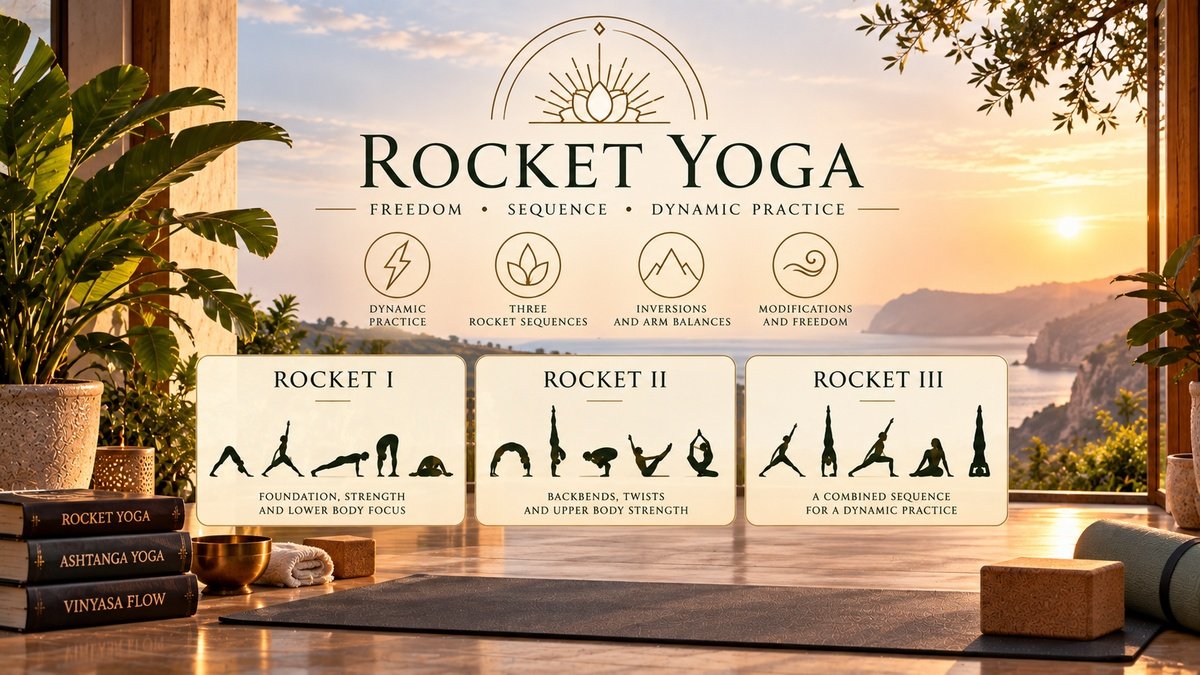
The system is commonly organised around Rocket I, Rocket II and Rocket III.
Together, these routines reorganise material from several Ashtanga series into a weekly practice framework.
The sequences remain recognisable enough for repetition and familiarity to develop.
At the same time, they provide considerably more variety than one unchanging series.
This balance between repetition and variation sits at the heart of Rocket practice.
What Is Rocket I?
Rocket I draws primarily from the architecture and postures of the Ashtanga Primary Series.
The sequence places substantial emphasis on the lower body, forward bending and seated work.
Standing variations also appear throughout the practice.
However, Rocket I should not be confused with simply performing the Ashtanga Primary Series under another name.
Schultz modified the sequence and introduced different transitions, strengthening elements and opportunities to explore inversions.
Contemporary Rocket teaching may also incorporate handstand work and additional conditioning exercises.
The result retains a clear Ashtanga ancestry while establishing its own rhythm and progression.
What Is Rocket II?
Rocket II draws more substantially from the Ashtanga Intermediate Series.
Its emphasis shifts towards the back body, upper body and core, with greater prominence given to backbending, twisting and arm balances.
Once again, the sequence does not simply reproduce the corresponding Ashtanga series.
Schultz reorganised the material according to the logic of the Rocket system.
This gives practitioners access to postures that may otherwise appear later within conventional Ashtanga progression.
Rocket II can therefore be physically demanding even when teachers provide modifications.
What Is Rocket III?
Rocket III combines material from Rocket I and Rocket II.
It is often described as the mixed-level or combined Rocket sequence.
The practice incorporates a broad range of standing postures, forward bends, backbends, twists, arm balances and inversions.
Because the sequence draws from both earlier routines, it can contain a considerable number of postures.
Yet “mixed level” should not be interpreted as meaning that every practitioner performs every variation.
The Rocket methodology depends substantially on options and modifications.
A shared sequence can therefore contain different expressions according to the practitioner’s experience and capacity.
Does Rocket Yoga Have a Fixed Sequence?
Yes — but with considerably more flexibility than the phrase “fixed sequence” might suggest.
Rocket has recognisable routines. Practitioners who return regularly become familiar with the order and recurring postures.
This distinguishes the method from completely open-ended flow classes.
However, Rocket also encourages modification and variation within that framework.
Teachers may offer alternative postures. Practitioners can work with different levels of an arm balance or inversion. Some transitions can change according to experience and context.
The structure therefore provides a map without requiring every practitioner to travel through it identically.
Why Are Arm Balances and Inversions Important in Rocket Yoga?
Arm balances and inversions are among Rocket Yoga’s most recognisable visual features.
Handstands, forearm balances and different arm-balancing postures can appear within the sequences or as optional explorations.
Part of this emphasis reflects Schultz’s willingness to expose practitioners to more advanced Ashtanga material without requiring conventional sequential progression.
However, an inversion does not become more valuable simply because it looks difficult.
These postures require appropriate strength, coordination, mobility, spatial awareness and judgement. They may also be unsuitable for some practitioners or circumstances.
Teachers can therefore offer preparation, alternatives or omission rather than treating the most complex variation as the purpose of the practice.
Access to a posture is not the same as an obligation to perform it.
Does Rocket Yoga Include Modifications?
Yes. Modification forms an important part of the method.
One of Schultz’s departures from more traditional approaches to Ashtanga progression was his willingness to let practitioners explore different versions of postures.
A complex arm balance might therefore have several entry points. An inversion can be prepared without requiring the complete posture. A transition can become simpler when that better suits the practitioner.
Modification does not necessarily mean making the entire practice easy.
Instead, it creates different ways of participating in the sequence.
This is an important distinction because Rocket remains a physically demanding practice for many people.
Is Rocket Yoga Faster Than Ashtanga?
Rocket often feels fast and energetic, but speed alone does not define it.
Classes commonly maintain a continuous rhythm and may move through substantial amounts of material within a relatively compact period.
However, the name “Rocket” should not encourage practitioners to rush through movement or breathing.
Breath remains an organising element.
Transitions still require attention. More technically demanding postures can require preparation rather than momentum.
The meaningful difference from Ashtanga lies primarily in sequencing, progression and choice — not simply in moving the body faster.
Is Rocket Yoga the Same as Vinyasa Yoga?
No, although Rocket belongs within the broader world of vinyāsa-based practice.
Vinyasa Yoga is a broad contemporary category. Teachers may create entirely different sequences from one class to another.
Rocket has identifiable sequences and a specific historical connection with Larry Schultz and Ashtanga Yoga.
Both can link breath and movement, use flowing transitions and allow creative teaching.
Nevertheless, calling any strong Vinyasa class “Rocket” would overlook the method’s particular sequences and history.
Is Rocket Yoga the Same as Power Yoga?
No, although the two emerged within a related period of American yoga history.
Power Yoga became a broad term for vigorous approaches influenced substantially by Ashtanga Yoga.
Rocket has a more specific founder, lineage and sequence structure.
Larry Schultz created identifiable Rocket routines, while Power Yoga developed through several teachers and never became one universally standardised method.
The practices may look similar at times, particularly when both include strong flowing movement.
Their histories and methodologies nevertheless remain distinct.
Is Rocket Yoga Suitable for Beginners?
The answer depends partly on what we mean by beginner.
Rocket explicitly developed around the idea that practitioners could explore postures without waiting until they had mastered everything that traditionally preceded them.
Modifications can make participation possible across different levels of experience.
However, that does not mean every Rocket class is physically introductory.
The pace, transitions, repeated weight-bearing, arm balances and inversions can create substantial demands.
Someone completely new to yoga may benefit from a class where the teacher actively introduces the sequence, breathing and modifications rather than assuming prior familiarity.
Accessible progression and low physical demand are not the same thing.
Do You Have to Do Handstands in Rocket Yoga?
No.
Handstands have become strongly associated with Rocket imagery and contemporary practice, but participation does not require performing one.
A practitioner may work with preparatory actions, alternative inversions or another movement entirely.
The same principle applies to arm balances and other technically complex postures.
Progress does not need to be measured by whether someone can support their body upside down.
The option to explore a posture can exist without turning that posture into a test of belonging.
What Role Does Breath Play in Rocket Yoga?
Rocket retains the Ashtanga relationship between movement and breath.
Inhalation and exhalation help organise transitions and provide rhythm within the sequence.
This connection matters particularly in a practice that can otherwise become dominated by speed or physical challenge.
Breathing offers another point of attention.
If maintaining a particular variation repeatedly disrupts the intended rhythm, that information may help a practitioner reconsider how they approach the posture.
Breath therefore functions as more than background to the movement.
It remains part of the practice’s internal structure.
Is Rocket Yoga Only a Physical Practice?
No, although its athletic appearance can easily dominate how it is represented.
Rocket emerged from Schultz’s engagement with Ashtanga Yoga, which itself sits within a wider yogic framework extending beyond āsana.
Teachers within the Rocket lineage continue to refer to meditation, breathing, philosophy and Patañjali’s eightfold path alongside physical practice.
At the same time, contemporary classes vary considerably in how explicitly they teach these dimensions.
One class may focus primarily on the sequence. Another may integrate meditation or philosophical enquiry more visibly.
The presence of difficult postures therefore tells us relatively little about the depth or breadth of the practice taking place.
What Are the Potential Benefits of Rocket Yoga?
The physical practice can provide substantial opportunities to explore strength, mobility, coordination, balance and movement endurance.
Repeated sequences may also allow practitioners to observe changes over time because familiar material returns regularly.
Modifications create opportunities to work progressively with technically demanding movements.
However, these possibilities should not become guaranteed health claims.
Rocket Yoga does not automatically prevent injury, correct posture, detoxify the body or treat physical or psychological conditions.
Its demanding elements also make appropriate progression and individual judgement particularly important.
What benefits one practitioner may not suit another in the same form.
A Common Misunderstanding: Advanced Postures Do Not Make an Advanced Practitioner
Rocket makes visually impressive postures unusually visible.
Handstands, arm balances, deep backbends and unusual transitions can easily become markers of progress.
Yet complexity and depth are not synonyms.
A practitioner can perform a difficult posture while paying very little attention to breathing, choice or experience.
Another person may practise a simpler variation with considerable precision and awareness.
Neither external appearance tells the complete story.
Making a complex posture available does not require making it the destination.
Freedom in practice includes the freedom to explore more — and the freedom to decide that more is not what the practice needs.
An Orenna Perspective: Structure Without Permission
Rocket Yoga raises an interesting question about who gets to decide when someone is ready to explore.
A structured tradition can provide coherence, patience and progression.
Yet structure can become something different when access depends entirely upon external permission.
Schultz challenged that relationship within the Ashtanga practice he had learned.
His answer was not to remove structure altogether.
Rocket still has sequences. It still repeats. Breath still matters. Technique still matters.
What changes is the space available within the structure.
A practitioner can explore, modify, attempt, reconsider and choose.
That freedom carries responsibility. Access to more options requires discernment rather than less of it.
A practice can offer a map without insisting that everyone must reach each destination in exactly the same order.
References & Further Reading
Rocket Yoga Academy. Larry’s Rocket. A contemporary lineage source describing the Rocket system, its three principal routines, modifications and relationship with the Ashtanga series.
Rocket Yoga Academy. Historical material on Larry Schultz, his study of Ashtanga Yoga and the development of Rocket. Lineage accounts are useful for understanding how the community describes its history, while broader historical claims about Ashtanga require comparison with modern yoga scholarship.
Kyle, David. Rocket Yoga. Human Kinetics. A contemporary presentation of classical Ashtanga material, the original Rocket sequences and approaches to adapting the practice.
Singleton, Mark. (2010). Yoga Body: The Origins of Modern Posture Practice. Oxford University Press. Provides wider historical context for the development of modern postural yoga.
Mallinson, James & Singleton, Mark. (2017). Roots of Yoga. Penguin Classics. Primary-source translations offering broader historical context for yoga traditions before the development of modern postural systems.



