


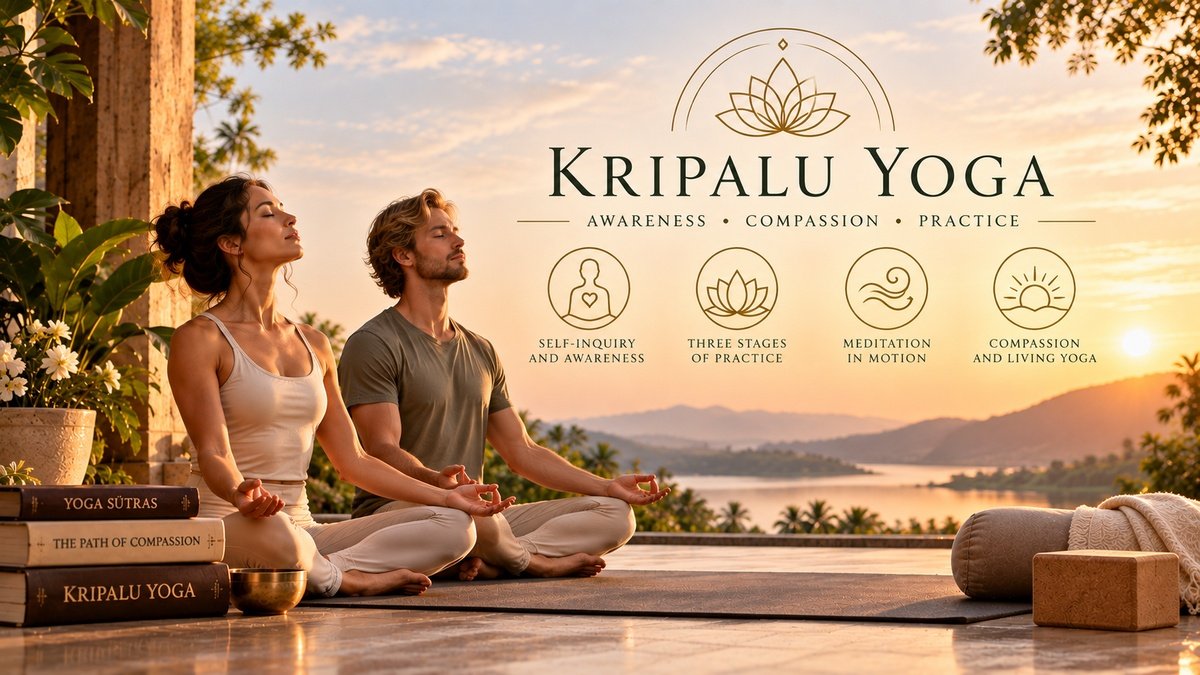
Kripalu Yoga places an unusual question at the centre of physical practice: not simply “Am I doing the posture correctly?” but “What am I noticing while I am here?”
Movement and alignment still matter. So do breath, āsana, prāṇāyāma and meditation. Yet Kripalu repeatedly directs attention towards the practitioner’s immediate experience.
Sensation, effort, thought, emotion and habitual reaction can all become material for observation.
This emphasis helps explain why contemporary Kripalu frequently describes yoga through qualities such as self-inquiry, non-judgmental awareness and compassion.
Its history, however, is more complex than the description of a yoga class might suggest.
The tradition takes its name from Indian teacher Swami Kripalvananda, commonly known as Swami Kripalu. His disciple Amrit Desai developed the American community from which Kripalu Yoga emerged. After a serious leadership crisis involving Desai in 1994, that community reorganised and eventually developed into the contemporary Kripalu Center for Yoga & Health.
So what is Kripalu Yoga? Who was Swami Kripalu? What role did Amrit Desai play? What are the three stages of practice? What does “Meditation in Motion” mean? And how did a guru-centred ashram become a modern educational organisation?
What Is Kripalu Yoga?
Kripalu Yoga is a modern approach to Haṭha Yoga that integrates physical practice, breathing, meditation and self-observation.
Its contemporary teaching places particular emphasis on developing awareness of experience without immediately judging, suppressing or reacting to it.
A Kripalu class can include centring, warm-ups, āsana, coordinated breathing, prāṇāyāma, relaxation and meditation.
However, the external sequence alone does not define the method.
Kripalu encourages practitioners to notice what occurs while they practise. Physical sensation may form part of that enquiry, alongside breathing, thoughts, effort, preferences and reactions.
The contemporary Kripalu School of Yoga describes its approach as combining technical foundations with an intuitive, experience-based way of practising and teaching.
Consequently, Kripalu Yoga is better understood as a methodology of practice and self-inquiry than as one fixed sequence of postures.
What Does Kripalu Mean?
The name Kripalu comes from Swami Kripalvananda, the Indian yoga teacher whose teachings inspired the tradition.
His given name was Haridas Jamnadas Majmundar. After becoming a renunciate, he received the name Swami Kripalvananda.
The name is associated with compassion, and Kripalu’s contemporary teaching continues to place compassion and non-judgmental awareness prominently within its understanding of practice.
However, Kripalu Yoga should not be understood simply as “compassion yoga”.
The name refers to a particular teaching lineage and the modern method that subsequently developed from it.
Who Was Swami Kripalu?
Swami Kripalvananda, usually known as Swami Kripalu, was an Indian renunciate and yoga teacher born in Gujarat in 1913.
Kripalu’s historical account describes him studying yoga, Ayurveda and Indian philosophical texts from the 1930s onwards. Patañjali’s eightfold system became one important influence on his teaching.
He became a renunciate in 1942 and subsequently devoted extensive periods to disciplined yogic practice, including meditation and prāṇāyāma.
Swami Kripalu’s teaching emphasised direct experience rather than intellectual knowledge alone.
Practice, in this understanding, provides a context in which practitioners can observe themselves more closely.
Three themes commonly associated with his legacy are sādhana, disciplined spiritual practice; sevā, service; and saṅgha, community.
Swami Kripalu travelled to the United States in 1977 and spent several years within the communities established by his disciple Amrit Desai.
He returned to India in 1981 and died later that year.
Who Developed Kripalu Yoga?
Swami Kripalu inspired the tradition, but the modern American system known as Kripalu Yoga developed substantially through the work of his disciple Amrit Desai.
Desai was born in India and later moved to the United States.
In 1966, he established the Yoga Society of Pennsylvania to promote yoga study and practice.
The organisation expanded during the following decade. In 1972, the first Kripalu ashram was established in Sumneytown, Pennsylvania. The community later adopted the name Kripalu Yoga Fellowship in recognition of Swami Kripalu’s influence.
In 1983, the organisation relocated to Stockbridge, Massachusetts, where the Kripalu Center developed.
These distinctions matter historically.
It would be too simple to say that Swami Kripalu personally created the contemporary Kripalu Yoga class system. His teachings provided its spiritual foundation, while Desai and the American community developed the methodology and organisation through which Kripalu Yoga became widely taught.
What Are the Three Stages of Kripalu Yoga?
One of the most distinctive frameworks within Kripalu Yoga practice is its description of practice through three stages.
These stages do not simply represent beginner, intermediate and advanced postures.
Instead, they describe a progression in the practitioner’s relationship with effort, attention and inner experience.
Stage One: Willful Practice
The practitioner learns foundational postures, breathing practices and alignment. Deliberate effort and concentration provide structure while awareness develops.
Stage Two: Sustaining and Deepening
Practice increasingly emphasises sustained attention. Practitioners may remain in postures for longer periods while observing sensations, thoughts and other aspects of experience.
Stage Three: Meditation in Motion
The traditional framework describes a movement away from deliberate control towards greater surrender and responsiveness to internal experience. Movement may become less externally prescribed and more spontaneous.
These stages belong to Kripalu’s own practice model.
They should not be interpreted as a universal hierarchy through which every yoga practitioner must progress.
What Is Willful Practice?
The first stage provides the structure through which practitioners learn.
Here, “willful” does not necessarily mean forceful.
The practitioner intentionally learns āsana, breathing, concentration and the fundamental methods of the tradition.
External guidance therefore has an important role.
A teacher may introduce alignment, coordinate movement with breath and help students develop enough familiarity with practice to observe their experience more clearly.
This stage reminds us that intuitive practice does not necessarily mean abandoning technique.
Kripalu first establishes a framework. Greater internal exploration develops within that framework.
What Happens in the Second Stage of Kripalu Yoga?
In the second stage, attention moves increasingly towards what happens within the posture.
Practitioners may sustain āsanas for longer periods and observe changing sensations, breathing, thoughts and reactions.
Kripalu teaching has historically used concepts such as finding an appropriate edge, observing sensation and cultivating witness consciousness within this stage.
The purpose is not simply to remain in a posture for as long as possible.
Duration creates an opportunity for observation.
A practitioner might notice the urge to leave a position, the desire to achieve more, changes in breathing or the tendency to judge an experience as pleasant or unpleasant.
The practice then includes both the posture and the practitioner’s relationship with what occurs inside it.
What Is Meditation in Motion?
Meditation in Motion describes the third stage of the traditional Kripalu Yoga model.
Rather than continuing to direct every movement deliberately, the practitioner experiments with allowing movement to emerge more spontaneously.
Traditional Kripalu language connects this process with prāṇa, the yogic concept of vital energy.
The practitioner observes and responds rather than consciously choreographing every action.
This does not mean that involuntary movement proves that a measurable physical energy has taken control of the body.
Prāṇa belongs to traditional Indian yogic frameworks. Modern physiology uses different models to explain movement, breathing and nervous-system activity.
We can describe the experience of spontaneous or less consciously directed movement without treating one traditional explanation as established biomedical fact.
Within Kripalu, the essential shift is from deliberate performance towards observation and responsiveness.
What Is BRFWA in Kripalu Yoga?
Another distinctive Kripalu methodology is commonly abbreviated as BRFWA:
Breathe. Relax. Feel. Watch. Allow.
The sequence provides a simple framework for bringing attention to present experience.
Breathe directs awareness towards breathing.
Relax invites the practitioner to notice and soften unnecessary effort where appropriate.
Feel turns attention towards direct experience.
Watch introduces observation rather than immediate reaction.
Allow encourages space for experience to unfold without requiring the practitioner to control everything that arises.
The method can function as an attentional tool rather than a promise that every difficult sensation or emotion should simply be tolerated.
Awareness remains compatible with changing a posture, resting or stopping when appropriate.
What Is Witness Consciousness?
The idea of witness consciousness plays an important role in Kripalu Yoga.
In practical terms, it involves observing aspects of experience without immediately becoming absorbed in every thought, sensation or reaction.
A practitioner may notice discomfort without instantly labelling the entire practice unsuccessful. A thought can appear without requiring action. An emotion may be recognised without becoming the sole definition of the moment.
This idea has deeper philosophical roots within Indian traditions of yoga and meditation.
It should therefore not be reduced entirely to a contemporary psychological technique.
At the same time, yoga philosophy and modern psychology use different conceptual frameworks. Similarities in language do not make them identical systems.
Why Does Kripalu Yoga Emphasise Non-Judgmental Awareness?
Kripalu encourages practitioners to observe experience with less immediate judgement.
That can alter the questions we bring to practice.
Instead of asking only whether a posture looks correct, someone might notice where effort appears, how breathing responds or what happens when a movement becomes challenging.
Non-judgment does not mean losing discernment.
Pain does not need to be ignored. A boundary does not need to disappear. Harmful behaviour does not become acceptable simply because someone observes it compassionately.
Rather, the practice creates some distance between noticing an experience and automatically condemning or identifying with it.
Compassion and discernment can therefore coexist.
What Happens in a Kripalu Yoga Class?
There is no single compulsory Kripalu Yoga sequence.
A class commonly begins with centring and awareness of breathing.
Warm-ups may prepare for āsana before the teacher introduces standing, seated, balancing or floor-based postures according to the purpose of the session.
Breath frequently accompanies movement, while periods of stillness provide opportunities for observation.
Prāṇāyāma, relaxation and meditation can also form part of the practice.
Contemporary Kripalu teacher training includes foundational āsanas and prāṇāyāma while encouraging teachers to create well-rounded classes and support students in developing self-awareness.
The method therefore combines external teaching with increasing attention to internal experience.
Does Kripalu Yoga Have a Fixed Sequence?
No. A fixed universal series does not define Kripalu Yoga.
Teachers can construct sequences according to the class, students and intended focus.
This distinguishes it from systems such as modern Ashtanga Yoga, where established series provide the principal structure of practice.
However, flexibility in sequencing does not mean absence of method.
Kripalu retains recognisable principles concerning breath, awareness, self-observation and the relationship between deliberate practice and deeper internal enquiry.
The sequence can change while the methodology remains recognisable.
Is Kripalu Yoga a Form of Hatha Yoga?
Kripalu Yoga developed as a modern approach to Hatha Yoga.
Its physical practice includes familiar elements such as āsana and prāṇāyāma, while its broader methodology incorporates meditation and philosophical enquiry.
However, modern Kripalu Yoga should not be projected unchanged into the history of premodern Haṭhayoga.
The method emerged within a twentieth-century transnational context, drawing from Indian yogic teachings while developing distinctive practices in North America.
It is therefore both connected with older yoga traditions and recognisably modern in its present form.
What Philosophical Traditions Influence Kripalu Yoga?
Kripalu’s contemporary teacher education identifies several Indian philosophical traditions as important influences, including Vedānta, Sāṃkhya, Tantra and Tantric Haṭha Yoga.
Patañjali’s yoga has also played an important role within the lineage associated with Swami Kripalu.
These traditions do not constitute one uniform philosophy.
Sāṃkhya, Vedānta, Pātañjala Yoga and different Tantric traditions can make substantially different claims about consciousness, reality, liberation and the relationship between the individual and the world.
Consequently, describing all of them as “the philosophy of Kripalu Yoga” would flatten meaningful distinctions.
Modern Kripalu draws from several streams and integrates them within its own contemporary teaching framework.
Is Kripalu Yoga Gentle Yoga?
Not necessarily.
Kripalu’s emphasis on compassion and self-awareness can lead to the assumption that every class is physically gentle.
In reality, intensity can vary.
A practice may be quiet and accessible, while another may involve sustained postures, stronger movement or considerable concentration.
The central issue is not whether the practice appears gentle from the outside.
Instead, practitioners are encouraged to develop enough awareness to recognise how they are responding and make appropriate choices.
Compassion does not require the absence of effort.
Is Kripalu Yoga Suitable for Beginners?
Kripalu Yoga can be accessible to beginners because its methodology encourages practitioners to notice their own experience rather than simply reproduce an advanced external form.
Contemporary Kripalu teaching also provides structured instruction in foundational āsanas, breathing and alignment.
However, accessibility still depends on the particular class.
Teachers can vary pace, intensity, duration and complexity. Individual physical circumstances also differ.
A beginner therefore benefits from the same principle that supports more experienced practitioners: work with what is actually happening rather than with an assumed standard of what the practice should look like.
What Happened at Kripalu in 1994?
Kripalu’s history includes a significant ethical and organisational crisis.
In 1994, revelations concerning founder and spiritual leader Amrit Desai’s abuse of power led the community to ask him to step down.
The event challenged an organisation that had developed around a powerful spiritual authority.
Rather than dissolving, Kripalu underwent substantial restructuring.
The organisation gradually moved away from its guru-centred ashram model. In 1999, it formally shifted from a religious society to an educational organisation governed by a Board of Trustees.
Kripalu itself now includes the 1994 crisis in its public historical timeline.
That acknowledgement matters because the history of a yoga method includes more than its postures and philosophy.
It also includes questions of authority, boundaries, governance and accountability.
Is Amrit Desai Still the Leader of Kripalu?
No.
Amrit Desai left his leadership position in 1994.
The contemporary Kripalu Center for Yoga & Health operates independently of his leadership and has evolved considerably from the original ashram community.
This distinction prevents two opposite historical errors.
Removing Desai from the history would obscure his substantial role in developing the American Kripalu tradition.
Treating contemporary Kripalu as though it remains his organisation would also be inaccurate.
A tradition can retain aspects of its historical teaching while changing the structures through which it operates.
How Did Kripalu Change from an Ashram to a Modern Yoga Centre?
The transformation occurred gradually.
Kripalu began within an explicitly spiritual community organised around yogic practice and spiritual leadership.
Following the 1994 crisis, governance changed and the organisation broadened its educational role.
Today, the Kripalu Center in Stockbridge offers yoga education alongside programmes in areas such as meditation, Ayurveda and related approaches to well-being.
The Kripalu School of Yoga continues to train yoga teachers while maintaining an explicit connection with the teachings of Swami Kripalu.
Contemporary Kripalu is therefore neither completely disconnected from its lineage nor structurally identical to the community from which it emerged.
What Are the Potential Benefits of Kripalu Yoga?
Kripalu Yoga combines movement, breathing, attention, relaxation and meditation in ways that practitioners may find valuable for different reasons.
Physical practice can provide opportunities to explore strength, mobility, balance and coordination. Breath and meditation introduce additional forms of attentional practice.
Its emphasis on observation may also help practitioners become more aware of how they respond to effort and changing experience.
These possibilities should remain distinct from medical claims.
Kripalu Yoga should not be presented as a guaranteed treatment for anxiety, depression, trauma, chronic pain or other health conditions.
Research may investigate particular yoga programmes and populations, but findings from specific interventions do not automatically establish therapeutic effects for every Kripalu class or practitioner.
A Common Misunderstanding: Listening to the Body Does Not Mean Doing Whatever Feels Pleasant
“Listen to your body” has become familiar language in contemporary yoga.
Yet listening is more complicated than simply choosing whatever feels easiest or most pleasant.
Experience contains competing information.
Effort may be appropriate. Discomfort can sometimes accompany unfamiliar movement. At other times, a sensation may indicate that changing or stopping is the sensible response.
Awareness alone does not automatically provide perfect interpretation.
Practice can instead help us become more curious about the information available to us.
Self-awareness is not the absence of discernment. It is part of what makes discernment possible.
An Orenna Perspective: Notice Before You Judge
Yoga can easily become another environment in which we measure ourselves.
How far did I move? How long did I stay? Did the posture look right? Was today’s practice better than yesterday’s?
Kripalu introduces another possibility.
Before deciding what an experience means, we can notice what is actually happening.
The breath changes. Effort appears. A thought interrupts. One side feels different from another. Perhaps the impulse is to continue. Perhaps it is to stop.
None of these observations needs to become a verdict on the practitioner.
That does not mean abandoning technique, intention or discernment. It means creating enough space to see more clearly before deciding what comes next.
Sometimes awareness changes practice not by telling us what we should experience, but by allowing us to recognise what is already there.
References & Further Reading
Kripalu Center for Yoga & Health. The Moments That Made Us: A Kripalu Timeline. The organisation’s historical timeline documents the development from the Yoga Society of Pennsylvania through the ashram period, the 1994 leadership crisis and subsequent organisational restructuring.
Kripalu Center for Yoga & Health. The Life of Swami Kripalu. An institutional account of Swami Kripalvananda’s life, practice and relationship with the American Kripalu community.
Kripalu Center for Yoga & Health. What Is Kripalu Yoga? A Guide to Its Philosophy, Stages, and Benefits. Contemporary description of the three stages of Kripalu Yoga and its emphasis on awareness and self-inquiry.
Kripalu School of Yoga. Current teacher-training materials describing foundational āsana, prāṇāyāma, natural alignment, self-awareness and the philosophical traditions informing contemporary Kripalu Yoga.
Cope, Stephen. (1999). Yoga and the Quest for the True Self. Bantam. A widely read exploration of yoga and contemplative practice written by a former scholar-in-residence at Kripalu.
Singleton, Mark. (2010). Yoga Body: The Origins of Modern Posture Practice. Oxford University Press. Provides broader scholarly context for the development of modern transnational postural yoga.



