


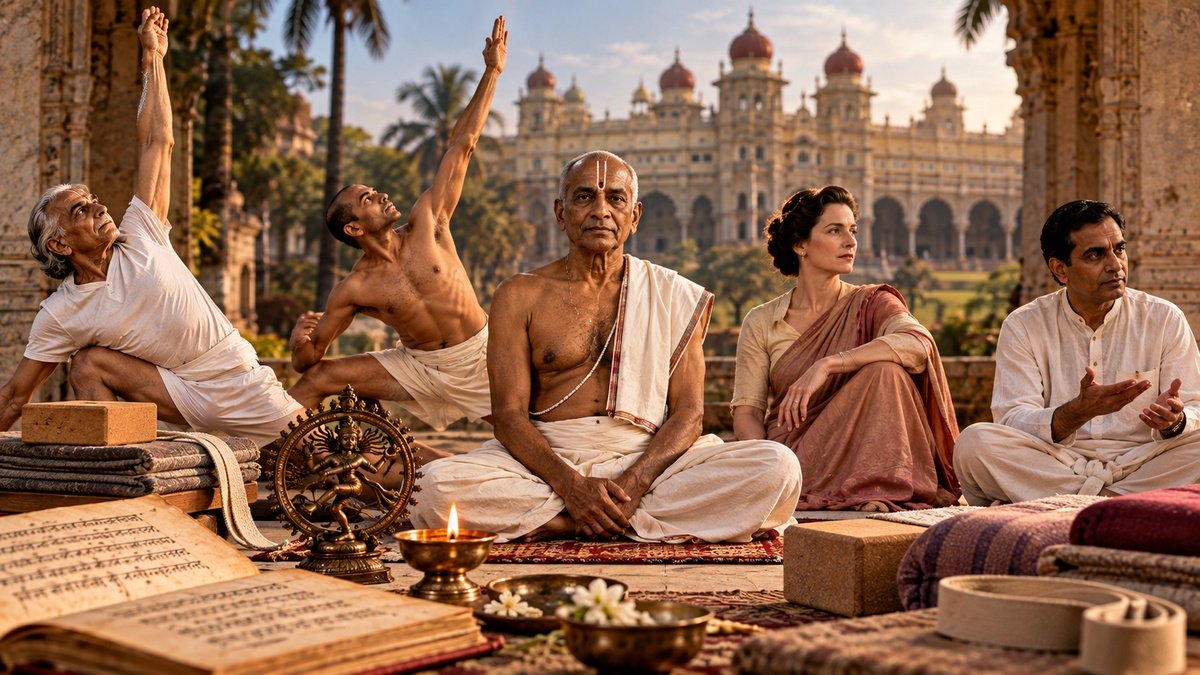
Few individuals occupy as prominent a place in the story of twentieth-century yoga as Krishnamacharya. His students went on to develop approaches that reached millions of practitioners around the world, yet those approaches often looked remarkably different from one another.
This creates an interesting question.
How could one teacher influence B.K.S. Iyengar, K. Pattabhi Jois, Indra Devi and T.K.V. Desikachar, while their later teaching developed in such different directions?
The answer reveals something important about yoga itself. Teaching does not always pass unchanged from one generation to the next. Context, individual needs, interpretation and experience can reshape what a teacher receives and what they later transmit.
Krishnamacharya’s own teaching also changed during his long life. His work in the Mysore Palace environment differed in important ways from the more individually adapted teaching associated with his later years in Madras, now Chennai.
His significance therefore lies not in creating one fixed modern yoga system, but in helping shape several influential directions within modern yoga.
Who Was T. Krishnamacharya?
Tirumalai Krishnamacharya lived from 1888 to 1989, spanning a period of extraordinary change in India and in the wider history of yoga.
He became known as a scholar and teacher with interests extending far beyond physical posture. His intellectual world included Sanskrit learning, Indian philosophy and traditional systems of yoga.
Although contemporary yoga history often remembers him primarily through āsana, this can give an incomplete impression of his work.
Āsana formed part of a much broader approach that could also include prāṇāyāma, chanting, meditation, philosophical study and other aspects of yoga.
Most importantly, his teaching did not remain completely static throughout his life.
Different students encountered him at different ages, in different settings and for different purposes. Those circumstances help explain why their experiences of his teaching were not identical.
Krishnamacharya and the Mysore Palace Years
One of the most influential periods in Krishnamacharya’s career took place in Mysore during the 1930s and 1940s.
With the patronage of the Maharaja of Mysore, he taught yoga in an environment that brought together traditional learning, education, public demonstration and physical culture.
Many of his students during this period were young and physically capable. His teaching could therefore include demanding āsanas, dynamic movement and demonstrations designed to display skill and control.
This context matters.
A practice taught to young students within the Mysore Palace environment should not automatically become a universal prescription for every practitioner.
Krishnamacharya himself would later become strongly associated with the principle that practice should respond to the individual and to changing circumstances.
Did Krishnamacharya Invent Modern Yoga?
No single individual invented modern yoga.
By the time Krishnamacharya began his influential work, yoga was already changing significantly.
Swami Vivekananda had presented yoga philosophy to international audiences in the late nineteenth century. Śrī Yogendra was developing approaches to yoga for householders and modern life. Swami Kuvalayananda was bringing yogic practices into dialogue with scientific research.
Physical culture was also developing rapidly in India and internationally.
Krishnamacharya therefore belongs within a larger historical transformation rather than standing at its beginning.
His influence was nevertheless substantial. In particular, several people who studied with him later became major figures in the international development of posture-centred yoga.
For the wider historical context, read From Tradition to Transformation: How Modern Yoga Took Shape.
Tradition and Innovation
It can be tempting to describe yoga teachers as either guardians of tradition or creators of something new.
Krishnamacharya makes that distinction difficult to maintain.
He drew upon Indian philosophical and yogic traditions while teaching within the social and physical-culture environment of twentieth-century India.
Older sources mattered to him. So did the person standing in front of him.
His work therefore demonstrates how tradition and innovation can exist together.
A teacher may inherit practices, texts and principles without reproducing every aspect of them in exactly the same form.
Transmission can involve interpretation.
Why Did His Teaching Change?
Krishnamacharya lived for more than a century. It would be surprising if his teaching had remained identical throughout such a long life.
His circumstances changed. The people seeking his guidance changed. His own age and experience changed as well.
After the Mysore Palace yoga school closed, he eventually settled in Madras. His later work became increasingly associated with individual teaching and adaptation.
Rather than beginning with the assumption that every person should perform the same practice, this approach considered the individual practitioner.
Age, capacity, circumstances and purpose could influence what a teacher selected.
This principle became particularly important in the teaching later associated with his son T.K.V. Desikachar.
B.K.S. Iyengar — Precision, Alignment and Support
Bellur Krishnamachar Sundararaja Iyengar, better known as B.K.S. Iyengar, studied with Krishnamacharya while he was young.
Iyengar subsequently developed a distinctive approach to yoga through decades of personal practice, experimentation and teaching.
His method became particularly associated with detailed attention to āsana, alignment, sequencing and careful observation of the body.
Props also became a notable feature of his teaching.
Blocks, belts, blankets, chairs, bolsters, walls and other forms of support could change the relationship between a practitioner and a posture.
A prop did not necessarily make a posture “easier.” It could help a practitioner explore a particular action, create stability, modify a position or remain within a posture under different conditions.
This work would become particularly significant for later approaches that explored supported and quieter forms of āsana.
K. Pattabhi Jois — Dynamic Sequencing and Ashtanga Vinyasa
K. Pattabhi Jois also studied with Krishnamacharya during the Mysore period.
Jois later became closely associated with the system now widely known as Ashtanga Vinyasa Yoga.
This approach organises āsanas into established sequences and connects movement with breathing through a dynamic practice structure.
The word aṣṭāṅga requires some clarification here.
In Sanskrit, aṣṭāṅga means “eight-limbed” or “having eight limbs.” Patañjali uses the term for the eight-part framework described in the Yoga Sūtras.
Modern Ashtanga Vinyasa Yoga, however, refers to a particular twentieth-century system of physical practice associated with Pattabhi Jois.
The two uses of the word should not be treated as though they describe exactly the same system.
For the earlier philosophical framework, read Beyond Āsana: Understanding the Eight Limbs of Yoga.
Indra Devi — Yoga Across New Audiences
Indra Devi offers another striking example of how Krishnamacharya’s teaching moved in a different direction.
Born Eugenie Peterson in what was then the Russian Empire, she later became known internationally as Indra Devi.
She studied with Krishnamacharya in Mysore and went on to teach yoga internationally.
Her career helped bring yoga to audiences that differed considerably from the young male students associated with parts of the Mysore Palace period.
Women became particularly important among her students, and her international work contributed to yoga’s growing visibility beyond India.
Her story also complicates any simple account in which modern yoga travelled in only one direction.
Yoga’s global development involved Indian teachers, international students, migration, travel, publishing and teaching across cultural boundaries.
Indra Devi became part of that transnational history.
T.K.V. Desikachar — Beginning With the Individual
T.K.V. Desikachar encountered Krishnamacharya in a very different relationship: he was his son as well as his long-term student.
Desikachar originally trained as an engineer before devoting himself more fully to yoga.
Through years of study with his father, he became an important transmitter of Krishnamacharya’s later teaching.
Individual adaptation became a defining principle of this approach.
Rather than requiring every practitioner to conform to one predetermined sequence, a teacher could consider the person’s circumstances, capacities and aims.
The practice might therefore change when the practitioner changed.
Age, experience, available time and other circumstances could all influence the form of practice.
This principle does not mean that anything can simply be called yoga. Adaptation still requires knowledge, discernment and an understanding of what the practice is intended to do.
However, it shifts an important question from “Can this person perform the prescribed practice?” towards “What form of practice is appropriate for this person?”
One Teacher, Four Very Different Legacies
Place these four students beside one another and the diversity becomes difficult to ignore.
Iyengar became associated with detailed āsana work, alignment and extensive use of props.
Pattabhi Jois developed a demanding sequential approach that became internationally known as Ashtanga Vinyasa Yoga.
Indra Devi brought yoga into new international environments and helped expand its audience.
Desikachar emphasised individual adaptation and transmitted important dimensions of his father’s later teaching.
These are not four copies of the same method.
Each teacher developed what they had received within a different life, audience and teaching environment.
That diversity is central to understanding Krishnamacharya’s legacy.
What Does “Lineage” Actually Mean?
Yoga communities often use the word lineage to describe a chain of teaching and transmission.
The idea can be valuable. It acknowledges that knowledge comes through relationships between teachers and students rather than appearing from nowhere.
Yet lineage does not necessarily mean exact replication.
Students interpret what they learn. Their bodies, circumstances, communities and historical periods differ from those of their teachers.
Some elements remain recognisable while others change.
The different legacies associated with Krishnamacharya demonstrate this particularly clearly.
A lineage can therefore contain both continuity and transformation.
Where Does Restorative Yoga Enter the Story?
The relationship between this history and contemporary Restorative Yoga requires careful wording.
Krishnamacharya should not simply be described as the founder of Restorative Yoga.
Nor should B.K.S. Iyengar automatically receive that title.
Iyengar’s extensive exploration of props, support and adapted postures nevertheless created an important context for later restorative approaches.
Judith Hanson Lasater studied within the Iyengar tradition and became a highly influential teacher of Restorative Yoga. Her work placed sustained, carefully supported rest at the centre of a distinct contemporary approach to practice.
Lasater has taught yoga since the early 1970s and has described how her own āsana practice increasingly incorporated supported postures as her life and body changed.
Her teaching and writing subsequently helped bring Restorative Yoga to a much wider audience.
The historical relationship is therefore better understood as influence and development rather than as a simple claim that one individual suddenly invented the entire practice.
For a closer look at the contemporary practice itself, read The Art of Supported Rest: Understanding Restorative Yoga.
Support Does Not Make a Practice Lesser
The development of prop-based practice also challenges a common assumption about yoga.
Support does not automatically represent a simplified version of the “real” posture.
A wall, chair, bolster, blanket or block changes the conditions of an āsana.
Sometimes that change increases accessibility. In another context, it may alter stability, orientation, duration or the specific action being explored.
The value of the prop therefore depends upon its purpose.
This principle has relevance far beyond one particular yoga method. It asks us to evaluate a practice according to what it is intended to support rather than according to how difficult it looks.
A Common Misunderstanding: Krishnamacharya Created One System
Looking backwards from today’s yoga styles can create the impression that Krishnamacharya developed one complete method and then distributed it among several students.
The historical picture is less tidy.
His teaching developed across different periods of his life. Students encountered him within different contexts and then continued to develop their own approaches.
The later methods associated with Iyengar, Pattabhi Jois, Indra Devi and Desikachar therefore should not simply be treated as four branded versions of one original system.
Each has its own history.
Recognising those differences gives us a more accurate understanding of how modern yoga develops: through transmission, interpretation, experimentation and change.
Adaptation Is Not the Same as Doing Anything
The idea of adapting yoga to an individual can sound simple, but responsible adaptation requires discernment.
A teacher needs to understand the purpose of a practice before changing its form.
What is the posture, breathing practice or sequence intended to explore? Which elements matter most? What can change without losing that purpose?
These questions become particularly important when people have different mobility, experience, comfort or support needs.
The goal does not have to be making every body reproduce one idealised external shape.
Instead, thoughtful adaptation can begin with function, purpose and the person who is actually practising.
This does not turn yoga teaching into medical diagnosis or treatment. Health concerns that fall outside a teacher’s professional competence remain matters for appropriately qualified healthcare professionals.
Why Krishnamacharya Still Matters
Krishnamacharya’s importance cannot be measured only by the number of contemporary yoga styles connected with his students.
His long teaching life also demonstrates how yoga can change across time and context.
The vigorous work associated with young students in Mysore does not tell the entire story. Neither does the individually adapted teaching associated with his later years.
Both belong to the history.
This makes his legacy especially useful when thinking about what tradition means.
Tradition does not necessarily require every practitioner to repeat the same sequence. Nor does adaptation require abandoning everything that came before.
The relationship between the two can be more dynamic.
The Orenna Perspective
At Orenna, this history offers an important principle without requiring a claim of direct lineage.
The practice should respond to the person.
That does not mean changing yoga randomly or assuming that every practice suits every circumstance.
It means beginning with purpose.
What are we exploring? What support does this person need? Which elements of the practice matter here? What can be adapted, and when would another approach be more appropriate?
This perspective also changes the meaning of support.
A bolster, chair, blanket, wall or block is not evidence that someone is doing less yoga. It is a tool that can alter the conditions of practice.
Sometimes movement may be appropriate. At another moment, stillness may offer more. One person may benefit from a chair while another prefers the floor. Even the same person’s practice may change from one day or life stage to another.
The history surrounding Krishnamacharya and his students reminds us that adaptation and tradition do not have to stand on opposite sides.
What matters is understanding what we have inherited, recognising what has changed and being clear about why we choose the practice we offer now.
References & Further Reading
Singleton, Mark. Yoga Body: The Origins of Modern Posture Practice. Oxford University Press, 2010. An influential study of the historical development of modern posture-centred yoga and the physical-culture environment in which Krishnamacharya taught.
Singleton, Mark & Fraser, Tara. Yoga. The Indian traditions and modern transformations of yoga provide broader context for understanding twentieth-century developments.
Mohan, A.G. & Mohan, Ganesh. Krishnamacharya: His Life and Teachings. Shambhala. A biographical account by students closely connected with Krishnamacharya’s later teaching.
Desikachar, T.K.V. The Heart of Yoga: Developing a Personal Practice. Inner Traditions. Presents an influential account of the individually adapted approach associated with Krishnamacharya’s later teaching.
Iyengar, B.K.S. Light on Yoga. A major twentieth-century work documenting Iyengar’s approach to āsana and yoga practice.
Lasater, Judith Hanson. Relax and Renew: Restful Yoga for Stressful Times. A foundational modern text in the development and wider dissemination of Restorative Yoga.
Centre for Yoga Studies. Śrī T. Krishnamacharya — The Source. Archival material and resources relating to Krishnamacharya and the teaching subsequently transmitted through T.K.V. Desikachar.
The Orenna Journal explores yoga from historical, philosophical and contemporary perspectives. Accounts of twentieth-century yoga lineages sometimes differ between biographical, institutional and scholarly sources. This article presents Krishnamacharya as an influential contributor to modern yoga rather than as the sole creator of one universal modern system. Orenna Wellness does not claim direct lineage from Krishnamacharya, Iyengar, Desikachar or Judith Hanson Lasater unless explicitly stated elsewhere.