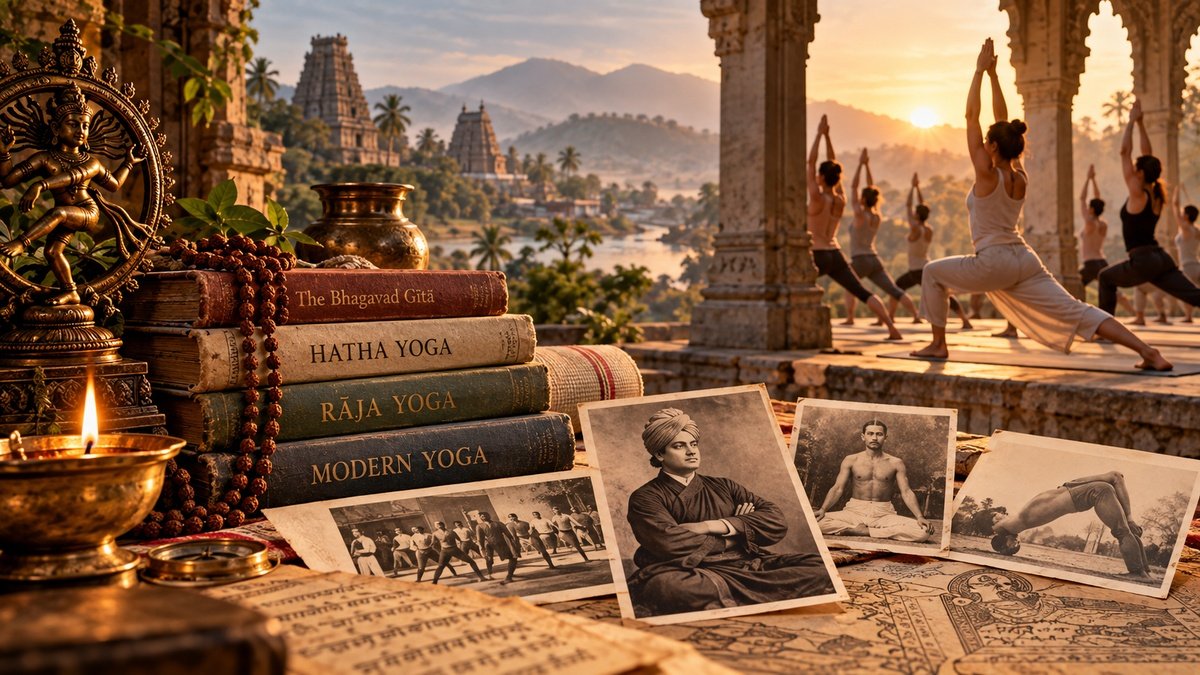
Walk into a yoga studio today and you may encounter mats, standing postures, flowing sequences, breathing practices, meditation and carefully structured classes. Yet much of this familiar environment represents a relatively recent chapter in the much longer history of modern yoga.
This does not mean that modern yoga has no relationship with older Indian traditions. Nor does it mean that the yoga practised today has existed unchanged for thousands of years.
The history is more interesting than either explanation.
Modern yoga developed through encounters between older Indian practices and philosophies, colonial-era institutions, physical culture, changing ideas about health, new technologies, Indian reform movements and increasingly international audiences.
Across the nineteenth and twentieth centuries, teachers and practitioners interpreted yoga for changing circumstances. In the process, they helped create forms of practice that would eventually travel around the world.
Understanding this transformation allows us to see modern yoga not as a historical mistake, but as part of yoga’s continuing history of adaptation and change.
What Do We Mean by “Modern Yoga”?
The term modern yoga does not describe one single practice.
Scholars use it to discuss a range of yoga systems that developed during the modern period, particularly from the nineteenth century onwards.
Some placed philosophy, meditation or religious experience at the centre. Others increasingly emphasised health, physical discipline and āsana. Many combined elements from several areas.
Modern yoga is therefore broader than what scholars sometimes call modern postural yoga.
The latter term draws particular attention to forms of yoga in which āsana becomes a major, and sometimes dominant, part of practice.
This distinction matters because the international prominence of posture can make it appear as though yoga has always revolved primarily around āsana.
Historically, that was not the case.
Yoga Before the Modern Studio
Long before the emergence of the modern yoga studio, the Indian subcontinent contained diverse traditions of yoga.
Different texts and communities developed practices involving meditation, ethical discipline, breath control, asceticism, devotion, philosophical inquiry and techniques for working with the body.
Patañjali’s Yoga Sūtras offered one influential formulation. The Bhagavad Gītā developed others through discussions of action, knowledge, meditation and devotion.
Medieval Haṭha traditions gave increasing importance to physical methods such as āsana, prāṇāyāma and mudrā, alongside subtle-body practices and meditative goals.
These traditions form important parts of yoga’s history. However, none corresponds exactly to the typical structure of a contemporary studio class.
For a closer exploration of this earlier physical tradition, read Beyond the Pose: Understanding Haṭha Yoga and Its Origins.
The Nineteenth Century: Yoga in a Changing India
The nineteenth century brought enormous political, social and cultural change across South Asia.
British colonial rule transformed institutions, education and public life while producing unequal relations of political power. At the same time, Indian thinkers, religious leaders, reformers and practitioners actively responded to these conditions in many different ways.
New forms of print culture made texts and ideas available to wider audiences. Expanding travel and international communication created further opportunities for exchange.
Indian intellectuals also reconsidered how religious and philosophical traditions might speak within a rapidly changing world.
Yoga participated in these transformations.
However, colonialism should not become the only explanation for modern yoga. Indian teachers and practitioners were not simply passive recipients of Western ideas. They interpreted, selected, resisted, combined and transformed ideas within changing historical circumstances.
The resulting history involves both unequal colonial power and significant Indian agency.
Swami Vivekananda and a Different Modern Yoga
Swami Vivekananda became one of the most influential figures in the early international presentation of yoga.
His appearance at the World’s Parliament of Religions in Chicago in 1893 helped establish him as a prominent Indian religious teacher before international audiences.
In 1896, he published Raja Yoga, presenting yoga through his interpretation of Patañjali and related philosophical ideas.
Yet Vivekananda’s presentation differed considerably from the posture-centred yoga that would later become internationally familiar.
Āsana did not dominate his system.
This is an important moment in the history of modern yoga because it demonstrates that yoga could become modern and transnational without becoming primarily a programme of physical postures.
The global prominence of āsana came through additional developments.
Yoga Meets Modern Physical Culture
During the late nineteenth and early twentieth centuries, physical culture expanded internationally.
Gymnastics, bodybuilding, calisthenics and systems of physical education circulated across national boundaries. India participated actively in this international culture of the body.
Indian practitioners experimented with relationships between older physical traditions, yoga, exercise and emerging ideas about health and strength.
As a result, the boundary between “traditional yoga” and “modern exercise” was not always simple or fixed.
Practices could influence one another. Teachers could reinterpret older techniques, incorporate new methods or present yoga through contemporary ideas about the body.
Over time, āsana gained considerably greater visibility within this environment. Oxford scholar Mark Singleton identifies the early twentieth century as a particularly important period in which yoga and physical culture increasingly interacted and posture became more prominent within mainstream modern yoga.
Was Modern Yoga Invented from Western Gymnastics?
No single explanation adequately describes this history.
Research has demonstrated important interactions between yoga and international physical culture, including gymnastics and bodybuilding.
However, saying that modern yoga was simply “invented from Western gymnastics” replaces one historical simplification with another.
Indian traditions already possessed substantial histories of āsana and other physical yogic practices. Recent research into premodern texts has also identified meaningful continuities between older postural traditions and later forms of yoga.
At the same time, modern practitioners did not merely preserve those earlier systems unchanged.
Indian and international physical cultures interacted. Teachers experimented, selected and innovated. Older postures could acquire new purposes, while new movements and methods entered developing systems of practice.
The result is better understood through continuity and transformation rather than through a choice between purely ancient and purely modern origins.
Yoga, Physical Culture and Indian Nationalism
Ideas about the body also carried political significance in colonial India.
Colonial discourse sometimes portrayed Indian people, particularly Indian men, through racialised stereotypes of physical weakness. Indian physical-culture movements responded within this unequal political environment in different ways.
Strength, discipline and bodily development could become connected with ideas of national regeneration and resistance to colonial representations.
Yoga entered parts of this wider conversation about the Indian body.
This does not mean that every modern yoga teacher pursued the same nationalist project. Nor should the diverse yoga movements of the period be reduced to politics alone.
Rather, the relationship between yoga and physical culture developed within a historical environment where health, education, religion, colonial power and emerging national identities could intersect.
Śrī Yogendra and Yoga for Modern Life
Śrī Yogendra was among the important figures who helped reshape yoga during the early twentieth century.
His work contributed to presenting yoga in forms suitable for householders rather than restricting practice to renunciant or ascetic settings.
Health, education and everyday life became increasingly important parts of this presentation.
This shift matters because the social setting of yoga was changing alongside its techniques.
A practice that could enter homes, educational environments and institutions could reach people whose lives looked very different from those of earlier ascetic practitioners.
Modernisation therefore involved more than changing the postures themselves. It also changed who could encounter yoga, where they might practise and what they might expect from it.
Swami Kuvalayananda and the Scientific Study of Yoga
Swami Kuvalayananda represents another significant development.
In the 1920s, his work at Kaivalyadhama brought yogic practices into sustained conversation with scientific investigation.
Researchers examined practices such as āsana and prāṇāyāma using the scientific methods available to them at the time.
This did not simply transform yoga into science. Rather, it created a new setting in which practitioners and researchers could describe traditional techniques through emerging physiological and medical frameworks.
The relationship between yoga and science would continue to develop throughout the twentieth century and remains influential today.
It also requires care. Historical yogic concepts and modern biomedical explanations are not automatically interchangeable, even when researchers study the physiological effects of a particular practice.
The Expanding Role of Āsana
One of the most visible changes in the history of modern yoga concerns the role of āsana.
Premodern yoga traditions already contained postures, and some later Haṭha sources documented substantial āsana repertoires.
During the twentieth century, however, posture acquired unprecedented prominence within many forms of transnational yoga.
Teachers documented increasingly extensive systems of āsana. Photography allowed readers to see precise bodily forms. Books and manuals could circulate those images far beyond the physical presence of an individual teacher.
These technologies changed how people could learn about yoga.
A photograph could transform an embodied practice into a reproducible image. Readers could compare positions, study alignment and encounter postures without travelling to meet the person who demonstrated them.
Modern media therefore became part of modern yoga’s development, not merely a way of recording something that already existed unchanged.
Krishnamacharya and the Mysore Years
Tirumalai Krishnamacharya became one of the most influential figures in twentieth-century postural yoga.
During the 1930s and 1940s, he taught yoga under the patronage of the Maharaja of Mysore. This period became particularly important for the development and public presentation of dynamic forms of āsana practice.
Krishnamacharya drew upon Indian yogic traditions while also teaching within a modern physical-culture environment.
Scholarship has therefore described his work not as the preservation of one untouched ancient sequence, but as a creative synthesis shaped by both inherited traditions and the circumstances of his time. :contentReference[oaicite:1]{index=1}
His influence became especially significant through the people who studied with him.
B.K.S. Iyengar, K. Pattabhi Jois, Indra Devi and T.K.V. Desikachar later became associated with distinctive approaches to yoga that reached audiences far beyond India.
Importantly, their methods were not identical.
The diversity among them is itself evidence that modern yoga did not develop through one fixed method passed unchanged from teacher to student.
Yoga Travels Beyond India
Yoga’s international development involved people moving in multiple directions.
Indian teachers travelled abroad. International students travelled to India. Books, photographs and organisations carried teachings across borders even when teachers themselves remained in one place.
Indra Devi became particularly important in bringing postural yoga to new international audiences. Other teachers and organisations developed their own networks across Europe, the Americas and elsewhere.
As yoga entered new cultural settings, its presentation continued to change.
Some communities retained explicitly religious or philosophical frameworks. Others foregrounded physical practice, meditation, health or personal development.
Students and teachers also adapted practice to different bodies, languages, cultures and social environments.
Globalisation therefore did not produce one universal modern yoga. It produced many modern yogas.
Who Gets Included in the History of Modern Yoga?
Historical narratives often become organised around a small number of famous teachers.
Those individuals matter, but they do not constitute the whole story.
Women played significant roles in the development and international circulation of modern yoga. So did householders, researchers, students, publishers, photographers, institutional patrons and less internationally recognised teachers.
Different regions of India also contributed distinct practices and intellectual traditions.
Moreover, the people who adopted yoga outside India did not form one culturally uniform audience.
A fuller history therefore asks not only which famous teacher created a particular system, but also which communities, institutions and social conditions allowed that system to develop and circulate.
This broader view makes the history more complex, but also more representative of the many people involved in yoga’s transformation.
From Spiritual Discipline to Global Practice
As yoga expanded internationally, its purposes also diversified.
For some practitioners, yoga remained deeply connected with religious commitment or liberation. Others approached it through meditation, philosophical study or disciplined self-cultivation.
Physical health and fitness became increasingly visible motivations within other settings.
Later, yoga also entered wellness spaces, community programmes, educational settings, leisure centres and commercial studios.
No single one of these environments now represents every experience of yoga.
This diversity helps explain why two people can both say that they practise yoga while describing very different activities, intentions and beliefs.
Modern yoga is not one homogeneous practice. It is a diverse field with multiple histories and purposes.
A Common Misunderstanding: Modern Yoga Is Either Ancient or Invented
Discussions about yoga history sometimes create a false choice.
One version claims that contemporary yoga preserves an ancient system that has remained essentially unchanged for thousands of years.
The opposite version claims that modern postural yoga is a recent invention with little meaningful relationship to earlier Indian yoga traditions.
Neither position captures the historical complexity particularly well.
Modern yoga contains genuine continuities with older Indian traditions. Āsana, prāṇāyāma, meditation and other yogic practices all have premodern histories.
At the same time, modern teachers reorganised these practices, developed new methods, changed their purposes and responded to new social environments.
Historical continuity does not require complete sameness.
Likewise, innovation does not erase everything that came before it.
Does Change Make Modern Yoga Less Authentic?
The word authentic can make discussions of yoga history difficult.
Authentic according to which period, text, community, lineage or purpose?
A practice does not become historically ancient simply because someone describes it as traditional. Equally, a practice does not automatically become meaningless because it developed recently.
Historians can investigate when practices appear in available sources, how teachers describe them and how traditions change.
Questions of personal or religious authenticity involve additional values that historical evidence alone cannot settle.
For contemporary practitioners, a more useful approach may be transparency.
We can value a modern practice while acknowledging that it is modern. We can respect its Indian roots without claiming that every element has remained unchanged since antiquity.
Why the History of Modern Yoga Matters
Understanding the history of modern yoga does not require abandoning contemporary practice.
It gives that practice context.
A standing posture can remain meaningful even if its contemporary form does not stretch unchanged across several thousand years.
A breathing practice can have historical roots while also acquiring new explanations in modern settings.
A teacher can adapt yoga thoughtfully without pretending that adaptation never occurred.
Historical literacy allows us to hold these possibilities together.
It also helps us distinguish between history and marketing. Claims about an ancient, unbroken practice may sound appealing, but the actual history often reveals something richer: generations of people interpreting yoga for changing circumstances.
For a broader exploration of yoga’s many meanings, read Beyond the Posture: What Does Yoga Actually Mean?.
The Orenna Perspective
At Orenna, understanding yoga’s history is not about searching for one moment when yoga was supposedly pure, complete or correct.
Yoga has never existed outside history.
People have interpreted it through different philosophies, religious traditions, bodies, communities and periods of social change.
The modern period forms part of that continuing story.
Recognising change also creates room for a more inclusive understanding of practice. Yoga does not need to depend upon reproducing one idealised body, one fixed sequence or one historical expression.
At the same time, adaptation benefits from historical honesty. Contemporary interpretation should not erase yoga’s Indian origins or present modern innovations as timeless facts.
We can acknowledge both inheritance and innovation.
We can recognise the influence of Indian teachers while also examining the wider cultural environments in which their methods developed.
And we can practise contemporary yoga without requiring history to remain still.
Perhaps that is one of the most useful lessons of modern yoga’s history: traditions can carry something forward while also changing along the way.
References & Further Reading
Singleton, Mark. Yoga Body: The Origins of Modern Posture Practice. Oxford University Press, 2010. An influential study of the rise of āsana within modern transnational yoga and its relationship with physical culture.
De Michelis, Elizabeth. A History of Modern Yoga: Patañjali and Western Esotericism. Continuum, 2004. An important study of the formation and development of modern yoga.
Alter, Joseph S. Yoga in Modern India: The Body Between Science and Philosophy. Princeton University Press, 2004. Explores modern yoga in relation to health, science, the body and Indian cultural history.
Newcombe, Suzanne. Yoga in Britain: Stretching Spirituality and Educating Yogis. Equinox, 2019. Examines the development and social history of yoga in Britain.
Mallinson, James & Singleton, Mark. Roots of Yoga. Penguin Classics, 2017. A sourcebook of translated texts that provides important evidence for the diversity of premodern yoga traditions.
Birch, Jason & Hargreaves, Jacqueline. Premodern Yogāsanas and Modern Postural Practice. Journal of Yoga Studies. Their research examines continuities between premodern āsana traditions and later modern postural practice.
Oxford Academic. Yoga Body: The Origins of Modern Posture Practice. Further academic information on the historical development of modern postural yoga.
The Orenna Journal explores yoga from historical, philosophical and contemporary perspectives. The history of modern yoga remains an active field of scholarship, and interpretations of particular influences, lineages and developments may differ. This article presents a contextual overview rather than suggesting that modern yoga developed through one single or uncontested historical pathway.