


The word meditation is used widely today.
It can describe sitting quietly, following the breath, listening to a guided recording, practising mindfulness or simply taking a few moments to become still.
Patañjali’s Yoga Sūtras use a more precise framework.
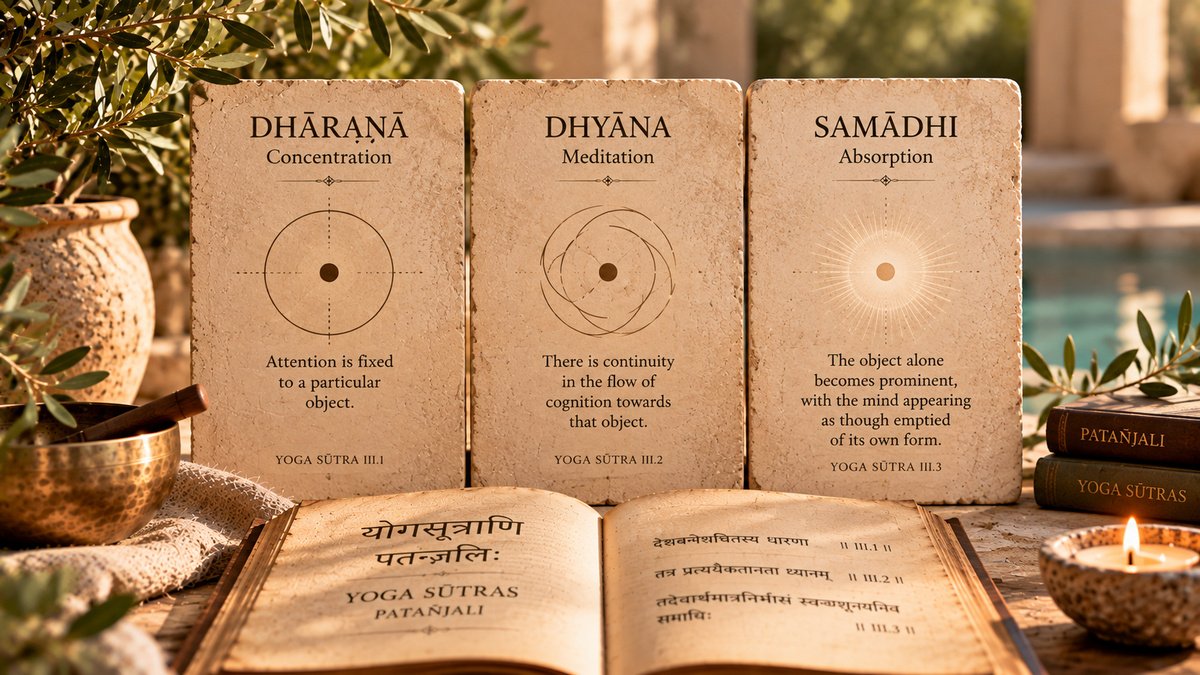
Rather than treating concentration, meditation and absorption as interchangeable experiences, the text distinguishes dhāraṇā, dhyāna and samādhi as the final three limbs of its eight-limbed yoga.
They are closely related, but they are not identical.
Dhāraṇā establishes attention. Dhyāna describes its sustained continuity. In samādhi, the relationship between the mind and its object becomes more profoundly absorbed.
Together, these three reveal that meditation in Classical Yoga is not simply about becoming relaxed or trying to stop thinking.
Where Do Dhāraṇā, Dhyāna and Samādhi Fit Within Yoga?
In Yoga Sūtra II.29, Patañjali presents eight limbs of yoga:
- Yama — ethical restraints
- Niyama — observances
- Āsana — posture
- Prāṇāyāma — regulation of breath
- Pratyāhāra — withdrawal or drawing inward of the senses
- Dhāraṇā — concentration
- Dhyāna — meditation
- Samādhi — absorption
The first five prepare a wider field of practice involving conduct, discipline, body, breath and the senses.
The final three turn more explicitly towards increasingly concentrated forms of mental practice.
Patañjali returns to them at the beginning of the third chapter, Vibhūti Pāda, where each receives a concise technical definition.
If you are unfamiliar with the wider framework, begin with Beyond Āsana: Understanding the Eight Limbs of Yoga.
Dhāraṇā — Establishing Concentration
Yoga Sūtra III.1 introduces dhāraṇā.
The Sanskrit phrase deśa-bandhaś cittasya dhāraṇā describes the binding or fixing of citta to a particular place or point.
Dhāraṇā is therefore commonly translated as concentration.
An object of concentration might be internal or external, depending on the practice and its context. What matters here is the deliberate directing of attention towards a particular object rather than allowing mental activity to move continually from one thing to another.
This distinction is important because attention naturally changes.
A sound appears. A memory arises. The body produces a sensation. A plan for tomorrow suddenly seems urgent. Attention follows one thought and then another.
Dhāraṇā introduces intentional direction into that movement.
Concentration Does Not Mean Forcing the Mind
The language of concentration can easily suggest force.
We may imagine that successful practice means gripping an object mentally and refusing to allow another thought to appear.
That is not a particularly helpful way to understand attention.
At the level of contemporary practice, distraction can simply become something we notice. When attention moves, recognising that movement already changes our relationship with it.
The object can then become the orientation to which attention returns.
This should not be confused with the full technical attainment of dhāraṇā in Classical Yoga. It does, however, offer a practical way to explore why concentration matters.
Dhyāna — When Attention Becomes Continuous
The seventh limb is dhyāna, usually translated as meditation.
Patañjali defines it immediately after dhāraṇā in Yoga Sūtra III.2.
Here the emphasis changes.
Dhāraṇā concerns establishing attention upon an object. Dhyāna concerns the continuity of cognition or attention towards that same object.
The distinction is subtle but important.
Imagine placing attention on a single object. At first, attention may repeatedly move away and return. The act of establishing it again belongs conceptually to concentration.
When that directed attention develops greater continuity, the character of the practice changes.
This continuity is central to Patañjali’s description of dhyāna.
Is Dhyāna the Same as Modern Meditation?
Not necessarily.
The English word meditation now covers an enormous range of practices drawn from different religious traditions, secular programmes, contemplative methods and modern wellness settings.
Some involve attention to breathing. Others use sound, visualisation, bodily sensation, compassion, open awareness or guided imagery.
These may all reasonably be described as forms of meditation within contemporary language.
However, that does not mean every practice called meditation is equivalent to Patañjali’s technical concept of dhyāna.
Historical context matters.
Dhyāna belongs within a specific philosophical system and develops in relation to the other limbs, the discipline of attention and the broader aims of Classical Yoga.
Samādhi — Absorption
The eighth limb is samādhi.
It is one of the most important and most easily oversimplified concepts in yoga philosophy.
In Yoga Sūtra III.3, Patañjali describes a further transformation of the meditative process. The object alone becomes prominent or “shines forth”, while the mind appears as though empty of its own form.
Translations and commentaries express this in different ways, so samādhi should not be reduced to a single English equivalent.
Absorption is useful because it communicates the increasing intensity of the relationship between attention and its object.
Yet samādhi is not merely strong concentration.
Nor does it simply mean relaxation, tranquillity, happiness or feeling deeply immersed in an enjoyable activity.
Samādhi Is Not Simply “Being in the Zone”
Modern explanations sometimes compare samādhi with being “in the zone”.
An athlete may become completely absorbed in movement. A musician may lose awareness of time while playing. An artist may become so involved in creative work that ordinary self-consciousness seems to recede.
These comparisons can make absorption easier to imagine.
But analogy is not equivalence.
Patañjali’s samādhi belongs within the technical vocabulary and soteriological aims of Classical Yoga. A modern experience of flow should not automatically be labelled samādhi simply because it involves intense concentration or reduced awareness of time.
The same caution applies to peaceful experiences during yoga.
Feeling profoundly calm after Restorative Yoga, Yoga Nidra or meditation may be meaningful. It does not provide evidence that someone has entered samādhi in Patañjali’s technical sense.
From Dhāraṇā to Dhyāna to Samādhi
The three concepts become clearer when considered together.
Dhāraṇā: attention is fixed or bound to a particular object.
Dhyāna: attention or cognition towards that object develops sustained continuity.
Samādhi: absorption deepens so that the object alone becomes prominent, while the mind appears as though emptied of its own form.
These are not three unrelated exercises.
They describe an increasingly refined relationship between citta, attention and the object of meditation.
This is why understanding Patañjali’s concept of mind matters. The final limbs cannot be separated completely from the wider discussion of citta and vṛtti.
For a closer examination of those terms, read Why Does the Mind Matter in Yoga? Understanding Citta and Vṛtti.
Saṃyama — When the Three Operate Together
Patañjali gives the relationship between these three limbs its own name.
In Yoga Sūtra III.4, dhāraṇā, dhyāna and samādhi applied together to the same object are called saṃyama.
This is an important concept because it shows that the final three limbs are not merely adjacent items in a list.
They can function as an integrated discipline.
Patañjali then develops saṃyama extensively throughout the third chapter of the Yoga Sūtras, applying it to different objects and describing forms of knowledge and extraordinary capacities associated with its mastery.
Those passages belong to a worldview that can appear very different from contemporary studio yoga.
Ignoring them entirely, however, can produce a misleading picture of what Patañjali’s text actually contains.
The “Inner Limbs” — With an Important Qualification
Dhāraṇā, dhyāna and samādhi are sometimes called the three “inner limbs” of yoga.
There is textual support for this description, but it needs qualification.
In Yoga Sūtra III.7, Patañjali describes these three as more internal in relation to the preceding limbs.
The comparison matters.
They are “inner” relative to yama, niyama, āsana, prāṇāyāma and pratyāhāra.
Yet the very next sūtra complicates the picture. III.8 states that even these three are external in relation to nirbīja samādhi — seedless samādhi.
So the final three limbs should not simply be treated as the absolute endpoint of Patañjali’s philosophical journey.
The text continues beyond them.
What Does This Have to Do With Āsana?
At first, concentration and absorption may seem far removed from physical yoga.
Yet āsana can provide a useful setting in which to notice attention.
Where does the mind move when a posture becomes uncomfortable? What happens when nothing particularly dramatic is occurring? Can sensation be observed without immediately trying to change it? Does attention remain with experience, or does it move towards judgement, anticipation or comparison?
These questions do not transform an ordinary posture into dhāraṇā or dhyāna automatically.
They do, however, shift the emphasis from what a posture looks like towards what is happening within attention.
This is one way a simple physical practice can become a setting for deeper inquiry.
Stillness Does Not Automatically Mean Meditation
A person can remain physically still while the mind moves rapidly.
Another person may be moving while maintaining considerable continuity of attention.
External stillness and mental concentration are therefore not the same thing.
This distinction is particularly relevant in practices such as Restorative Yoga and Yoga Nidra, where physical stillness may be prominent.
Stillness can create conditions in which mental activity becomes easier to notice. It does not guarantee a particular contemplative state.
Nor should a teacher claim to know from outward appearance whether another person has entered dhyāna or samādhi.
A Common Misunderstanding: Meditation Means Having No Thoughts
One of the most persistent ideas about meditation is that success means making every thought disappear.
This expectation can make ordinary mental activity feel like failure.
A thought appears, so the practitioner concludes that meditation has gone wrong.
Patañjali certainly places extraordinary importance on the regulation and stilling of citta-vṛtti. However, reducing the entire system to the instruction “stop thinking” obscures the complexity of the text.
Dhāraṇā, dhyāna and samādhi describe increasingly refined relationships with an object of concentration. They belong within a disciplined process rather than a simple battle against thoughts.
For someone beginning a contemporary meditation practice, noticing distraction can itself be informative.
The appearance of a thought does not need to become another reason for judgement.
Meditation Is Not Necessarily Relaxation
Meditation and relaxation can overlap, but they are not synonyms.
A meditation practice may feel calm. It may also reveal restlessness, boredom, discomfort, emotional activity or the speed at which attention moves.
Likewise, a deeply relaxing practice does not automatically become meditation simply because the body becomes quiet.
This distinction protects both practices from unnecessary promises.
Relaxation can be valuable without being labelled samādhi. Meditation can be meaningful without producing immediate tranquillity.
The Orenna Perspective
At Orenna, concentration, meditation and stillness can form part of a personalised yoga experience.
A practice might invite attention towards breathing, bodily sensation, sound or another appropriate point of focus. Movement may gradually become quieter. Supported stillness may create space for observation. A guided meditation may offer a structure through which attention can settle.
These practices can be explored without claiming that a particular internal state has been achieved.
We do not need to call a quiet moment dhyāna to make it meaningful.
We do not need to describe deep relaxation as samādhi to recognise its value.
And we do not need to promise that meditation will empty the mind.
Instead, practice can begin more simply: noticing where attention is, recognising when it moves and becoming curious about the changing experiences that appear within awareness.
This contemporary exploration is not identical to the full soteriological path described by Patañjali.
But understanding that older framework gives modern practice greater context.
It reminds us that yoga has historically asked questions extending far beyond flexibility or physical performance.
Among them is a deceptively simple one:
What happens when attention stops moving everywhere else?
References & Further Reading
Bryant, Edwin F. The Yoga Sūtras of Patañjali: A New Edition, Translation, and Commentary. North Point Press.
Mallinson, James & Singleton, Mark. Roots of Yoga. Penguin Classics.
Feuerstein, Georg. The Yoga Tradition: Its History, Literature, Philosophy and Practice.
Internet Encyclopedia of Philosophy. The Yoga Sūtras of Patañjali. An academic overview of Classical Yoga, including Patañjali’s treatment of concentration, meditation and samādhi.
Primary source: Patañjali’s Yoga Sūtras, particularly III.1–III.8. The wider treatment of samādhi also requires Book I and cannot be understood solely through the final three limbs.
The Orenna Journal explores yoga from historical, philosophical and contemporary perspectives. Sanskrit terms such as dhāraṇā, dhyāna, samādhi and saṃyama do not correspond perfectly to single English words, and translations vary between scholars, commentators and traditions. Contemporary practices discussed here should therefore be distinguished from claims about attaining the technical states described in Patañjali’s Yoga Sūtras.