


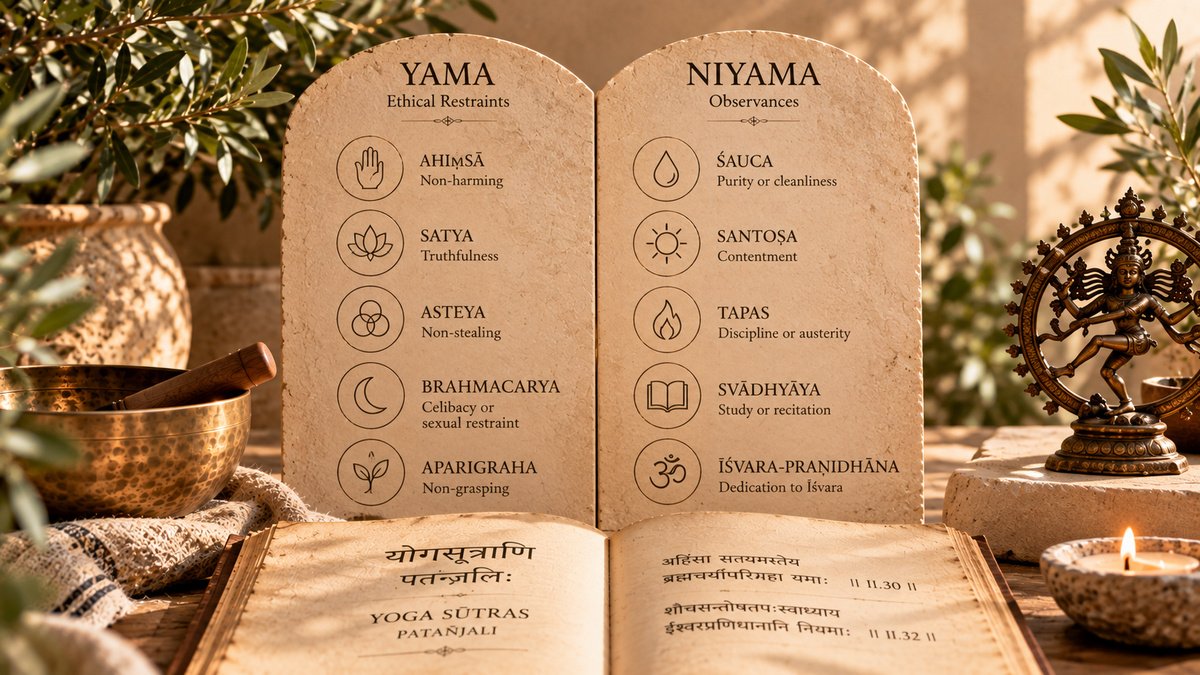
Before posture, before breath regulation and before meditation, Patañjali begins his eight-limbed framework with two forms of practice: yama and niyama.
They are often introduced today as the ethical principles of yoga — a collection of restraints and observances that can guide the way we live.
That description is useful, but it can also make them sound like a simple list of yogic “dos and don’ts”.
Within Patañjali’s Yoga Sūtras, their role is more significant.
Yama and niyama form the first two limbs of aṣṭāṅga, Patañjali’s eight-limbed yoga. They appear before āsana, prāṇāyāma, concentration and meditation because Classical Yoga is concerned not only with what happens during formal practice, but with the conditions through which that practice develops.
Before asking what shape the body can make, this framework asks something more fundamental: How are we living?
Where Do Yama and Niyama Fit Within Yoga?
In Yoga Sūtra II.29, Patañjali introduces eight limbs:
- Yama — restraints
- Niyama — observances
- Āsana — posture
- Prāṇāyāma — regulation of breath
- Pratyāhāra — withdrawal or drawing inward of the senses
- Dhāraṇā — concentration
- Dhyāna — meditation
- Samādhi — absorption
Yama and niyama therefore precede the practices most readily associated with yoga today.
This ordering does not mean that someone must perfectly complete ten ethical requirements before being permitted to practise an āsana. Nor should the eight limbs be understood simply as boxes completed one after another.
Instead, the arrangement reveals the breadth of Patañjali’s system. Ethical conduct, personal discipline, body, breath, senses and attention all belong within yoga.
You can explore that wider structure in Beyond Āsana: Understanding the Eight Limbs of Yoga.
Yama — Five Ethical Restraints
Patañjali lists five yamas in Yoga Sūtra II.30:
- Ahiṃsā — non-harming or non-violence
- Satya — truthfulness
- Asteya — non-stealing
- Brahmacarya — traditionally associated with celibacy or sexual restraint
- Aparigraha — non-grasping or non-possessiveness
The following sūtra gives these restraints particular weight. Patañjali describes them as a mahāvrata — a great vow — not restricted by class, place, time or circumstance.
In other words, they are not presented merely as techniques to use during a yoga session.
Ahiṃsā — Non-Harming
Ahiṃsā is commonly translated as non-violence or non-harming.
It has a long history within Indian religious and philosophical traditions and is not unique to Patañjali’s Yoga. It also occupies an important place within Jain, Buddhist and broader Hindu traditions, although its interpretation differs across contexts.
Within the Yoga tradition, ahiṃsā concerns restraint from causing harm to living beings.
Later commentary gives it particular importance in relation to the other restraints.
Contemporary yoga often extends ahiṃsā into questions about how we relate to ourselves. For example, practitioners may ask whether forcing the body into a painful position is compatible with non-harming.
That can be a useful modern application. However, it is worth distinguishing such contemporary reflection from the historical meaning of the term rather than assuming that Patañjali was specifically writing about modern ideas of self-care.
Satya — Truthfulness
Satya is truthfulness.
At first glance, this may seem straightforward: do not lie.
Yet the ethical tradition surrounding yoga asks us to consider truth in relation to conduct, speech and its consequences.
The classical commentary associated with the Yoga Sūtras treats truthful communication as something that should correspond with what is known while also avoiding harm.
This creates a more subtle ethical question than simply saying whatever we believe to be true.
Truthfulness exists alongside ahiṃsā.
For a contemporary practitioner, satya can therefore invite reflection on honesty, intention and the way communication affects others without reducing the concept to a motivational slogan about “living your truth”.
Asteya — Non-Stealing
Asteya means non-stealing.
Its clearest meaning concerns not taking what belongs to another.
Modern yoga discussions sometimes expand asteya to include stealing someone’s time, attention, ideas or energy. Some of these interpretations may provide useful ethical questions, but they are contemporary extensions rather than simple translations of the Sanskrit term.
There is also a particularly relevant application within modern yoga education: acknowledging where teachings, ideas and practices come from.
Crediting teachers, traditions and sources is not merely good academic practice. It also helps resist the tendency to detach yoga concepts from their histories and present inherited knowledge as something newly invented.
Brahmacarya — More Complex Than “Energy Management”
Brahmacarya is one of the yamas most frequently reinterpreted in contemporary yoga.
Modern teaching often translates it as moderation, wise use of energy or “energy management”. These interpretations can make the concept easier to apply within contemporary household life, but they should not be presented as straightforward translations of Patañjali.
In the ascetic and commentarial context surrounding Classical Yoga, brahmacarya is strongly associated with celibacy and sexual restraint.
This historical meaning matters.
We do not need to insist that every contemporary yoga practitioner adopt an ancient ascetic discipline. However, historical interpretation becomes misleading if the older meaning disappears entirely and is replaced by a modern concept without explanation.
A more transparent approach is to acknowledge both: the classical context and the ways later practitioners have chosen to interpret the principle in different circumstances.
Aparigraha — Non-Grasping
Aparigraha is commonly translated as non-possessiveness, non-grasping or freedom from accumulation.
The principle directs attention towards our relationship with acquisition and attachment.
Possessions themselves are not the only interesting question. Grasping can also provide a useful lens through which contemporary practitioners examine the desire to acquire experiences, achievements or identities.
Even yoga can become something to collect.
A more advanced posture. Another qualification. A particular experience in meditation. A stronger sense of being someone who is “good at yoga”.
Aparigraha complicates the assumption that progress must always mean obtaining more.
Niyama — Five Observances
After the yamas, Patañjali gives five niyamas in Yoga Sūtra II.32:
- Śauca — purity or cleanliness
- Santoṣa — contentment
- Tapas — austerity or disciplined practice
- Svādhyāya — study or recitation
- Īśvara-praṇidhāna — dedication or devotion to Īśvara
Modern descriptions sometimes call the niyamas “rules for self-care” or personal lifestyle habits.
That language may make them approachable, but it does not fully represent their role in Classical Yoga. They belong to a disciplined path whose aims extend considerably beyond contemporary wellness.
Śauca — Purity and Cleanliness
Śauca is associated with purity or cleanliness.
Classical interpretation can include both external cleanliness and internal purification.
Modern practitioners sometimes translate śauca into ideas such as keeping a tidy home, eating “clean” food or removing negativity from life. Those interpretations should be treated cautiously.
In particular, the language of purity can become problematic when it is turned into rigid judgements about bodies, food or other people.
Understanding śauca historically allows us to engage with the concept without automatically importing contemporary wellness culture into an ancient philosophical system.
Santoṣa — Contentment
Santoṣa is usually translated as contentment.
Contentment does not have to mean passivity or pretending that every circumstance is desirable.
Nor does it require someone to deny difficulty, injustice, grief or the desire for change.
Within a yogic context, santoṣa concerns the relationship between contentment and the continual movement of desire.
This makes it particularly interesting beside aparigraha. Both raise questions about what happens when fulfilment is continually placed somewhere else — in the next possession, achievement, experience or result.
For modern practice, santoṣa can therefore invite inquiry rather than forced positivity.
Tapas — Discipline, Heat and Austerity
Tapas is another term whose meaning becomes narrower when translated simply as “discipline”.
The Sanskrit term carries associations with heat, austerity and disciplined effort and has a history in Indian ascetic traditions that predates Patañjali.
Modern yoga often turns tapas into determination: get up early, complete the practice, stay committed and work harder.
Discipline certainly belongs to the conversation, but tapas should not become a justification for ignoring pain, exhaustion or personal limits.
Within contemporary practice, commitment and discernment need not be opposites.
Sometimes discipline means continuing. At other times, disciplined practice may involve changing what we are doing rather than pursuing intensity for its own sake.
Svādhyāya — More Than Self-Reflection
Svādhyāya is frequently translated in modern yoga as “self-study”.
This has led to valuable contemporary practices such as reflective writing, observing behavioural patterns and asking questions about ourselves.
Historically, however, the term has stronger connections with study, recitation and engagement with sacred or liberative texts and teachings.
The classical commentarial tradition also connects svādhyāya with mantra recitation.
Journalling can therefore be a modern reflective practice inspired by the broader idea of inquiry, but it should not simply be presented as what Patañjali meant by svādhyāya.
This distinction is important because it preserves the intellectual dimension of yoga.
Practice is not only something performed with the body. Study can also be practice.
Īśvara-Praṇidhāna — Dedication to Īśvara
Īśvara-praṇidhāna is perhaps the niyama that requires the greatest care when translated for a contemporary audience.
It is often described as surrender to a higher power. Modern interpretations may then define that higher power as God, nature, the universe, cosmic energy or even one’s own inner wisdom.
Those can be contemporary ways of engaging with the concept, but they should not be confused with Patañjali’s description of Īśvara.
Within the Yoga Sūtras, Īśvara has a specific philosophical role. In I.24, Patañjali describes Īśvara as a distinctive or special puruṣa, untouched by the afflictions, actions and their consequences. The text also associates Īśvara with Oṃ and its repetition and contemplation.
Īśvara-praṇidhāna also appears elsewhere in the text, including Patañjali’s description of kriyā-yoga.
For that reason, simply replacing Īśvara with any personally meaningful concept changes the philosophical framework.
A contemporary practitioner is free to interpret or engage with the idea differently. Historical accuracy simply asks us to be clear when we are doing so.
Are Yama and Niyama Moral Commandments?
It is tempting to compare yama and niyama with a set of commandments.
There are similarities in the sense that they establish ethical and disciplinary requirements. However, importing a framework from another religious tradition can obscure the philosophical system in which they operate.
In Classical Yoga, conduct is connected with the wider project of transforming the conditions of the mind and ultimately overcoming the misidentification of consciousness with the changing processes of prakṛti.
Their significance is therefore not limited to becoming a conventionally “good person”.
They belong within a soteriological system — a path concerned ultimately with liberation.
What Do Ethics Have to Do With the Mind?
This question brings yama and niyama back to the central concerns of Patañjali’s Yoga.
If our actions continually generate conflict, attachment, deception, agitation or grasping, sitting quietly does not automatically make those patterns disappear.
Conduct and mental activity are not entirely separate domains within the system.
The ethical disciplines help establish conditions considered supportive of the increasingly concentrated states described later in the Yoga Sūtras.
This is one reason yama and niyama appear before dhāraṇā, dhyāna and samādhi.
To explore Patañjali’s understanding of mental activity in greater depth, read Why Does the Mind Matter in Yoga? Understanding Citta and Vṛtti.
A Common Misunderstanding: Modern Interpretations Are Direct Translations
Yoga traditions have never remained frozen in one historical moment.
Concepts travel. Teachers interpret them. Communities adapt practices to different lives, cultures and periods.
There is nothing inherently wrong with contemporary interpretation.
The difficulty begins when interpretation is presented as translation.
Brahmacarya can be explored today through questions of moderation, but “energy management” is not an adequate historical translation. Svādhyāya may inspire journalling, but journalling does not capture its older associations with study and recitation. Īśvara-praṇidhāna may be reinterpreted by a non-theistic practitioner, but Patañjali’s Īśvara cannot simply be replaced historically with “the universe”.
We can allow yoga concepts to live while still being transparent about where older meanings end and modern interpretations begin.
The Orenna Perspective
At Orenna, yama and niyama are not used as a test of whether someone is “good enough” to practise yoga.
They are an invitation to recognise that yoga can involve more than what happens during a sequence of postures.
Ahiṃsā can raise questions about the relationship between effort and harm. Aparigraha can make us notice our attachment to achievement. Santoṣa can challenge the assumption that practice is valuable only when something improves. Svādhyāya reminds us that learning and inquiry also belong within yoga.
These are contemporary reflections rather than claims that Patañjali was writing a modern wellness philosophy.
That distinction matters.
We can encounter an old philosophical system with curiosity without pretending that we live in the world that produced it. We can question parts of it, reinterpret others and recognise where modern values differ.
At the same time, allowing the historical tradition to remain visible gives contemporary practice greater depth.
Perhaps that is one of the most interesting things yama and niyama offer today.
They move the question of yoga beyond “What can my body do?”
And towards another question:
“How does the way I practise relate to the way I live?”
References & Further Reading
Bryant, Edwin F. The Yoga Sūtras of Patañjali: A New Edition, Translation, and Commentary. North Point Press.
Mallinson, James & Singleton, Mark. Roots of Yoga. Penguin Classics.
Feuerstein, Georg. The Yoga Tradition: Its History, Literature, Philosophy and Practice.
Internet Encyclopedia of Philosophy. The Yoga Sūtras of Patañjali. An academic overview of Patañjali’s Classical Yoga, including its ethical disciplines, philosophical framework and eight-limbed practice.
Primary source: Patañjali’s Yoga Sūtras, particularly II.29–II.45. For Īśvara and Īśvara-praṇidhāna, see also I.23–I.29 and II.1.
The Orenna Journal explores yoga from historical, philosophical and contemporary perspectives. Sanskrit terms often carry meanings that do not correspond exactly to a single English word, and translations differ between scholars, commentators and traditions. Contemporary applications discussed here should therefore be distinguished from claims about the precise historical meaning of Patañjali’s text.



