
For many people, the first encounter with yoga begins with āsana — physical posture.
Yet in Patañjali’s Yoga Sūtras, posture forms only one part of a much wider framework.
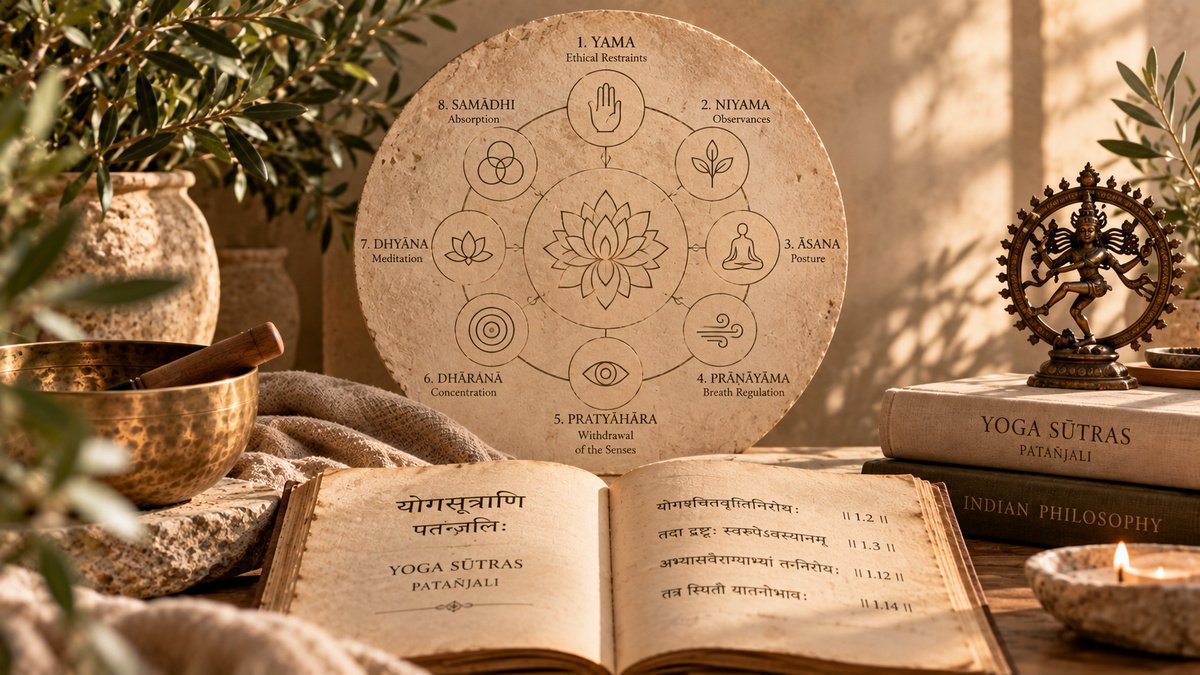
The eight limbs of yoga, known in Sanskrit as aṣṭāṅga, bring together ethical conduct, personal discipline, posture, breath, the senses, concentration, meditation and samādhi.
Together, they reveal a vision of yoga that reaches far beyond what the body can do on a mat.
Understanding this framework also changes an important question. Instead of asking only “What postures do I practise?”, we can begin to ask “How does practice shape the way I act, attend, breathe, observe and understand experience?”
Where Do the Eight Limbs of Yoga Come From?
Patañjali presents the eight-limbed framework in the Yoga Sūtras, a foundational text of Classical Yoga.
The Sanskrit expression is aṣṭāṅga: aṣṭa means eight, while aṅga can mean limb, member or component.
In Yoga Sūtra II.29, Patañjali names eight:
- Yama — ethical restraints
- Niyama — observances or disciplines
- Āsana — posture
- Prāṇāyāma — regulation of breath
- Pratyāhāra — withdrawal or drawing inward of the senses
- Dhāraṇā — concentration
- Dhyāna — meditation
- Samādhi — absorption
These terms can look like a simple list. However, each belongs to a much larger philosophical system concerned with the activity of the mind, discernment and liberation.
The eight limbs are therefore more than a catalogue of yoga techniques.
1. Yama — Our Relationship With Conduct
The first limb is yama, a set of ethical restraints that shape conduct and our relationship with others and the wider world.
Patañjali identifies five:
- Ahiṃsā — non-harming
- Satya — truthfulness
- Asteya — non-stealing
- Brahmacarya — traditionally associated with celibacy or disciplined conduct; interpreted in different ways in later and modern contexts
- Aparigraha — non-grasping or non-possessiveness
These principles make an important point before Patañjali says anything about physical posture: yoga includes how a person lives and acts.
Modern discussions sometimes turn the yamas into general lifestyle advice. Their original philosophical context is more demanding. They form part of a disciplined path towards freedom from the patterns that sustain attachment, disturbance and misidentification.
2. Niyama — Disciplines of Practice
The second limb, niyama, turns towards observances or personal disciplines.
Patañjali again gives five:
- Śauca — purity or cleanliness
- Santoṣa — contentment
- Tapas — disciplined effort or austerity
- Svādhyāya — study or recitation, particularly in relation to sacred teaching
- Īśvara-praṇidhāna — dedication or devotion to Īśvara
These concepts also require context.
For example, tapas is not simply modern motivation or “pushing through”. Svādhyāya cannot be reduced entirely to journalling or self-reflection. Likewise, Īśvara-praṇidhāna belongs to Patañjali’s particular philosophical treatment of Īśvara and should not automatically be translated into any preferred modern idea of a “higher power”.
Contemporary practitioners may interpret these principles in different ways, but recognising their historical context helps prevent modern meanings from being mistaken for Patañjali’s own.
3. Āsana — Posture
The third limb is the one most familiar in contemporary yoga: āsana.
However, Patañjali says remarkably little about posture compared with the enormous attention it receives in modern yoga culture.
Yoga Sūtra II.46 describes āsana as sthira-sukham āsanam, a phrase commonly interpreted in relation to steadiness and ease or comfort.
The text does not provide a catalogue of standing poses, balances, backbends or flowing sequences.
This does not make modern postural yoga invalid. It does, however, remind us that contemporary āsana practice and Patañjali’s treatment of posture are not identical.
Within the eight-limbed framework, posture has a place. It is simply not the whole of yoga.
4. Prāṇāyāma — Working With the Breath
After āsana comes prāṇāyāma.
The term is often introduced today simply as “breathwork”. That can be useful conversationally, but it does not capture the full historical concept.
Patañjali discusses the regulation of inhalation and exhalation, including their movement, duration and number. He also refers to pauses or suspensions in the breathing process.
Breath therefore becomes an intentional aspect of yogic discipline rather than merely something happening alongside posture.
Later yoga traditions develop prāṇāyāma much further and connect it with broader concepts of prāṇa, the subtle body and yogic transformation.
These later developments should not automatically be read back into every statement made by Patañjali.
5. Pratyāhāra — Turning the Senses Inward
Pratyāhāra is sometimes described as withdrawal of the senses.
This does not necessarily mean blocking out the world or becoming physically isolated from sensory experience.
Rather, the relationship between the senses and their objects changes. Attention becomes less automatically pulled outward by every sound, sight, sensation or other sensory stimulus.
This limb forms an important transition within the framework. The earlier limbs involve conduct, discipline, body and breath. With pratyāhāra, the movement towards increasingly internal forms of practice becomes more explicit.
For a contemporary practitioner, this idea can be interesting to explore without pretending that simply closing the eyes reproduces the full meaning of pratyāhāra.
6. Dhāraṇā — Concentration
The sixth limb is dhāraṇā, commonly translated as concentration.
Here, attention is directed towards a particular point or object.
Anyone who has tried to sustain attention will recognise the challenge. The mind moves. Memories appear. Sounds attract attention. Plans emerge without invitation.
Dhāraṇā involves the deliberate placing or binding of attention rather than allowing it to move continually between competing objects.
This brings us directly back to Patañjali’s wider interest in citta and its changing activities.
7. Dhyāna — Meditation
Dhyāna is usually translated as meditation.
Yet meditation can mean many different things in contemporary language, so the translation needs some care.
Within Patañjali’s sequence, dhyāna develops from concentration. Attention becomes a more continuous flow towards the chosen object rather than a repeated effort to bring the mind back.
The distinction between dhāraṇā and dhyāna can be subtle. One way to approach it is to think of concentration as establishing attention and meditation as its more sustained continuity.
However, these are philosophical and contemplative concepts, not performance targets that can be measured by how long someone sits quietly.
8. Samādhi — Absorption
The eighth limb is samādhi, often translated as absorption.
This is one of the most complex concepts in the Yoga Sūtras. Patañjali discusses different forms and levels of samādhi rather than presenting it as one simple experience.
It should therefore be approached carefully.
Samādhi is not simply feeling peaceful after a yoga class. Nor is every moment of relaxation, stillness or intense concentration evidence that someone has reached the culminating state of Classical Yoga.
Within Patañjali’s philosophical system, increasingly refined states of concentration and absorption belong to a much larger path concerned ultimately with discriminative knowledge and liberation.
Are the Eight Limbs Eight Steps?
The numbered list can make the framework look like a staircase.
Learn the yamas, complete the niyamas, master posture, move on to breathing and eventually graduate to meditation.
That interpretation is too simple.
Patañjali does present meaningful relationships between the limbs, and the later practices move towards increasingly internal forms of concentration. Yet the framework should not be reduced to eight boxes that a practitioner ticks off one at a time.
Ethical conduct does not stop becoming relevant when someone begins āsana. Attention to the breath does not require abandoning the yamas. Meditation does not make ethical discipline unnecessary.
The limbs belong to an interconnected discipline.
Patañjali also groups the final three — dhāraṇā, dhyāna and samādhi — together under the term saṃyama when they operate in relation to the same object. This shows that relationships between the limbs become more sophisticated than a simple numbered progression.
Patañjali’s Aṣṭāṅga Is Not Ashtanga Vinyasa Yoga
The word Ashtanga can create confusion in modern yoga.
Patañjali’s aṣṭāṅga refers to the eight-limbed framework described in the Yoga Sūtras.
Ashtanga Vinyasa Yoga, by contrast, is a modern system of posture practice associated particularly with K. Pattabhi Jois and the twentieth-century Mysore yoga tradition.
The modern system uses the name Ashtanga and draws upon a wider yogic framework, but it should not be confused with the eight limbs themselves.
Patañjali was not describing the modern Primary Series or a flowing sequence of āsanas.
Keeping these meanings separate makes both easier to understand.
What Do the Eight Limbs Change About Modern Practice?
The eight limbs do not require us to reject modern physical yoga.
Instead, they place posture within a larger landscape.
An āsana can involve more than creating a shape. It can reveal impatience, comparison, effort and distraction. Breath can become an intentional practice rather than background activity. Stillness can create an opportunity to observe where attention moves.
Ethical questions can also enter the practice. How do we respond when the body cannot do what we expected? Does ambition override non-harming? Can discipline exist without becoming punishment? What does non-grasping mean when progress itself becomes something we want to possess?
These questions move yoga beyond performance without requiring physical practice to disappear.
They simply change what we understand practice to include.
A Common Misunderstanding: Āsana Is the Centre of the System
Because posture dominates much contemporary yoga imagery, it can appear to be the central practice around which everything else revolves.
Patañjali’s framework gives us a different perspective.
Āsana is important enough to have its own place, but it occupies one limb among eight. Ethical conduct comes before it in the list. Breath follows it. The later limbs increasingly concern the senses, attention, meditation and absorption.
Physical complexity therefore tells us very little about someone’s progress within Classical Yoga.
A person capable of an advanced-looking posture has demonstrated a particular physical capacity. That alone does not tell us about non-harming, non-attachment, concentration, meditation or discernment.
The external shape cannot reveal the whole practice.
The Orenna Perspective
At Orenna, the eight limbs offer a valuable reminder that yoga does not need to be organised around increasingly difficult physical postures.
A personalised practice may include movement, supported āsana, breathing, sensory awareness, concentration, meditation and stillness. Different elements can become more or less prominent according to the person and the purpose of the session.
The philosophical framework also changes how we understand simplicity.
A physically simple practice can still ask for attention. Remaining in a supported position may reveal restlessness. Following the breath may expose distraction. Sitting quietly can make changing mental activity more visible.
None of these experiences means that a practitioner has achieved Patañjali’s ultimate goal of liberation. They can, however, create opportunities to explore some of the questions that Classical Yoga places before us.
The Orenna Journal explores one of those questions more closely in The Mind in Yoga: Understanding Citta and Vṛtti, where we consider why changing mental activity matters within Patañjali’s system.
Seen from this wider perspective, āsana does not become less meaningful.
It simply takes its place within something much larger.
References & Further Reading
Bryant, Edwin F. The Yoga Sūtras of Patañjali: A New Edition, Translation, and Commentary. North Point Press.
Mallinson, James & Singleton, Mark. Roots of Yoga. Penguin Classics.
Singleton, Mark. Yoga Body: The Origins of Modern Posture Practice. Oxford University Press.
Internet Encyclopedia of Philosophy. Yoga Philosophy. An overview of Classical Yoga and the philosophical system associated with Patañjali.
Primary source: Patañjali’s Yoga Sūtras, particularly Sūtras II.29–II.55 and III.1–III.8.
The Orenna Journal explores yoga from historical, philosophical and contemporary perspectives. Sanskrit terms can carry meanings that do not correspond exactly to modern English words, and translations vary between scholars and traditions. Contemporary interpretations should therefore be distinguished from claims about the meaning of Patañjali’s original text.