


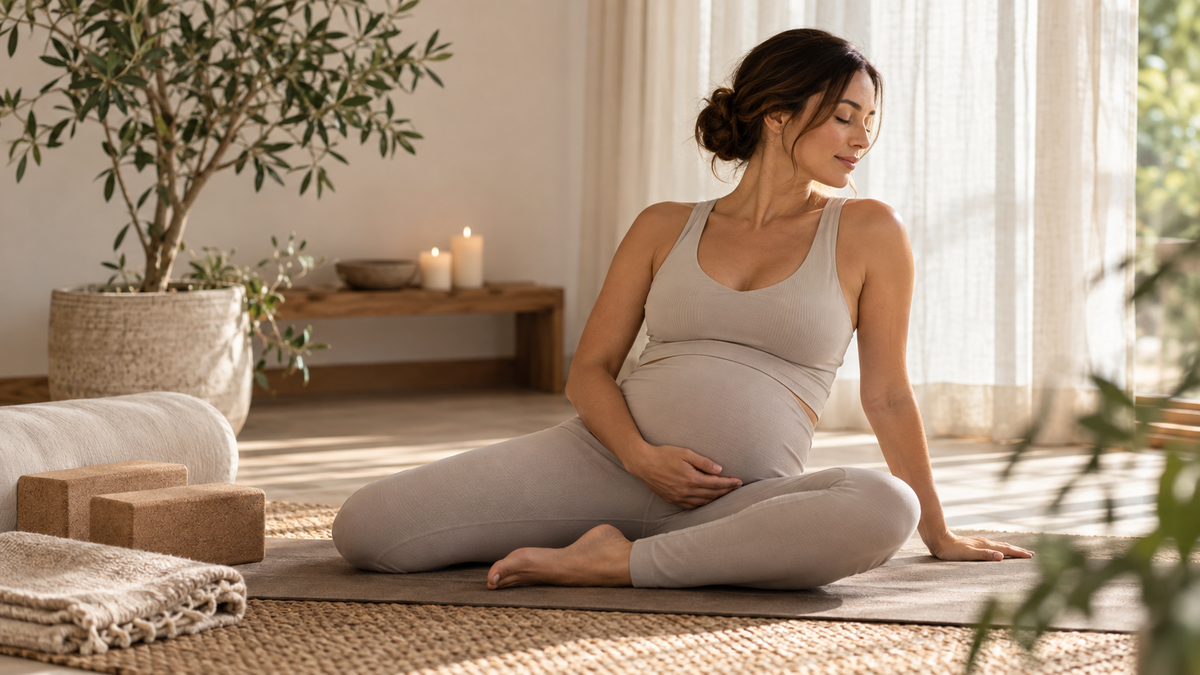
Pregnancy can change the experience of movement in ways that are both gradual and surprising. Balance may feel different, energy can vary, and familiar positions may need to change as pregnancy progresses.
For this reason, yoga during pregnancy does not need to follow one fixed sequence. Instead, the practice can evolve alongside the person practising it.
Movement can change. Props can add support. Rest can become more important when needed. Most of all, the practice can respond to what feels appropriate today rather than trying to reproduce what was possible before pregnancy.
This creates a different starting point. Rather than asking, “What can I still do?”, it may be more useful to ask, “What would support me now?”
What Is Yoga During Pregnancy?
Yoga during pregnancy — also called pregnancy yoga, prenatal yoga or antenatal yoga — is yoga that takes account of the changes that can happen during pregnancy.
Depending on the individual, a session may include adapted yoga postures, gentle or more active movement, breathing practices, meditation and supported rest. However, there is no single sequence that every pregnant person needs to follow.
The main difference is not simply which postures appear in a session. What matters more is how the practice responds to the individual.
As pregnancy progresses, comfort, balance, mobility and energy can change. A useful practice therefore leaves room for those changes instead of expecting the body to continue in exactly the same way.
A Practice That Changes With You
Pregnancy is a period of ongoing change, and each person experiences it differently.
Someone may feel energetic during one stage and unusually tired during another. A growing abdomen can change the amount of space available in certain positions. Balance may also feel less familiar, while getting down to the floor or standing up again may require more care.
These changes do not mean that yoga must stop. Instead, they can guide how someone practises.
For example, a wider stance may create more space. A wall or chair can offer extra support. Blocks can bring the floor closer, while bolsters and blankets can make resting positions more comfortable.
At other times, the best choice may simply be to reduce the intensity, change a position or leave something out.
As a result, yoga during pregnancy may look different from week to week. That ability to change is part of the practice rather than a departure from it.
Adaptation Is Part of the Practice
Yoga culture can sometimes make modification seem like a lesser option. The unsupported posture becomes the goal, while using a chair, wall, block or bolster can appear to be the easier version.
Pregnancy offers a useful reason to question that idea.
A thoughtful adaptation changes a posture to suit the person practising it. It does not make the practice less meaningful.
For instance, a chair can provide stability. Blocks can reduce the distance towards the floor. A different position can create more room for the abdomen, and additional support can make rest more comfortable.
The aim is not to preserve the appearance of a posture at all costs. Instead, the practice should respond to the person.
In that sense, adaptation is not a step away from yoga. It can become part of practising with attention.
How Props Can Support Yoga During Pregnancy
Props can play an important role during pregnancy because they give the practitioner more options.
A wall may help with balance. Blocks can change the height of a position, while a chair can offer support during standing or seated movements. Bolsters, cushions and folded blankets can also help someone find a more comfortable resting position.
However, every person does not need the same arrangement. One practitioner may enjoy considerable support, while another may prefer very little.
Needs can also change from one session to another. Therefore, props work best as tools for choice rather than items that every pregnant practitioner must use in the same way.
This approach keeps the focus on the individual instead of creating another set of rules to follow.
Movement, Breathing and Rest
Pregnancy yoga is sometimes presented as an entirely gentle practice with very little movement. Yet that description does not suit every person or every pregnancy.
Current UK guidance encourages physical activity during an uncomplicated pregnancy. People who already exercise can usually continue while they remain comfortable, although they may need to adjust their activity as pregnancy progresses.
Within yoga, this allows for a wide range of practices. One session may include standing movement and strength. Another may focus more on mobility, breathing or supported rest.
A single practice can also move between these different qualities. For example, someone might begin with gentle movement, continue with a few supported standing positions and finish with breathing or rest.
The right level of activity depends on the individual. Previous experience, the stage of pregnancy, current comfort and advice from the maternity team may all influence the practice.
Therefore, pregnancy does not automatically mean doing as little as possible. At the same time, there is no need to prove that nothing has changed.
Comfort Matters, but So Does Safety
Paying attention to the body is valuable during pregnancy. However, comfort alone cannot answer every safety question.
General guidance for physical activity during pregnancy still matters, and individual health or pregnancy concerns can change what is suitable.
For example, NHS guidance advises against lying flat on the back for long periods, particularly after 16 weeks of pregnancy. The NHS also advises avoiding strenuous exercise in hot conditions, drinking enough water and adjusting activity rather than exercising to exhaustion.
Anyone attending a yoga or exercise class should tell the teacher about the pregnancy and how many weeks pregnant they are. This information helps the teacher offer suitable choices within their training and professional role.
Some situations require advice beyond the yoga teacher’s role. If someone has pregnancy complications, new symptoms, health concerns or questions about whether exercise is suitable, their midwife, maternity team, GP or another qualified healthcare professional can provide individual advice.
A yoga teacher can guide and adapt yoga within their professional competence. Maternity care remains the role of the appropriate healthcare professionals.
There Is No Universal Pregnancy Yoga Sequence
Lists of “safe pregnancy poses” can appear reassuring because they make practice seem simple. In reality, individual circumstances matter.
Stage of pregnancy, previous yoga experience, balance, mobility, energy, comfort and health advice can all influence how someone approaches a session.
For that reason, a useful approach asks more than, “Is this pose allowed?”
It can also ask:
- Does this position suit this person today?
- Does it feel comfortable and steady?
- Would a different position or extra support work better?
- Can the practitioner enter and leave the position comfortably?
- Has anything changed since the previous practice?
- Does a concern need advice from a healthcare professional?
These questions shift attention away from memorising a fixed list of postures. Instead, they encourage observation, choice and appropriate adaptation.
What Might Yoga During Pregnancy Feel Like?
There is no particular feeling that a pregnancy yoga session needs to create.
On some days, movement may feel welcome. At other times, a quieter practice may feel more suitable.
A session might begin with standing movement while using a wall or chair for support. The practitioner may choose slower transitions or adjust positions to create more space and comfort.
Later, breathing practices can offer a period of focused attention without forcing or straining the breath. Bolsters, blankets and cushions can then help create a comfortable position for rest.
For some people, the most interesting change may not involve the postures at all. Pregnancy can make practice less predictable, which may encourage a different relationship with yoga.
Rather than measuring practice against what the body could do before, attention can return to what is happening now.
A Common Misunderstanding: Pregnancy Yoga Does Not Promise a Particular Birth
Some descriptions of pregnancy yoga suggest that certain postures or breathing practices can produce a particular type of labour or birth. Such claims place too much responsibility on both the practice and the pregnant person.
Many factors influence pregnancy, labour and birth. Yoga cannot guarantee how those experiences will unfold.
That does not make the practice less worthwhile. Yoga can offer time for movement, breathing, rest and attention without needing to promise a specific outcome.
It may also give someone different ways to approach comfort and movement as their body changes. These possibilities have value in their own right.
The Orenna Perspective
At Orenna, yoga during pregnancy begins with the individual rather than a predetermined sequence.
Pregnancy changes over time, and people experience those changes differently. The practice therefore needs enough flexibility to respond.
Movement can change according to comfort and circumstance. Props can offer additional support when useful, while standing, seated, side-lying and other suitable positions provide different options. Transitions also deserve attention, especially if moving down to the floor or standing up again becomes less comfortable.
Choice remains central throughout the experience. There is no requirement to reach a particular depth, shape or version of a posture.
Equally, Orenna does not approach pregnancy as a problem that yoga needs to correct. Instead, practice can create space to notice change and respond to it with greater care.
What feels right today may change tomorrow. The practice can change too.
References & Further Reading
NHS. Exercise in pregnancy. Guidance on physical activity, exercise intensity, hydration and exercise considerations during pregnancy.
NHS. Keeping well in pregnancy. Information on exercise, health and well-being throughout pregnancy.
Royal College of Obstetricians and Gynaecologists (RCOG). Patient information and professional guidance relating to pregnancy, maternity care and physical health.
The Orenna Journal provides general educational information and does not provide medical or maternity advice. Pregnancy and individual circumstances vary. If you have health concerns, pregnancy complications, new symptoms or questions about whether yoga or exercise is appropriate for you, seek advice from your midwife, maternity team, GP or another appropriately qualified healthcare professional.



