


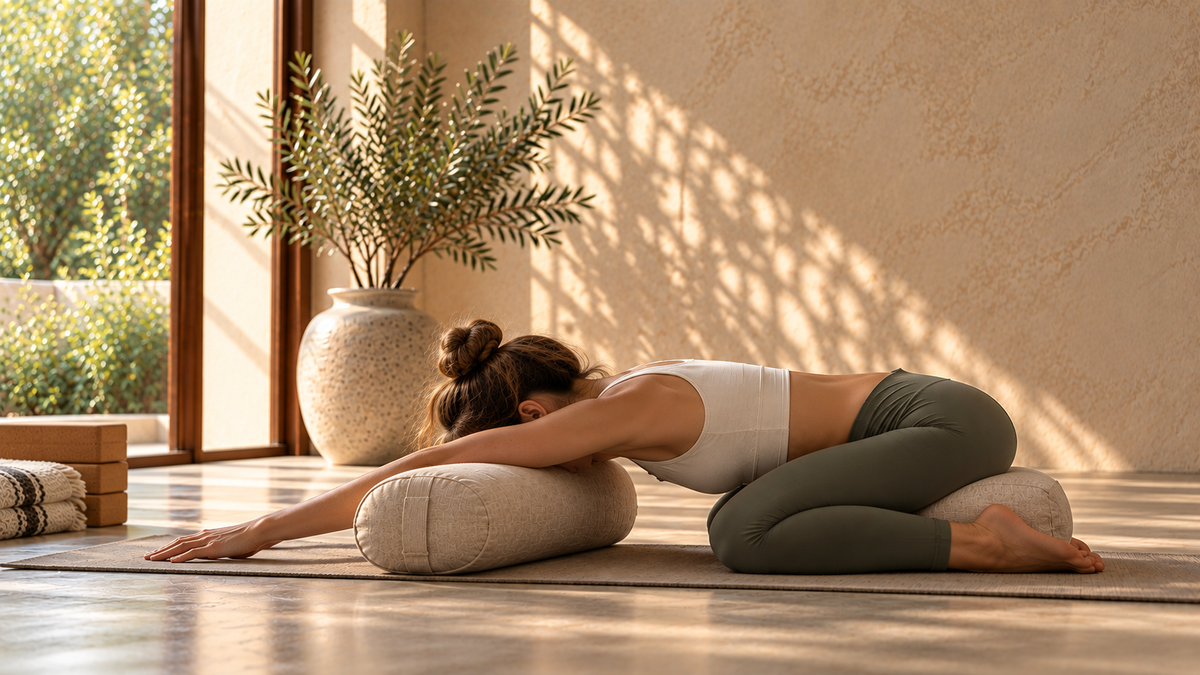
Some yoga practices move quickly from one shape to another. Yin Yoga takes a different approach. Postures are generally explored close to the floor, muscular effort is reduced where appropriate, and positions are given time to unfold.
From the outside, this slower pace can make Yin Yoga appear simple. Yet remaining in a position for several minutes changes the nature of the practice. Sensation becomes easier to notice. The impulse to move may become more apparent. Attention has time to encounter both the physical position and our response to it.
Yin Yoga is therefore more than a collection of long-held stretches. Its contemporary form brings together particular approaches to posture, loading, stillness and attention, alongside a distinctive modern history.
What Is Yin Yoga?
Yin Yoga is a contemporary approach to yoga in which predominantly floor-based postures are commonly held for longer periods, often with relatively little muscular effort in the area being explored.
Rather than moving repeatedly through a large number of postures, a Yin practice may contain fewer shapes and allow more time within each one. Props can be used to alter the position, moderate intensity or make a posture more appropriate for the individual.
The practice often involves sensation, but sensation is not a competition. Intensity does not demonstrate that a posture is more effective, and pain is not an objective of Yin Yoga. A practitioner can adjust, reduce or leave a position when the experience is no longer appropriate.
The Development of Contemporary Yin Yoga
The form now widely known as Yin Yoga developed relatively recently. Its history is different from that of the classical and medieval yoga traditions from which many modern yoga practices also draw.
Paulie Zink, a martial artist and yoga teacher, was an important early influence. Paul Grilley later studied with Zink and developed an approach that combined long-held floor postures with his own interests in anatomy and concepts drawn from Chinese traditions. Sarah Powers subsequently contributed to the development and wider teaching of Yin Yoga, including through the integration of contemplative practices.
These influences helped establish Yin Yoga as a recognisable contemporary style. This history also reminds us that the practice should not simply be projected backwards and described as an unchanged ancient system called “Yin Yoga”. Its current name, structure and teaching methodology belong largely to modern yoga culture.
Why Is It Called “Yin” Yoga?
The language of yin and yang comes from Chinese thought, where the terms describe relational and complementary qualities rather than two completely separate categories.
Within contemporary Yin Yoga, the term yin is commonly used to distinguish slower, more passive or receptive qualities from more active forms of practice sometimes described as yang.
This is a useful teaching framework, but it should not be mistaken for a simple scientific classification of tissues, exercises or physiological states. The language operates partly as a conceptual model within the modern practice.
Time Changes the Practice
One of the most distinctive features of Yin Yoga is time.
Remaining in a posture for longer than we might in a flowing practice creates a different experience. The body is not repeatedly entering and leaving the shape. Instead, there is time to observe how sensation changes, whether effort is necessary and whether the position remains appropriate.
Time also changes the attentional quality of practice. A posture that initially feels straightforward may reveal subtle sensations after a minute or two. Conversely, an initially noticeable sensation may settle or change.
The duration of a posture is not a test of endurance. Longer is not automatically better. Time is one variable among many and should remain responsive to the individual.
Sensation, Loading and Individual Variation
Yin Yoga is often described as working with connective tissues such as fascia, ligaments and joint structures. These explanations require some care.
Human tissues respond to mechanical load, but the effects depend on many variables, including the magnitude, direction and duration of loading, as well as individual anatomy, previous activity and health context. A yoga posture does not selectively isolate a single tissue simply because it is held for several minutes.
It is therefore more accurate to understand a Yin posture as creating a particular mechanical and sensory experience rather than claiming that it predictably targets or transforms one specific anatomical structure.
Individual variation is especially important. Two people can appear to be performing the same posture while experiencing very different forces and sensations. Skeletal proportions, joint structure, mobility, previous experience and the arrangement of props can all influence what a position feels like.
Yin Yoga Is Not Restorative Yoga
Yin Yoga and Restorative Yoga can look similar at first. Both may use floor-based positions, props, stillness and longer holds. Their underlying intentions, however, are different.
In Restorative Yoga, support is generally organised to reduce unnecessary effort and minimise demand so that a position can be sustained comfortably. Strong sensation is not the objective.
In Yin Yoga, some degree of appropriate physical loading or sensation is commonly part of the practice. Props may still be used, but not necessarily to remove sensation altogether. They can help modify its intensity, alter the geometry of the posture or make the position more suitable for the individual.
The distinction matters because stillness alone does not make a practice restorative, just as a long-held floor posture is not automatically Yin Yoga.
Stillness as a Context for Attention
The relative stillness of Yin Yoga can also create space for observation.
Without constant movement, attention may become more aware of sensation, breathing, thoughts and impulses. A practitioner might notice the desire to deepen a posture, leave it, adjust it or compare the experience with an expectation.
None of these responses needs to be treated as failure. They can become information.
This is one of the more interesting dimensions of slower practice. The posture provides a structure, while attention explores what changes within that structure over time.
What Might a Yin Practice Feel Like?
There is no single sensation that proves someone is practising Yin Yoga correctly.
A position may create a broad feeling of tension or stretch. Another may feel relatively neutral. Sensation may increase, decrease or move as time passes. Some postures may feel quiet and spacious; others may require considerably more attention.
What matters is not pursuing the strongest possible experience. A practitioner can remain curious while retaining the ability to respond. If sensation becomes sharp, painful, unstable, numb or otherwise concerning, the position can be changed or left.
Coming out of a longer-held posture can also be part of the experience. Moving gradually and noticing the transition allows the practitioner to observe how the body responds rather than immediately rushing into the next shape.
A Common Misunderstanding: Deeper Is Not Necessarily Better
Because Yin Yoga often involves noticeable sensation, it can be tempting to assume that more sensation means more benefit.
That creates an unnecessary hierarchy in which the deepest-looking posture or strongest sensation becomes the goal. Human anatomy does not support such a simple conclusion.
Range of movement differs between people for many reasons. A person’s appropriate endpoint may also vary from one day to another. The shape seen from outside tells us relatively little about the internal experience.
A considered Yin practice therefore values responsiveness over performance. The question is not “How far can I go?” but rather “What am I experiencing here, and is this an appropriate place to remain?”
The Orenna Perspective
At Orenna Wellness, Yin Yoga is approached as an individual exploration rather than a prescribed pursuit of depth or flexibility.
Postures can be adapted according to the person, their proportions, their experience and how they are arriving on that particular day. Props are used deliberately, and time within a posture remains flexible rather than becoming a target that must be completed.
The slower pace also creates an opportunity to explore attention. Sensation can be noticed without automatically chasing it. Movement can occur when needed. Stillness can be present without becoming an obligation.
In this sense, Yin Yoga can offer something more interesting than simply “stretching for longer”. It can become an exploration of time, sensation, attention and the choices we make in response to changing experience.
References & Further Reading
- Paul Grilley, Yin Yoga: Principles and Practice. A key contemporary source for the development, principles and teaching framework of Yin Yoga.
- Sarah Powers, Insight Yoga. Explores Yin and Yang approaches alongside contemplative practice.
- Bernie Clark, The Complete Guide to Yin Yoga. A detailed contemporary presentation of Yin Yoga practice, history and anatomical considerations.
- Paulie Zink — teaching and biographical materials concerning his Taoist yoga and martial arts practice and its influence on the later development of Yin Yoga.
- Schleip R, Jäger H, Klingler W. Research and scholarship concerning fascia, connective tissue and mechanical loading provide useful context for evaluating simplified claims sometimes made about Yin Yoga.



