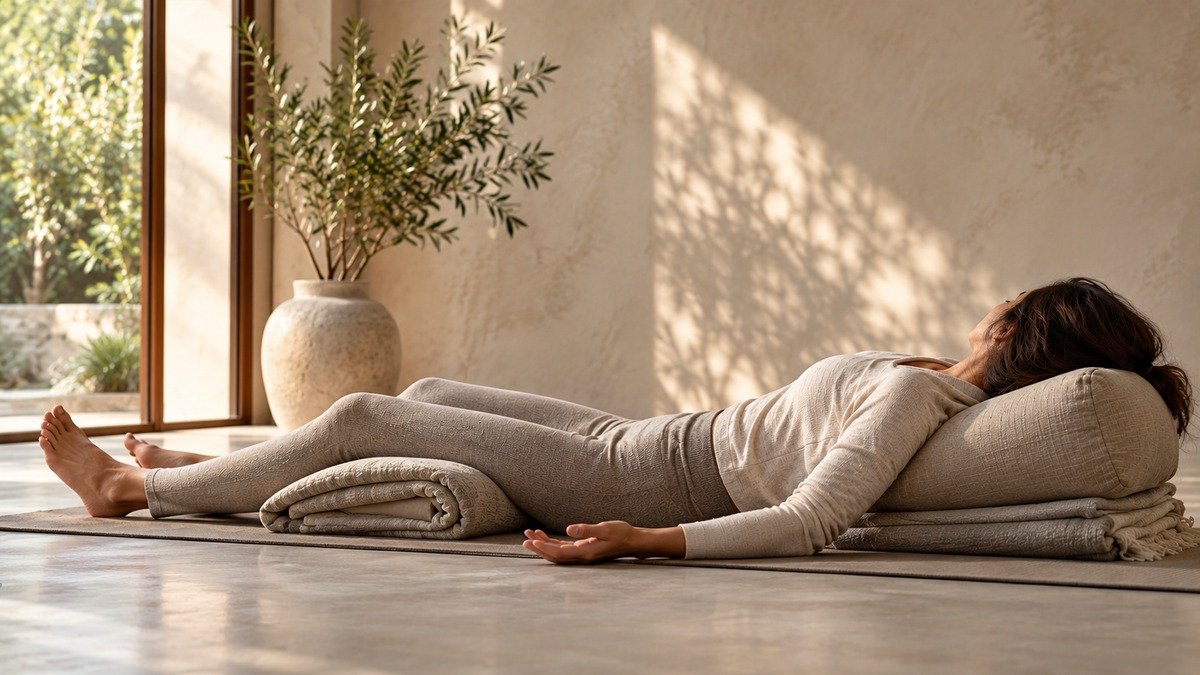
There are forms of yoga in which we learn through movement, effort and repetition. Restorative Yoga asks something different of us: to become sufficiently supported that doing less becomes possible.
At first glance, the practice can appear remarkably simple. A body rests over bolsters, blankets, blocks or other supports. Practitioners generally remain in postures quietly and for longer periods, with very little visible movement.
Yet the apparent simplicity can be deceptive. Restorative Yoga depends on thoughtful positioning, appropriate support, time and careful observation. Rather than asking the body to maintain a shape through muscular effort, the practice aims to create conditions in which unnecessary effort can gradually soften.
What Is Restorative Yoga?
Restorative Yoga is a quiet, supported approach to yoga practice in which props help the body remain in positions with relatively little muscular effort. A session may include only a small number of postures, each given enough time for the practitioner to settle, observe and respond.
The word restorative can sometimes create confusion. It does not mean that a posture mechanically “restores” the body to a particular physiological state, nor does it imply treatment for a medical condition. In this context, the term describes an approach to practice characterised by support, reduced effort, stillness and time.
This makes the practice distinct from simply lying down or taking a break. The teacher or practitioner considers the relationship between the body, the supports and the environment. Small adjustments to height, angle, temperature or positioning can substantially change how sustainable a posture feels.
From B.K.S. Iyengar to Contemporary Restorative Yoga
The development of contemporary Restorative Yoga is closely connected with the influential twentieth-century teacher B.K.S. Iyengar. His teaching made extensive and sophisticated use of props such as blocks, belts, blankets, bolsters, chairs, walls and ropes. These supports could help practitioners explore postures with different degrees of stability, accessibility and precision.
It is important, however, not to collapse Iyengar Yoga and contemporary Restorative Yoga into the same thing. Iyengar developed a broad and rigorous approach to yoga practice. Supported postures formed part of that much larger system rather than constituting a separate practice called Restorative Yoga.
Judith Hanson Lasater, who studied with B.K.S. Iyengar, became particularly influential in the development and popularisation of Restorative Yoga as a recognisable contemporary practice. Her teaching placed sustained attention on supported postures, reduced effort and the practical conditions that allow a person to rest more comfortably.
The contemporary practice therefore has important connections with Iyengar’s use of props while also developing its own emphasis, teaching language and methodology.
Support Is Part of the Practice
Props in Restorative Yoga are not simply accessories added for comfort. Support is part of the architecture of the posture.
A bolster may change the relationship between the torso and the floor. A folded blanket may alter the position of the head or reduce pressure at a contact point. Blocks may support the limbs so that they do not need to be held actively. A wall or chair can provide stability that changes the amount of muscular work required.
More support is not automatically better. The purpose is to find an arrangement appropriate to the individual, the posture and the intention of the practice.
This requires observation. If a position produces persistent strain, compression, discomfort or a sense of having to hold oneself in place, the arrangement may need to change. Sometimes a very small adjustment can make the position considerably more sustainable.
Stillness Does Not Mean Nothing Is Happening
Restorative Yoga can appear almost motionless from the outside. Internally, however, there may be considerable activity.
Attention may move towards breathing, physical sensation, sound, thought or the simple experience of remaining in one place for a period of time. A practitioner may notice areas of unnecessary muscular effort. They may become aware of habitual adjustments or of the impulse to move before movement is actually required.
Stillness can therefore become a context for observation rather than an objective that must be achieved perfectly.
This distinction matters. Restorative practice does not require someone to manufacture a particular internal state. Thoughts may continue. Attention may wander. A person may feel settled on one occasion and restless on another. These changing experiences can simply become part of what is noticed.
Restorative Yoga and the Nervous System
Restorative Yoga is frequently described using the language of the nervous system. Some explanations suggest that particular postures directly “switch on” the parasympathetic nervous system, reduce cortisol or place the body into a predetermined state of relaxation.
The physiology of stress and regulation is more complex than these statements imply.
Slow, supported practices may create conditions that some people experience as calming. Reduced muscular demand, comfortable positioning, slower breathing, a quiet environment and sustained attention may all contribute to the experience. Research into yoga and stress also suggests potentially useful relationships, although studies vary considerably in population, intervention and methodology.
For this reason, Orenna uses cautious language. Restorative Yoga can support opportunities for rest, awareness and reduced effort. It should not be presented as a guaranteed mechanism for controlling the autonomic nervous system or treating a health condition.
Restorative Yoga Is Not Yin Yoga
Restorative Yoga and Yin Yoga are sometimes grouped together because both may involve floor-based positions, props, relative stillness and longer holds. Their intentions and methods, however, are not identical.
In Yin Yoga, practitioners commonly explore sustained positions with a deliberate degree of physical loading or sensation. The practice has its own history, principles and teaching methodology.
Restorative Yoga generally moves in another direction. Props are arranged to reduce the amount of work required to remain in the posture. Strong sensation is not the objective. The emphasis is on support, sustainability and the possibility of relinquishing unnecessary effort.
Neither approach is inherently superior. They are different practices and should be taught and understood as such.
What Might a Restorative Practice Feel Like?
There is no single experience that defines Restorative Yoga.
For one person, becoming physically supported may feel immediately comfortable. For another, stillness may initially make restlessness more noticeable. Some people enjoy extensive support; others prefer simpler arrangements. Temperature, sound, lighting, clothing and the amount of time spent in a posture can also affect the experience.
This is one reason individualisation matters.
A well-considered restorative practice allows room to adapt. A posture can be changed. More support can be added or removed. Someone can move, sit up or leave a position when necessary. The person does not need to remain still simply because a posture was originally intended to last for a particular length of time.
A Common Misunderstanding: Rest Is Not Something to Perform
Modern wellness culture can sometimes turn rest into another achievement.
We can begin to evaluate whether we are relaxing correctly, breathing correctly or becoming calm quickly enough. Restorative Yoga can become another task to complete successfully.
That interpretation misses something important.
The practice can instead offer an environment in which there is less to accomplish. Comfort does not have to look a particular way. Stillness does not have to be absolute. A quiet mind is not an entrance requirement.
The practice is not a performance of relaxation. It is an opportunity to explore what becomes possible when support, time and attention are deliberately provided.
The Orenna Perspective
At Orenna Wellness, Restorative Yoga is approached as a personalised practice rather than a fixed sequence of postures.
The starting point is the individual: how they are arriving, what feels appropriate that day and what kind of support may help the practice become more sustainable. Props, temperature, light, sound and pacing are considered part of the environment rather than decorative additions.
There is also no assumption that every session must produce deep relaxation. The experience may instead involve curiosity, observation, comfort, stillness, restlessness or simply a quieter period in which there is less demand to do.
This reflects a broader understanding of yoga at Orenna: practice is not only about the shapes the body can make. It can also create opportunities to notice how we relate to effort, attention, sensation and changing experience.
References & Further Reading
- B.K.S. Iyengar, Light on Yoga. A foundational work for understanding Iyengar’s wider approach to yoga practice and the development of precise, supported approaches to āsana.
- Judith Hanson Lasater, Relax and Renew: Restful Yoga for Stressful Times. A major contemporary text on Restorative Yoga and supported practice.
- Judith Hanson Lasater — professional biography and educational resources concerning Restorative Yoga and the influence of B.K.S. Iyengar.
- Systematic review of yoga interventions and perceived stress, 2024. Available through PubMed.
- Randomised controlled research comparing restorative yoga and stretching in adults with metabolic syndrome, including cortisol and psychosocial outcomes. Available through PubMed.